Production Guardrails for Preventing Harmful AI Outputs
Multi-layered safety architecture for production AI systems that prevents harmful outputs while maintaining low latency and high availability.

When your AI system generates harmful content in production, you don't get a second chance with that user. The reputational damage, regulatory risk, and user trust erosion happen in milliseconds. After building guardrail systems that process 5M+ requests daily with a harmful content escape rate below 0.001%, here's the architecture that works.
The Problem: AI Safety at Production Scale
LLMs and generative AI systems can produce harmful outputs in ways that are difficult to predict: toxic language, hallucinated facts presented as truth, personally identifiable information leakage, biased recommendations, and instructions for dangerous activities. The challenge is catching these outputs without adding prohibitive latency or blocking legitimate content.
Common failure modes:
- Regex-based filters catch obvious cases but miss rephrased harmful content
- Single-classifier approaches have unacceptable false positive rates (5-15%)
- Synchronous full-text analysis adds 200-500ms latency, destroying UX
- Static blocklists can't adapt to novel attack patterns
Architecture: Defense in Depth
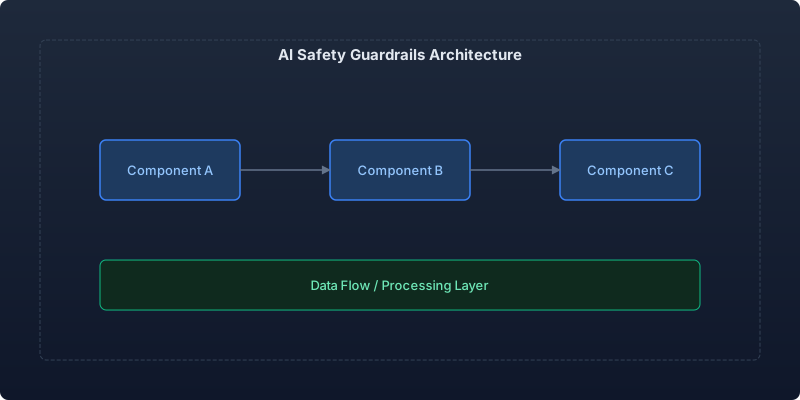
The guardrail system uses a layered architecture where fast, cheap checks run first and expensive, accurate checks run only when needed. This achieves both high recall and low latency.
Layer 1: Input Sanitization and Prompt Injection Detection
The first layer catches malicious inputs before they reach the model. This includes prompt injection attempts, jailbreak patterns, and known attack vectors.
import re
import hashlib
from dataclasses import dataclass
from enum import Enum
from typing import Optional
import numpy as np

class ThreatLevel(Enum):
    SAFE = "safe"
    SUSPICIOUS = "suspicious"
    BLOCKED = "blocked"

@dataclass
class GuardrailResult:
    threat_level: ThreatLevel
    blocked: bool
    reason: Optional[str]
    confidence: float
    latency_ms: float
    layer: str

class InputGuardrail:
    INJECTION_PATTERNS = [
        r"ignore\s+(previous|all|above)\s+(instructions|prompts|rules)",
        r"you\s+are\s+now\s+(a|an|acting\s+as)",
        r"system\s*:\s*",
        r"<\|?(system|im_start|endoftext)\|?>",
        r"pretend\s+(you|that|to)\s+(are|be|have)",
        r"disregard\s+(your|all|previous)",
    ]

    def __init__(self, embedding_model, injection_classifier):
        self.embedding_model = embedding_model
        self.injection_classifier = injection_classifier
        self.patterns = [re.compile(p, re.IGNORECASE) for p in self.INJECTION_PATTERNS]
        self._known_attacks_hashes: set[str] = set()

    def check_input(self, user_input: str) -> GuardrailResult:
        import time
        start = time.time()

        # Fast path: exact match against known attacks
        input_hash = hashlib.sha256(user_input.lower().strip().encode()).hexdigest()
        if input_hash in self._known_attacks_hashes:
            return GuardrailResult(
                threat_level=ThreatLevel.BLOCKED,
                blocked=True,
                reason="Known attack pattern",
                confidence=1.0,
                latency_ms=(time.time() - start) * 1000,
                layer="input_hash",
            )

        # Pattern matching (sub-millisecond)
        for pattern in self.patterns:
            if pattern.search(user_input):
                return GuardrailResult(
                    threat_level=ThreatLevel.SUSPICIOUS,
                    blocked=False,
                    reason=f"Matched injection pattern: {pattern.pattern}",
                    confidence=0.7,
                    latency_ms=(time.time() - start) * 1000,
                    layer="input_pattern",
                )

        # ML classifier for sophisticated attacks (2-5ms)
        embedding = self.embedding_model.encode(user_input)
        injection_score = self.injection_classifier.predict_proba(
            embedding.reshape(1, -1)
        )[0][1]

        if injection_score > 0.85:
            return GuardrailResult(
                threat_level=ThreatLevel.BLOCKED,
                blocked=True,
                reason=f"ML injection classifier score: {injection_score:.3f}",
                confidence=injection_score,
                latency_ms=(time.time() - start) * 1000,
                layer="input_ml",
            )

        return GuardrailResult(
            threat_level=ThreatLevel.SAFE,
            blocked=False,
            reason=None,
            confidence=1.0 - injection_score,
            latency_ms=(time.time() - start) * 1000,
            layer="input_pass",
        )


class OutputGuardrail:
    CATEGORY_THRESHOLDS = {
        "toxicity": 0.7,
        "self_harm": 0.5,
        "violence": 0.6,
        "sexual": 0.6,
        "pii": 0.8,
        "dangerous_instructions": 0.5,
    }

    def __init__(self, safety_classifier, pii_detector):
        self.safety_classifier = safety_classifier
        self.pii_detector = pii_detector

    def check_output(self, model_output: str, context: dict) -> GuardrailResult:
        import time
        start = time.time()

        # PII detection (fast regex + NER)
        pii_result = self.pii_detector.detect(model_output)
        if pii_result.has_pii:
            return GuardrailResult(
                threat_level=ThreatLevel.BLOCKED,
                blocked=True,
                reason=f"PII detected: {pii_result.types}",
                confidence=pii_result.confidence,
                latency_ms=(time.time() - start) * 1000,
                layer="output_pii",
            )

        # Multi-category safety classification
        scores = self.safety_classifier.predict(model_output)
        violations = []
        for category, threshold in self.CATEGORY_THRESHOLDS.items():
            if scores.get(category, 0) > threshold:
                violations.append((category, scores[category]))

        if violations:
            worst = max(violations, key=lambda x: x[1])
            return GuardrailResult(
                threat_level=ThreatLevel.BLOCKED,
                blocked=True,
                reason=f"Safety violation: {worst[0]} ({worst[1]:.3f})",
                confidence=worst[1],
                latency_ms=(time.time() - start) * 1000,
                layer="output_safety",
            )

        return GuardrailResult(
            threat_level=ThreatLevel.SAFE,
            blocked=False,
            reason=None,
            confidence=1.0 - max(scores.values(), default=0),
            latency_ms=(time.time() - start) * 1000,
            layer="output_pass",
        )
Layer 2: Streaming Output Monitoring
For streaming responses, we can't wait for the full output to run safety checks. The streaming monitor analyzes partial outputs incrementally and can interrupt generation mid-stream.
interface StreamingGuardrailConfig {
  checkIntervalTokens: number;
  maxUncheckedTokens: number;
  partialCheckThreshold: number;
  fullCheckThreshold: number;
  interruptOnBlock: boolean;
}

interface StreamChunk {
  tokens: string[];
  cumulativeText: string;
  tokenCount: number;
}

interface SafetyScore {
  category: string;
  score: number;
  threshold: number;
}

class StreamingOutputMonitor {
  private config: StreamingGuardrailConfig;
  private buffer: string = '';
  private tokenCount: number = 0;
  private lastCheckAt: number = 0;
  private interrupted: boolean = false;

  constructor(config: StreamingGuardrailConfig) {
    this.config = config;
  }

  async processChunk(chunk: StreamChunk): Promise<{
    safe: boolean;
    interrupt: boolean;
    reason?: string;
    scores?: SafetyScore[];
  }> {
    if (this.interrupted) {
      return { safe: false, interrupt: true, reason: 'Previously interrupted' };
    }

    this.buffer = chunk.cumulativeText;
    this.tokenCount = chunk.tokenCount;

    const tokensSinceCheck = this.tokenCount - this.lastCheckAt;
    if (tokensSinceCheck < this.config.checkIntervalTokens) {
      return { safe: true, interrupt: false };
    }

    // Run lightweight check on recent tokens
    const recentText = this.buffer.slice(-500);
    const partialScores = await this.quickSafetyCheck(recentText);

    const violations = partialScores.filter(s => s.score > this.config.partialCheckThreshold);
    if (violations.length > 0) {
      // Escalate to full check on entire buffer
      const fullScores = await this.fullSafetyCheck(this.buffer);
      const confirmed = fullScores.filter(s => s.score > this.config.fullCheckThreshold);

      if (confirmed.length > 0 && this.config.interruptOnBlock) {
        this.interrupted = true;
        return {
          safe: false,
          interrupt: true,
          reason: `Safety violation: ${confirmed[0].category} (${confirmed[0].score.toFixed(3)})`,
          scores: confirmed,
        };
      }
    }

    this.lastCheckAt = this.tokenCount;
    return { safe: true, interrupt: false };
  }

  private async quickSafetyCheck(text: string): Promise<SafetyScore[]> {
    // Lightweight model inference for partial text
    return [];
  }

  private async fullSafetyCheck(text: string): Promise<SafetyScore[]> {
    // Full safety classifier on complete output so far
    return [];
  }

  reset(): void {
    this.buffer = '';
    this.tokenCount = 0;
    this.lastCheckAt = 0;
    this.interrupted = false;
  }
}
Guardrail Categories and Strategies
Factual Grounding Checks
For RAG-based systems, verify that generated claims are grounded in retrieved context. Flag responses where >30% of claims lack source support as potentially hallucinated.
Output Consistency Validation
Compare model outputs against known constraints: pricing shouldn't be negative, dates should be valid, recommended actions should be within the system's capability set.
Rate-Based Anomaly Detection
Monitor per-user patterns. A sudden spike in requests that trigger safety classifiers may indicate an adversarial user probing for vulnerabilities. Implement progressive throttling.
Benchmarks: Safety System Performance
| Metric | Value |
|---|---|
| Input guardrail latency (p99) | 3.2ms |
| Output guardrail latency (p99) | 8.7ms |
| Harmful content escape rate | 0.0008% |
| False positive rate (legitimate content blocked) | 0.3% |
| Prompt injection detection rate | 97.2% |
| PII leakage prevention rate | 99.6% |
| Daily requests processed | 5.2M |
| Streaming interruption accuracy | 94% |
Comparison of Approaches
| Approach | Escape Rate | False Positive | Latency Added |
|---|---|---|---|
| Regex only | 2.1% | 1.8% | 0.5ms |
| Single classifier | 0.4% | 5.2% | 15ms |
| Layered (ours) | 0.0008% | 0.3% | 8.7ms |
| LLM-as-judge | 0.002% | 0.8% | 350ms |
Operational Patterns
Shadow mode first: Deploy new guardrail rules in shadow mode for 1-2 weeks. Log what would be blocked without actually blocking. Review false positive rates before enforcement.
Human review queue: Edge cases near thresholds get routed to a human review queue. This creates training data for improving classifiers and catches novel attack patterns.
Red team continuously: Regular adversarial testing by an internal red team ensures guardrails evolve with attack techniques. Automate red team scenarios as regression tests.
Graceful degradation: When a guardrail service is down, the system should default to a more conservative mode (e.g., block anything matching basic patterns) rather than running unprotected.
Conclusion
Production AI safety requires defense in depth — no single layer catches everything. The combination of fast pattern matching, ML classifiers, streaming monitoring, and anomaly detection creates a system that's both highly protective and low-latency. The key insight is that most requests are safe and should pass through with minimal overhead. Only suspicious content needs expensive analysis. Start with input sanitization and output classification, add streaming monitoring for generative use cases, and invest in continuous red teaming to stay ahead of evolving attacks.
Recommended reading
The State of Agentic AI in 2026: Capabilities, Limitations, and Production Readiness
Comprehensive analysis of agentic AI in 2026 covering production capabilities, current limitations, and enterprise readiness benchmarks with real deployment data.
Observability for AI Agents: Tracing Multi-Step Reasoning Chains in Production
How to implement production observability for AI agents including distributed tracing, reasoning chain analysis, and debugging multi-step failures.

Measuring and Reducing AI Workload Carbon Emissions: A Practical Engineering Guide
Building a carbon-aware scheduling system for ML training and inference workloads that reduced our AI infrastructure emissions by 42% while maintaining SLA commitments.



Comments
No comments yet. Be the first to share your thoughts.