A Quantitative Framework for Build-vs-Buy Decisions
Stop arguing with opinions—use this data-driven framework to make build-vs-buy decisions that account for true total cost, opportunity cost, and strategic value.

Every CTO makes dozens of build-vs-buy decisions per year. Most make them badly—either defaulting to "let's build it" (engineering teams love building) or "just buy something" (product teams want speed). Both defaults are wrong roughly half the time.
The cost of a bad build-vs-buy decision at a Series A startup ranges from $150K to $500K in wasted engineering time, delayed roadmap, or accumulated vendor lock-in. At Series B+, the stakes multiply.
I developed a quantitative framework after one particularly expensive mistake: we built a custom analytics pipeline that cost $320K in engineering time over 8 months, when a $1,200/month SaaS tool would have covered 90% of our needs. The remaining 10% could have been handled with a lightweight adapter. That $320K was 3 engineers for 8 months who could have been building our core product.
Never again.
Why Intuition Fails
Build-vs-buy decisions are vulnerable to three cognitive biases:
The IKEA Effect: Engineers value things more when they built them. "Our custom solution is better because we understand it completely." This is often true—but "better" isn't the relevant question. "Better enough to justify the cost" is.
The Vendor Discount Illusion: Product managers see the SaaS price and compare it to $0 (the perceived cost of building internally). They forget that "building internally" costs $150-200K per engineer-year fully loaded.
The Scope Minimization Bias: When proposing to build, teams estimate scope optimistically. "It's just a queue processor, two weeks max." Six months later, it has retry logic, dead letter handling, monitoring, alerting, on-call runbooks, and version upgrades that nobody budgeted for.
The TCO-5 Framework
I evaluate build-vs-buy using five dimensions, each scored quantitatively:
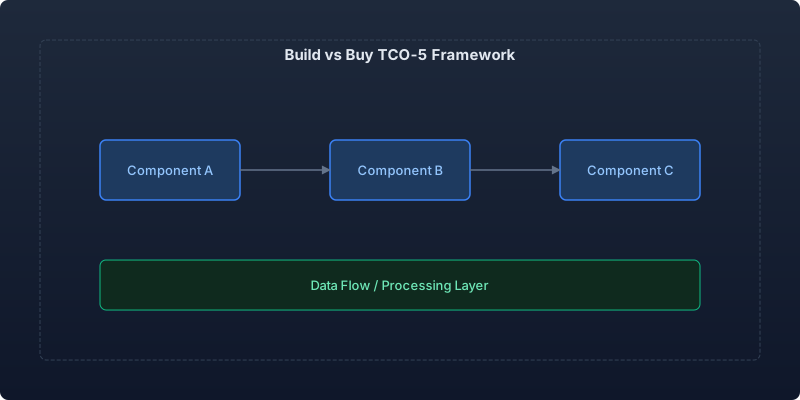
Dimension 1: True Build Cost (TBC)
Calculate the honest total cost of building, not just initial development:
True Build Cost = Initial Development + Annual Maintenance + Opportunity Cost

Where:
- Initial Development = (Engineer-months x $20K fully loaded) x 1.5 complexity multiplier
- Annual Maintenance = 20-30% of initial development cost per year
- Opportunity Cost = What those engineers would have built instead (revenue impact)
The 1.5x complexity multiplier accounts for the consistent reality that internal projects take 50% longer than estimated. If your team historically delivers on time, use 1.2x. If they consistently miss, use 2.0x.
Example calculation:
Building a custom notification system:
- Initial estimate: 2 engineers x 3 months = 6 engineer-months
- True build cost: 6 x $20K x 1.5 = $180K initial
- Annual maintenance: $180K x 0.25 = $45K/year
- 3-year total: $180K + ($45K x 3) = $315K
Dimension 2: True Buy Cost (TBuC)
Calculate the honest total cost of buying, including hidden costs:
True Buy Cost = License + Integration + Customization + Migration Risk + Lock-in Premium

Where:
- License = Annual SaaS cost (including growth-based pricing increases)
- Integration = Engineering time to integrate and maintain integration (usually 2-6 weeks)
- Customization = Workarounds for gaps between your needs and the tool's capabilities
- Migration Risk = Cost to switch if the vendor fails or becomes uneconomical (estimated)
- Lock-in Premium = Pricing power the vendor gains as you become dependent
Example calculation:
Buying a notification SaaS:
- License: $800/month, growing to $2,000/month at projected scale = $50K over 3 years
- Integration: 1 engineer x 1 month = $20K
- Customization: 2 weeks of workarounds per year = $30K over 3 years
- Migration risk: Estimated 1 month to switch providers if needed = $20K (amortized)
- Lock-in premium: Assume 20% price increase in year 3 = $5K
- 3-year total: $125K
Dimension 3: Strategic Alignment Score (1-10)
Not all capabilities are equal. Score how strategically important this capability is:
| Score | Criteria | Example |
|---|---|---|
| 9-10 | Core differentiator — this IS your product | Matching algorithm for a marketplace |
| 7-8 | Competitive advantage — doing this well matters | Custom analytics for a data product |
| 5-6 | Important but commoditized — quality matters, uniqueness doesn't | Authentication, payment processing |
| 3-4 | Necessary but generic — any solution works | Email sending, file storage |
| 1-2 | Peripheral — barely connected to core value | Internal HR tools, office management |
Rule of thumb: Build when strategic alignment is 7+. Buy when it's 5 or below. For 5-7, use the other dimensions to break the tie.
Dimension 4: Market Maturity Score (1-10)
How good are the available buy options?
| Score | Market State | Implication |
|---|---|---|
| 9-10 | Mature market, multiple excellent vendors | Strong buy signal |
| 7-8 | Good options exist, minor gaps | Lean buy with light customization |
| 5-6 | Options exist but imperfect fit | Evaluate gaps carefully |
| 3-4 | Few vendors, significant gaps | Lean build unless gaps are tolerable |
| 1-2 | No good solutions exist | Build is likely necessary |
Dimension 5: Reversibility Score (1-10)
How easy is it to reverse this decision if it's wrong?
| Score | Reversibility | Example |
|---|---|---|
| 9-10 | Trivially switchable | Swap one logging library for another |
| 7-8 | Moderately switchable (weeks of work) | Change email provider |
| 5-6 | Difficult to switch (months of work) | Change database |
| 3-4 | Very difficult (6+ months, significant risk) | Change cloud provider |
| 1-2 | Essentially irreversible | Core architecture choice |
High reversibility favors "buy now, build later if needed." Low reversibility favors careful upfront analysis.
The Decision Matrix
Combine all five dimensions into a single decision score:
Build Score = TBuC / TBC x Strategic Alignment x (11 - Market Maturity) x (11 - Reversibility)
A higher Build Score favors building. A lower Build Score favors buying.
But the raw score isn't the only output. Here's the decision matrix:
| Build Score | Strategic Alignment | Market Maturity | Recommendation |
|---|---|---|---|
| >500 | 7+ | <5 | Build — high strategic value, no good alternatives |
| 200-500 | 5-7 | 5-7 | Evaluate deeply — could go either way |
| <200 | <5 | 7+ | Buy — low strategic value, great alternatives |
| Any | 9-10 | Any | Build — this is your product, own it |
| Any | <3 | 8+ | Buy — this is not your business |
Real-World Decision Examples
Example 1: Authentication System
| Dimension | Score | Reasoning |
|---|---|---|
| True Build Cost (3-year) | $280K | Custom auth is complex (MFA, SSO, security patches) |
| True Buy Cost (3-year) | $85K | Auth0/Clerk well-priced, integration straightforward |
| Strategic Alignment | 3/10 | Auth is necessary but not differentiating |
| Market Maturity | 9/10 | Excellent vendors, battle-tested |
| Reversibility | 6/10 | Switching auth providers is painful but doable |
Decision: Buy. The math isn't close. Building custom auth costs 3.3x more and pulls engineers away from your actual product.
Example 2: Recommendation Engine for E-Commerce
| Dimension | Score | Reasoning |
|---|---|---|
| True Build Cost (3-year) | $450K | ML pipeline, feature store, A/B testing infrastructure |
| True Buy Cost (3-year) | $180K | Several vendors exist, but customization gaps likely |
| Strategic Alignment | 8/10 | Recommendations directly drive revenue and differentiation |
| Market Maturity | 6/10 | Good generics exist but domain-specific tuning limited |
| Reversibility | 4/10 | Deep integration with product experience |
Decision: Build. High strategic alignment and moderate market maturity mean you'll outgrow any vendor quickly. The investment pays back in differentiation.
Example 3: Internal Admin Dashboard
| Dimension | Score | Reasoning |
|---|---|---|
| True Build Cost (3-year) | $120K | Seems simple but scope always grows |
| True Buy Cost (3-year) | $25K | Retool/Appsmith covers 80% of needs |
| Strategic Alignment | 2/10 | Internal tooling, zero customer value |
| Market Maturity | 9/10 | Excellent low-code admin tools |
| Reversibility | 9/10 | Trivial to switch |
Decision: Buy. Don't build internal tools when your product needs engineers.
The Hybrid Option
The best decision is often neither pure build nor pure buy. Consider these hybrid approaches:
Buy the platform, build the integration layer. Use a SaaS product for 80% of functionality, build a thin adapter layer for custom requirements. This preserves flexibility while minimizing build cost.
Build the core, buy the commodities. Build the algorithm that differentiates you, but use managed services for storage, queuing, authentication, and other infrastructure.
Buy now, build later. Start with a vendor to validate the need and learn requirements. Once you understand exactly what you need (and confirm it's strategic), build a custom replacement with better specs.
Common Mistakes
Mistake 1: Ignoring maintenance costs. Building something is 30-40% of the total cost. Maintaining it for 3 years is 60-70%. Always calculate the 3-year TCO.
Mistake 2: Assuming your needs are unique. They probably aren't. "But we need custom X" is usually solvable with configuration, webhooks, or a thin adapter layer.
Mistake 3: Vendor evaluation based on current scale. Check the vendor's pricing at 10x your current scale. Some vendors are cheap at startup scale and ruinously expensive at growth stage.
Mistake 4: Not accounting for opportunity cost. The three engineers building an internal tool could be building the feature that lands your next enterprise deal. What's that worth?
Mistake 5: Making the decision permanent. Document your reasoning and set a review trigger: "Re-evaluate this decision when we reach X users / $Y revenue / Z complexity." Markets change. Your needs change. The right decision today might be wrong in 18 months.
Actionable Takeaways
- Calculate 3-year TCO for both options. Include maintenance, integration, opportunity cost, and lock-in risk.
- Score strategic alignment honestly. If it's not your core differentiator, buy it.
- Default to buy when market maturity is 7+. Good vendors exist for most commodity needs.
- Default to build when strategic alignment is 8+. Own what makes you unique.
- Document the decision and set a review trigger. Build-vs-buy isn't permanent—revisit when conditions change.
The goal isn't to always build or always buy. It's to allocate your engineering capacity where it creates the most value. Build your moat. Buy everything else.
Recommended reading

Why the Gulf Will Produce the Next Wave of Logistics Tech Unicorns
Capital, demographics, infrastructure, and regulation are converging in the GCC. A thesis from inside a Qatari delivery platform doing 16M orders a year.
Post-Acquisition Technical Integration Playbook
How CTOs navigate the technical integration process after an acquisition, from day-one decisions through full platform consolidation
Landing Your First Enterprise Customer as a Startup: The Technical Credibility Playbook
A tactical guide for startup CTOs navigating enterprise sales cycles, from security questionnaires to architecture reviews, with timelines and preparation checklists.



Comments
No comments yet. Be the first to share your thoughts.