Building an AI Workflow Automation Platform
Architecture patterns for AI-powered workflow automation including task orchestration, decision routing, and human-in-the-loop escalation at enterprise scale

AI workflow automation moves beyond simple chatbots into systems that execute multi-step business processes autonomously. From processing insurance claims to onboarding customers to managing procurement approvals, these systems combine LLM reasoning with deterministic business logic and human oversight.
This article presents the architecture for building reliable AI workflow automation that handles complex processes while maintaining auditability and control.
Architecture Principles
Production workflow automation must satisfy competing requirements:
| Requirement | Implementation | Why It Matters |
|---|---|---|
| Reliability | Deterministic orchestration layer | Business processes cannot fail silently |
| Flexibility | LLM-powered decision making | Handle edge cases and natural language |
| Auditability | Complete execution log | Compliance, debugging, legal |
| Controllability | Human-in-the-loop gates | High-stakes decisions need oversight |
| Scalability | Async execution, queue-based | Handle burst workloads |
| Recoverability | Checkpoint-based state | Resume after failures |
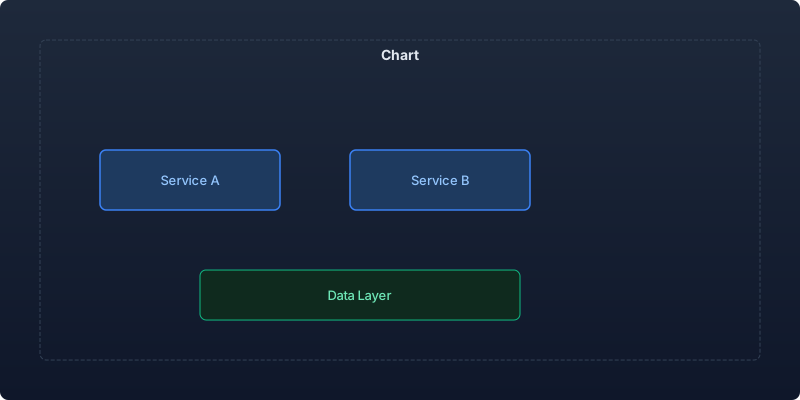
Workflow Engine Design
The core engine orchestrates steps while delegating intelligence to specialized AI components:
from dataclasses import dataclass, field
from enum import Enum
from typing import Any, Callable, Dict, List, Optional
import uuid
import time

class StepStatus(Enum):
    PENDING = "pending"
    RUNNING = "running"
    COMPLETED = "completed"
    FAILED = "failed"
    WAITING_HUMAN = "waiting_human"
    SKIPPED = "skipped"

@dataclass
class WorkflowStep:
    id: str
    name: str
    step_type: str  # "ai_decision", "action", "human_gate", "condition"
    handler: Callable
    next_steps: Dict[str, str]  # outcome -> next step id
    timeout_seconds: int = 300
    retry_count: int = 2
    requires_approval: bool = False

@dataclass
class WorkflowExecution:
    workflow_id: str
    execution_id: str = field(default_factory=lambda: str(uuid.uuid4()))
    current_step: Optional[str] = None
    status: StepStatus = StepStatus.PENDING
    context: Dict[str, Any] = field(default_factory=dict)
    history: List[dict] = field(default_factory=list)
    created_at: float = field(default_factory=time.time)

class WorkflowEngine:
    def __init__(self, store, event_bus):
        self.store = store
        self.events = event_bus
        self.workflows: Dict[str, List[WorkflowStep]] = {}

    def register_workflow(self, workflow_id: str, steps: List[WorkflowStep]):
        """Register a workflow definition."""
        self.workflows[workflow_id] = {step.id: step for step in steps}

    async def execute(self, workflow_id: str, initial_context: dict) -> str:
        """Start a new workflow execution."""
        execution = WorkflowExecution(
            workflow_id=workflow_id,
            context=initial_context,
        )

        # Find start step
        steps = self.workflows[workflow_id]
        start_step = next(iter(steps.values()))
        execution.current_step = start_step.id

        await self.store.save(execution)
        await self._run_step(execution, start_step)

        return execution.execution_id

    async def _run_step(self, execution: WorkflowExecution, step: WorkflowStep):
        """Execute a single workflow step."""
        execution.status = StepStatus.RUNNING
        self._log_step(execution, step, "started")

        try:
            # Check if human approval needed
            if step.requires_approval:
                execution.status = StepStatus.WAITING_HUMAN
                await self.store.save(execution)
                await self.events.emit("approval_requested", {
                    "execution_id": execution.execution_id,
                    "step": step.name,
                    "context": execution.context,
                })
                return  # Resume when human approves

            # Execute step handler
            result = await step.handler(execution.context)
            execution.context.update(result.get("updates", {}))

            # Determine next step
            outcome = result.get("outcome", "default")
            next_step_id = step.next_steps.get(outcome)

            self._log_step(execution, step, "completed", result)

            if next_step_id and next_step_id in self.workflows[execution.workflow_id]:
                next_step = self.workflows[execution.workflow_id][next_step_id]
                execution.current_step = next_step_id
                await self.store.save(execution)
                await self._run_step(execution, next_step)
            else:
                execution.status = StepStatus.COMPLETED
                await self.store.save(execution)

        except Exception as e:
            execution.status = StepStatus.FAILED
            self._log_step(execution, step, "failed", {"error": str(e)})
            await self.store.save(execution)
            await self._handle_failure(execution, step, e)
AI Decision Steps
LLM-powered decision making within the workflow:
from openai import OpenAI

class AIDecisionStep:
    """Use LLM for complex classification and routing decisions."""

    def __init__(self, client: OpenAI, decision_config: dict):
        self.client = client
        self.config = decision_config

    async def execute(self, context: dict) -> dict:
        """Make an AI-powered decision."""
        prompt = self._build_decision_prompt(context)

        response = self.client.chat.completions.create(
            model="gpt-4o",
            messages=[
                {"role": "system", "content": self.config["system_prompt"]},
                {"role": "user", "content": prompt},
            ],
            response_format={"type": "json_object"},
            temperature=0.1,
        )

        decision = json.loads(response.choices[0].message.content)

        # Validate decision is within allowed outcomes
        if decision["outcome"] not in self.config["allowed_outcomes"]:
            decision["outcome"] = self.config["default_outcome"]

        return {
            "outcome": decision["outcome"],
            "updates": {
                "ai_decision": decision,
                "ai_reasoning": decision.get("reasoning", ""),
                "ai_confidence": decision.get("confidence", 0.0),
            },
        }

    def _build_decision_prompt(self, context: dict) -> str:
        template = self.config["prompt_template"]
        return template.format(**context)


# Example: Insurance claim routing
claim_router = AIDecisionStep(
    client=OpenAI(),
    decision_config={
        "system_prompt": (
            "You are an insurance claim routing system. Analyze the claim "
            "and decide the appropriate processing path. Consider claim amount, "
            "type, complexity, and fraud indicators."
        ),
        "prompt_template": (
            "Claim: {claim_description}\n"
            "Amount: ${claim_amount}\n"
            "Policy type: {policy_type}\n"
            "Customer history: {customer_history}\n\n"
            "Decide the routing. Respond with JSON containing: "
            "outcome, reasoning, confidence, fraud_risk_score"
        ),
        "allowed_outcomes": ["auto_approve", "manual_review", "fraud_investigation", "deny"],
        "default_outcome": "manual_review",
    },
)
Human-in-the-Loop Gates
For high-stakes decisions, route to human operators:
class HumanGateManager:
    """Manage human approval gates in workflows."""

    def __init__(self, notification_service, store):
        self.notifications = notification_service
        self.store = store

    async def request_approval(self, execution_id: str, step_name: str,
                              context: dict, assignee: str = None):
        """Request human approval for a workflow step."""
        approval_request = {
            "id": str(uuid.uuid4()),
            "execution_id": execution_id,
            "step_name": step_name,
            "context": self._prepare_context_for_human(context),
            "ai_recommendation": context.get("ai_decision", {}),
            "assigned_to": assignee or self._auto_assign(context),
            "created_at": time.time(),
            "sla_deadline": time.time() + 3600,  # 1 hour SLA
        }

        await self.store.save_approval(approval_request)
        await self.notifications.send(
            to=approval_request["assigned_to"],
            template="approval_needed",
            data=approval_request,
        )

    async def process_decision(self, approval_id: str, decision: str,
                              reviewer_notes: str = ""):
        """Process human decision and resume workflow."""
        approval = await self.store.get_approval(approval_id)

        # Record decision for audit
        approval["decision"] = decision
        approval["reviewer_notes"] = reviewer_notes
        approval["decided_at"] = time.time()
        await self.store.update_approval(approval)

        # Resume workflow execution
        execution = await self.store.get_execution(approval["execution_id"])
        execution.context["human_decision"] = decision
        execution.context["reviewer_notes"] = reviewer_notes

        # Continue to next step
        await self.engine.resume(execution, outcome=decision)
Workflow Definition Example
Here is a complete claim processing workflow:
# Define the workflow
claim_workflow = [
    WorkflowStep(
        id="intake",
        name="Claim Intake & Extraction",
        step_type="ai_decision",
        handler=extract_claim_data,
        next_steps={"complete": "risk_assessment"},
    ),
    WorkflowStep(
        id="risk_assessment",
        name="AI Risk Assessment",
        step_type="ai_decision",
        handler=claim_router.execute,
        next_steps={
            "auto_approve": "payment",
            "manual_review": "human_review",
            "fraud_investigation": "fraud_team",
            "deny": "denial_letter",
        },
    ),
    WorkflowStep(
        id="human_review",
        name="Manual Review",
        step_type="human_gate",
        handler=human_review_handler,
        requires_approval=True,
        next_steps={"approve": "payment", "deny": "denial_letter"},
    ),
    WorkflowStep(
        id="payment",
        name="Process Payment",
        step_type="action",
        handler=process_payment,
        next_steps={"success": "notification"},
    ),
    WorkflowStep(
        id="notification",
        name="Send Confirmation",
        step_type="action",
        handler=send_notification,
        next_steps={},
    ),
]
Performance Metrics
From a production deployment processing 15K claims/day:
| Metric | Before Automation | After Automation | Improvement |
|---|---|---|---|
| Avg processing time | 4.2 days | 3.8 hours | 96% faster |
| Auto-approved (no human) | 0% | 62% | New capability |
| Cost per claim | $45 | $12 | -73% |
| Error rate | 3.8% | 1.2% | -68% |
| Customer satisfaction | 3.2/5 | 4.4/5 | +38% |
| Fraud detection rate | 78% | 94% | +16pp |
Key Takeaways
- Deterministic orchestration, intelligent decisions. The workflow engine must be reliable and auditable. LLMs provide intelligence within controlled boundaries.
- Human-in-the-loop is a feature, not a limitation. For high-stakes workflows, human gates build trust and catch AI errors. Design them as first-class workflow steps.
- Checkpointing enables resilience. Every step saves state so workflows can resume after any failure without repeating work.
- Start with high-volume, low-risk workflows. Auto-approve simple cases first, then gradually expand AI autonomy as confidence grows.
- Audit trails are non-negotiable. Every AI decision, every human override, every context change must be logged for compliance and continuous improvement.
The future of enterprise AI is not replacing humans but orchestrating the right combination of AI speed and human judgment for each decision in a business process.
Recommended reading
The State of Agentic AI in 2026: Capabilities, Limitations, and Production Readiness
Comprehensive analysis of agentic AI in 2026 covering production capabilities, current limitations, and enterprise readiness benchmarks with real deployment data.
Observability for AI Agents: Tracing Multi-Step Reasoning Chains in Production
How to implement production observability for AI agents including distributed tracing, reasoning chain analysis, and debugging multi-step failures.
Measuring and Reducing AI Workload Carbon Emissions: A Practical Engineering Guide
Building a carbon-aware scheduling system for ML training and inference workloads that reduced our AI infrastructure emissions by 42% while maintaining SLA commitments.



Comments
No comments yet. Be the first to share your thoughts.