Your Engineering Brand Is Your Best Recruiter. Here Is How to Build One.
How we built an engineering brand that generates 40% of qualified candidates organically, reducing cost-per-hire by 55% and time-to-fill by 3 weeks.

Recruiting engineers is expensive. The average cost-per-hire for a senior engineer in 2026 is $42,000 when you factor in recruiter fees, engineering time spent interviewing, and the opportunity cost of unfilled positions. We spent 18 months building an engineering brand that now generates 40% of our qualified candidate pipeline organically — no recruiter fees, no cold outreach, no paid job ads. Cost-per-hire dropped from $38,000 to $17,000. Here's the complete system.
The Math That Motivated Us
Before investing in engineering brand, we tracked our hiring funnel:
| Source | % of Hires | Cost Per Hire | Time to Fill | Quality (1-year retention) |
|---|---|---|---|---|
| External recruiters | 45% | $52,000 | 62 days | 72% |
| Job boards (LinkedIn, etc.) | 30% | $28,000 | 45 days | 78% |
| Employee referrals | 20% | $12,000 | 35 days | 91% |
| Inbound (organic) | 5% | $3,000 | 28 days | 94% |
The pattern was clear: inbound candidates were cheaper, faster, and stayed longer. The problem was volume — only 5% of hires came through organic channels. We needed to increase that without proportionally increasing spending.
The Engineering Brand System
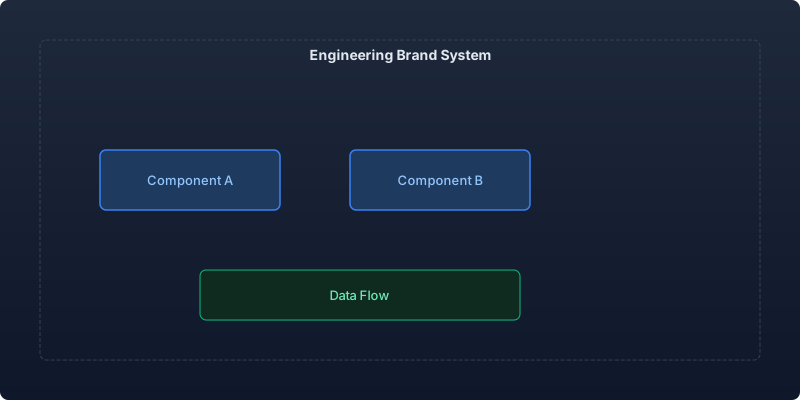
After studying companies with strong engineering brands (Stripe, Linear, Vercel, Cloudflare), we identified five channels that compound over time:
Channel 1: Technical Blog (The Foundation)
Our engineering blog became our highest-ROI recruiting asset. But it only works with specific content strategy:
What works:
- Deep technical post-mortems (readers learn AND see your culture)
- "How we built X" with real architecture decisions and tradeoffs
- Open-source project announcements with contributor guides
- Performance benchmarks and optimization stories
- Engineering culture pieces (how we work, interview, grow people)
What doesn't work:
- Product announcements disguised as engineering posts
- Shallow "we use React" technology stack posts
- Recruiting posts that say "we're hiring!" without technical substance
- Vendor-sponsored content that feels like an ad
Content metrics after 18 months:
| Metric | Month 1 | Month 6 | Month 12 | Month 18 |
|---|---|---|---|---|
| Blog posts published | 2 | 4 | 4 | 4 |
| Monthly unique readers | 800 | 8,400 | 28,000 | 52,000 |
| Avg time on page | 2.1 min | 4.8 min | 5.4 min | 5.6 min |
| Job page visits from blog | 12 | 180 | 620 | 1,100 |
| Applications from blog readers | 3 | 24 | 85 | 142 |
The compounding is real: posts written 12+ months ago still drive traffic and applications. Our most successful post ("How we reduced P99 latency by 80%") still generates 15 applications per month, 14 months after publication.
Who writes: Engineers volunteer. We provide editorial support (a technical writer cleans up prose) and count blog posts toward promotion criteria. Writing is optional but incentivized.
Channel 2: Conference Talks and Meetups
Speaking at conferences puts faces and voices to your engineering brand. It signals that your engineers are good enough to teach others.
Our approach:
- Identify 3-4 conferences per year aligned with our tech stack
- Support 6-8 engineers in submitting talk proposals
- Fund all travel and preparation time (2 days per talk)
- Record all talks and post to YouTube/blog
Talk-to-hire pipeline: 8% of our conference talk viewers visit our careers page. Of those, 12% apply. Talk viewers convert to hires at 3× the rate of general blog readers because they've seen a real person presenting real work.
Channel 3: Open Source Contributions
We open-sourced three internal tools that were genuinely useful to others:
| Project | Stars | Contributors (external) | Hires Attributed |
|---|---|---|---|
| API rate limiter library | 2,400 | 34 | 4 |
| K8s cost allocation tool | 1,800 | 18 | 2 |
| Testing fixtures framework | 900 | 12 | 1 |
Open-source creates hiring opportunities through contributor relationships. Four of our hires were open-source contributors who already knew our code, culture, and team members before they applied.
## Open-source hiring flow:
1. Contributor opens a PR
2. Our engineers review and collaborate
3. Contributor sees our code standards, communication style, and review culture
4. After multiple contributions, we invite high-performers to coffee chats
5. Natural transition to "would you be interested in joining full-time?"
Channel 4: Engineering Social Presence
Individual engineers posting about their work on Twitter/X and LinkedIn amplifies reach beyond official company channels:
- Engineers share blog posts with personal commentary
- Live-tweeting incident responses (post-resolution) shows transparency
- LinkedIn posts about engineering challenges get 10× more engagement than company page posts
We don't mandate this. We make it easy: pre-written sharing templates, approval-free posting about non-sensitive topics, and recognition for engineers whose posts perform well.
Channel 5: The Careers Page Experience
Most engineering careers pages are generic. Ours includes:
- The engineering handbook (public): How we work, our rituals, our values
- Tech stack details: Not just "we use React" but "here's why we chose it and what we'd change"
- Team spotlights: 2-minute videos of actual engineers describing their day
- Interview process transparency: Exact steps, what we evaluate, how to prepare
- Compensation philosophy: Bands are public within the page (ranges, not exact)
Conversion rate from careers page visit to application: 8.4% (industry average: 2-3%).
Content Production System
Publishing consistently is the hard part. Here's our system:
# Monthly content cadence
monthly_output:
  blog_posts: 4
  # 2 deep technical + 1 culture + 1 open-source/tooling

  social_posts: 12
  # 3 per week across team members

  conference_submissions: 2
  # Rotating engineers

# Content pipeline
pipeline:
  week_1: "Topic ideation (team Slack channel)"
  week_2: "Draft writing (engineer owns)"
  week_3: "Technical review + editorial polish"
  week_4: "Publication + distribution"

# Support resources
resources:
  technical_writer: "0.5 FTE - edits all posts for clarity"
  designer: "2 hours/week - blog graphics and diagrams"
  eng_manager_time: "1 hour/week - reviewing pipeline, unblocking"
The key insight: engineers produce better content when someone else handles editing and distribution. The technical writer role was our highest-ROI hire for the brand program.
Measuring ROI
After 18 months, our hiring funnel transformed:
| Source | Before (%) | After (%) | Cost Per Hire Change |
|---|---|---|---|
| External recruiters | 45% | 18% | Same ($52K) |
| Job boards | 30% | 25% | -15% ($24K) |
| Employee referrals | 20% | 17% | Same ($12K) |
| Inbound (organic) | 5% | 40% | Same ($3K) |
Blended cost-per-hire: $38,000 → $17,000 (55% reduction) Average time-to-fill: 52 days → 34 days (35% reduction) 1-year retention for brand-sourced hires: 94% (vs. 78% overall)
Annual savings on a hiring plan of 20 engineers: $420,000 in reduced recruiter fees and faster fills. Against a brand investment of $85,000/year (writer, design, conference budget, engineer time), that's a 5× return.
What Didn't Work
1. Company-branded podcast: We tried and stopped after 8 episodes. Not enough differentiation, too much production overhead, and the audience didn't convert to applicants.
2. Hackathon sponsorships: Expensive ($15-25K per event) with minimal brand impact. The audience is too junior for our hiring needs.
3. University partnerships: Good for intern pipeline but didn't impact experienced hire sourcing.
4. "Day in the life" content: Generic and unmemorable. Technical depth is what attracts senior engineers, not office tours.
Getting Buy-In for the Investment
Engineering brand requires upfront investment before returns are visible. Here's how I pitched it:
## Investment Ask: Engineering Brand Program

**Problem**: 45% of hires come from recruiters at $52K/hire.
We plan to hire 20 engineers next year = $468K in recruiting fees alone.

**Proposal**: $85K annual investment in engineering brand
- Technical writer (0.5 FTE): $55K
- Conference budget: $20K
- Design/tooling: $10K

**Expected outcome (12-month)**: Shift inbound from 5% to 30% of hires.
Saves ~$250K in year 1, growing as brand compounds.

**Leading indicators (monthly)**:
- Blog traffic growth
- Careers page visits from content
- Application volume from organic sources

**Trailing indicators (quarterly)**:
- Source mix shift
- Cost-per-hire reduction
- Time-to-fill improvement
Key Takeaways
-
Inbound candidates are 3× cheaper and stay 20% longer — the math alone justifies investing in engineering brand.
-
Technical depth attracts senior talent — generic "we're a great place to work" content doesn't differentiate. Deep technical posts do.
-
Compounding is real but slow — expect 6 months before meaningful results. Blog posts from month 3 still drive applications in month 18.
-
Editorial support unlocks engineer participation — engineers will write if someone else handles editing, graphics, and distribution. Invest in a technical writer.
-
Open source creates the deepest relationships — contributors who become hires already know your code, standards, and people. They ramp 50% faster.
-
Measure leading and trailing indicators — traffic and engagement show early progress. Cost-per-hire and source mix prove ROI at 12+ months.
Your engineering brand is an asset that appreciates over time. Every blog post, talk, and open-source project builds a permanent recruiting channel that works while you sleep. The companies that invest early will have an unfair hiring advantage for years.
Recommended reading
The Legacy of Leadership: What Remains When You Leave
The thing people remember is not your architecture. It is not your processes. It is how you made them feel. Reflections on what actually endures from engineering leadership.
What 3 A.M. Incidents Taught Me That AWS Certifications Never Did
Twenty production incidents reviewed: why understanding beats fixing, what certifications actually train, and the habits that keep a team calm at 3 a.m.
An Engineering Leader's Sustainable Weekly Rhythm
A realistic weekly rhythm that balances strategy, people, and operational work — without burning out or losing yourself in back-to-back meetings.



Comments
No comments yet. Be the first to share your thoughts.