AI-Powered Customer Support: From 4-Hour Resolution to 12 Minutes with Claude
How we built a Claude-powered support system that reduced average ticket resolution time from 4 hours to 12 minutes while maintaining 96% customer satisfaction.

Our support team was drowning. With 2,300 tickets per week and an average resolution time of 4 hours, we were hemorrhaging both money and customer goodwill. Hiring more agents wasn't sustainable — we needed a fundamentally different approach. We built a Claude-powered support automation system that now handles 71% of tickets autonomously and reduced average resolution time to 12 minutes.
This isn't a chatbot that says "let me transfer you to a human." This is a system that understands context, takes actions, and resolves issues end-to-end.
The Problem Space
Our B2B SaaS platform serves 3,400 customers. Support tickets fell into predictable categories:
- Account/billing issues (28%): subscription changes, invoice questions, access problems
- Integration failures (24%): API errors, webhook issues, OAuth token problems
- Configuration help (22%): how to set up features, best practices
- Bug reports (15%): actual product issues requiring engineering
- Feature requests (11%): product feedback and enhancement asks
The first three categories — 74% of volume — followed patterns that could be automated with the right context and tooling.
Architecture
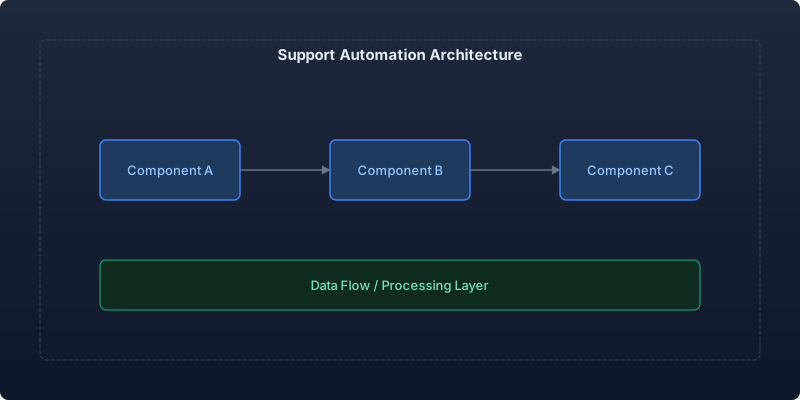
The system consists of four layers: intake classification, context enrichment, resolution engine, and escalation router.
Intake and Classification
Every ticket first passes through a classification layer that determines intent, urgency, and whether automation can handle it.
import anthropic
from enum import Enum
from pydantic import BaseModel

class TicketCategory(str, Enum):
    BILLING = "billing"
    INTEGRATION = "integration"
    CONFIGURATION = "configuration"
    BUG = "bug"
    FEATURE_REQUEST = "feature_request"
    SECURITY = "security"

class TicketClassification(BaseModel):
    category: TicketCategory
    urgency: str  # "critical", "high", "medium", "low"
    automatable: bool
    confidence: float
    reasoning: str
    required_context: list[str]

class SupportClassifier:
    def __init__(self):
        self.client = anthropic.Anthropic()

    def classify(self, ticket_text: str, customer_context: dict) -> TicketClassification:
        response = self.client.messages.create(
            model="claude-sonnet-4-20250514",
            max_tokens=1024,
            messages=[{
                "role": "user",
                "content": f"""Classify this support ticket.

Customer context:
- Plan: {customer_context['plan']}
- Account age: {customer_context['account_age_days']} days
- Recent tickets: {customer_context['recent_ticket_count']}
- Integrations: {', '.join(customer_context['active_integrations'])}

Ticket:
{ticket_text}

Respond with JSON matching this schema:
{{
    "category": "billing|integration|configuration|bug|feature_request|security",
    "urgency": "critical|high|medium|low",
    "automatable": true/false,
    "confidence": 0.0-1.0,
    "reasoning": "brief explanation",
    "required_context": ["list of data needed to resolve"]
}}"""
            }]
        )

        data = json.loads(response.content[0].text)
        return TicketClassification(**data)
Context Enrichment
Before attempting resolution, the system gathers all relevant context: the customer's account state, recent API logs, configuration, and historical tickets.
import Anthropic from '@anthropic-ai/sdk';

interface SupportContext {
  customer: {
    id: string;
    plan: string;
    mrr: number;
    healthScore: number;
  };
  recentActivity: {
    apiCalls: ApiLogEntry[];
    configChanges: ConfigChange[];
    errors: ErrorLogEntry[];
  };
  historicalTickets: PreviousTicket[];
  knowledgeBase: RelevantArticle[];
}

class ContextEnricher {
  private anthropic: Anthropic;

  constructor() {
    this.anthropic = new Anthropic();
  }

  async enrichContext(
    ticketText: string,
    classification: TicketClassification,
    customerId: string
  ): Promise<SupportContext> {
    // Parallel data fetching based on classification needs
    const fetchers: Record<string, () => Promise<any>> = {
      apiLogs: () => this.fetchApiLogs(customerId, '24h'),
      configState: () => this.fetchCurrentConfig(customerId),
      billingState: () => this.fetchBillingInfo(customerId),
      errorLogs: () => this.fetchErrorLogs(customerId, '72h'),
      previousTickets: () => this.fetchTicketHistory(customerId, 10),
      knowledgeArticles: () => this.searchKnowledgeBase(ticketText)
    };

    // Only fetch what's needed for this category
    const neededData = classification.required_context;
    const results = await Promise.all(
      neededData.map(key => fetchers[key]?.() ?? Promise.resolve(null))
    );

    return this.assembleContext(results, neededData);
  }

  private async searchKnowledgeBase(query: string): Promise<RelevantArticle[]> {
    // Semantic search against internal KB
    const response = await this.anthropic.messages.create({
      model: 'claude-sonnet-4-20250514',
      max_tokens: 512,
      messages: [{
        role: 'user',
        content: `Generate 3 search queries to find relevant support articles for: "${query}"`
      }]
    });

    const queries = JSON.parse(response.content[0].text);
    // Execute searches and return top results
    return this.vectorSearch(queries);
  }
}
Resolution Engine
The resolution engine uses Claude with tool use to actually fix problems — not just explain them.
class SupportResolutionEngine:
    def __init__(self):
        self.client = anthropic.Anthropic()
        self.tools = self._define_tools()

    def resolve(self, ticket: dict, context: dict) -> dict:
        messages = [{
            "role": "user",
            "content": self._build_resolution_prompt(ticket, context)
        }]

        # Agentic loop - Claude uses tools to investigate and resolve
        while True:
            response = self.client.messages.create(
                model="claude-sonnet-4-20250514",
                max_tokens=4096,
                tools=self.tools,
                messages=messages
            )

            if response.stop_reason == "end_turn":
                return self._extract_resolution(response)

            # Process tool calls
            tool_results = []
            for block in response.content:
                if block.type == "tool_use":
                    result = self._execute_tool(block.name, block.input)
                    tool_results.append({
                        "type": "tool_result",
                        "tool_use_id": block.id,
                        "content": json.dumps(result)
                    })

            messages.append({"role": "assistant", "content": response.content})
            messages.append({"role": "user", "content": tool_results})

    def _define_tools(self) -> list:
        return [
            {
                "name": "check_api_status",
                "description": "Check the status of a customer's API integration",
                "input_schema": {
                    "type": "object",
                    "properties": {
                        "customer_id": {"type": "string"},
                        "integration_name": {"type": "string"}
                    },
                    "required": ["customer_id", "integration_name"]
                }
            },
            {
                "name": "reset_oauth_token",
                "description": "Reset and regenerate OAuth tokens for an integration",
                "input_schema": {
                    "type": "object",
                    "properties": {
                        "customer_id": {"type": "string"},
                        "integration_name": {"type": "string"}
                    },
                    "required": ["customer_id", "integration_name"]
                }
            },
            {
                "name": "update_configuration",
                "description": "Update a customer's configuration setting",
                "input_schema": {
                    "type": "object",
                    "properties": {
                        "customer_id": {"type": "string"},
                        "setting_path": {"type": "string"},
                        "new_value": {"type": "string"}
                    },
                    "required": ["customer_id", "setting_path", "new_value"]
                }
            },
            {
                "name": "send_customer_response",
                "description": "Send a response to the customer explaining what was done",
                "input_schema": {
                    "type": "object",
                    "properties": {
                        "message": {"type": "string"},
                        "include_steps": {"type": "boolean"}
                    },
                    "required": ["message"]
                }
            }
        ]
Safety Guardrails
We implemented strict guardrails to prevent the AI from making harmful changes:
- Action allowlists — Each ticket category has a defined set of permitted actions
- Reversibility requirement — Every automated action must be reversible within 24 hours
- Value thresholds — Billing changes above $500/month require human approval
- Confidence gating — Actions only proceed if Claude's confidence exceeds 0.85
- Customer opt-out — Enterprise customers can require human-only support
Benchmarks
After 6 months in production:
| Metric | Before | After | Change |
|---|---|---|---|
| Avg. resolution time | 4.1 hours | 12 min | 95% faster |
| First response time | 47 min | 28 sec | 99% faster |
| Tickets resolved autonomously | 0% | 71% | - |
| Customer satisfaction (CSAT) | 82% | 96% | +14 points |
| Support cost per ticket | $18.40 | $4.20 | 77% reduction |
| Escalation rate | N/A | 29% | - |
The CSAT improvement surprised us. Customers prefer fast, accurate resolution over waiting for a human who gives the same answer.
Cost Model
Monthly costs for handling ~9,200 tickets:
- Claude API (classification + resolution): $3,100/month
- Infrastructure (compute, vector DB): $680/month
- Human agents (handling 29% escalations): $24,000/month
- Total: $27,780/month (down from $78,000/month with all-human team)
Edge Cases and Failures
The system struggles with:
- Emotionally charged tickets — When customers are angry, the system escalates even if it could resolve technically. Emotional intelligence in responses is improving but not yet human-level.
- Multi-issue tickets — Tickets containing 3+ distinct problems sometimes only resolve the first one.
- Novel issues — Problems not represented in training data or knowledge base get escalated quickly (which is the correct behavior).
Lessons Learned
Start with classification accuracy. If you can't classify correctly, nothing downstream works. We spent 3 weeks just on the classifier before building the resolution engine.
Tool use is the differentiator. The gap between "explain the solution" and "fix the problem" is enormous for customer satisfaction. Invest in safe, reversible tool actions.
Monitor for drift. As your product evolves, the support system's knowledge becomes stale. We run weekly accuracy audits against a holdout set of resolved tickets.
Conclusion
Claude-powered support automation isn't about replacing humans — it's about letting humans focus on the 29% of tickets that genuinely need empathy, creativity, or deep investigation. The 71% that follow patterns get resolved faster and more consistently than any human team could achieve at scale. The key is building the safety net that lets you trust the automation: guardrails, reversibility, and continuous monitoring.
Recommended reading
The State of Agentic AI in 2026: Capabilities, Limitations, and Production Readiness
Comprehensive analysis of agentic AI in 2026 covering production capabilities, current limitations, and enterprise readiness benchmarks with real deployment data.
Observability for AI Agents: Tracing Multi-Step Reasoning Chains in Production
How to implement production observability for AI agents including distributed tracing, reasoning chain analysis, and debugging multi-step failures.
Measuring and Reducing AI Workload Carbon Emissions: A Practical Engineering Guide
Building a carbon-aware scheduling system for ML training and inference workloads that reduced our AI infrastructure emissions by 42% while maintaining SLA commitments.



Comments
No comments yet. Be the first to share your thoughts.