The CTO Role in 2027: Managing Agents, Not Just Engineers
AI agents already review our code and run our migrations. My honest projection of the 2027 engineering org, and which CTO skills appreciate or depreciate.

A year ago I wrote about how an AI agent made my team look six times bigger. That article described a present-tense fact. This one is a projection, and I will be honest about which is which, because I have low patience for confident futurism.
But the trend line at Rafeeq is steep enough that I think I can see 2027 from here. Agents already do our first-pass code review. They generated the migration plan when we evacuated an AWS region in six hours. The question is no longer whether agents join engineering teams. It is what the humans, and especially the CTO, do differently once they have.
The week is already changing shape
We track roughly how engineering time is spent. Here is 2024 measured, and 2027 as I project it if current adoption curves hold:
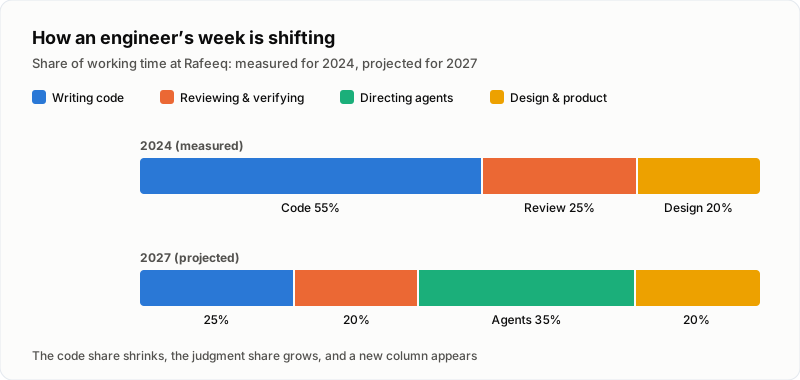
The striking part is not that "writing code" shrinks. It is that a column that did not exist in 2024 becomes the largest single activity: directing agents. Writing specs an agent can execute, decomposing work into verifiable tasks, reviewing verdicts instead of diffs, and deciding when the agent's output earns trust.
What managing agents actually means
People imagine it as prompting. In practice, at our current maturity, it looks like management:
- You delegate outcomes, not keystrokes. A good agent task reads like a good ticket for a strong mid-level engineer: context, constraints, definition of done. Engineers who write vague tickets get vague code, from humans and agents alike. The skill transfers exactly.
- You design the verification, not just the work. The question that matters is never "can the agent do it?" It is "how will we know it did it correctly?" Tests, evals, staged rollouts, human sign-off on defined risk classes. Verification design is becoming a senior engineering discipline of its own.
- You manage a portfolio of trust. Our agents merge documentation changes with light review, draft infrastructure changes that always get human approval, and touch nothing in payments without two humans. That trust map is reviewed like we review IAM policies. Expanding it deliberately is now part of my job.
Which CTO skills appreciate, which depreciate
| Depreciating | Appreciating |
|---|---|
| Being the fastest coder in the room | Writing specifications that survive contact with execution |
| Encyclopedic framework knowledge | Judgment about what is worth building at all |
| Reviewing every line personally | Designing review systems that scale beyond you |
| Headcount as the measure of capacity | Capacity per person as the measure of leadership |
| Hiring for years of syntax experience | Hiring for taste, ownership, and verification instinct |
The pattern: everything mechanical depreciates, everything judgmental appreciates. The uncomfortable corollary for CTOs who grew up as 10x coders is that their old superpower is exactly the thing agents commoditize first.
The risks I actually worry about
Honest projections include failure modes, and I see three:
- Skill atrophy. If juniors never write the boring code, where do seniors come from? We now deliberately assign agent-free work to early-career engineers, the way pilots still hand-fly approaches. It costs speed. It buys us 2030.
- Rubber-stamping. When the agent is right 95% of the time, humans stop reading. Our defense is measuring reviewer disagreement rates: a reviewer who never overrides the agent is not reviewing, and we say so out loud.
- Accountability fog. An agent cannot be responsible for an outage. Every agent action in our systems traces to a human who directed or approved it. The day that traceability blurs is the day the model breaks, legally and culturally.
What I'd tell a CTO planning for 2027
Start the trust map now, even if your agents only autocomplete. Rewrite your ticket culture, because spec quality is about to become your throughput ceiling. Rethink your junior pipeline before the market forces you to. And stop measuring your organization in headcount, because the board conversation of 2027 will not be "how many engineers do you have?" It will be "what is your capacity per engineer, and how fast is it compounding?"
I said I would be honest about fact versus projection, so: the chart's 2027 column is a forecast and I will happily be wrong about the percentages. The direction, though, I would bet the company on. Partly because I already am.
Recommended reading
The State of Agentic AI in 2026: Capabilities, Limitations, and Production Readiness
Comprehensive analysis of agentic AI in 2026 covering production capabilities, current limitations, and enterprise readiness benchmarks with real deployment data.
Observability for AI Agents: Tracing Multi-Step Reasoning Chains in Production
How to implement production observability for AI agents including distributed tracing, reasoning chain analysis, and debugging multi-step failures.
Measuring and Reducing AI Workload Carbon Emissions: A Practical Engineering Guide
Building a carbon-aware scheduling system for ML training and inference workloads that reduced our AI infrastructure emissions by 42% while maintaining SLA commitments.



Comments
No comments yet. Be the first to share your thoughts.