Detecting Data Drift and Triggering Automated Model Retraining
Production patterns for detecting statistical drift in model inputs and outputs, with automated retraining pipelines that maintain model freshness without manual intervention.

Every ML model decays. The world changes, user behavior shifts, and the data distribution your model learned from gradually diverges from reality. The question isn't whether your models will drift — it's whether you'll detect it before your customers do. After building drift detection systems that monitor 60+ production models, here's how to detect drift early and retrain automatically.
The Problem: Silent Model Degradation
A credit scoring model trained on pre-pandemic data saw accuracy drop 12% over three months as spending patterns shifted. A recommendation engine's click-through rate declined 8% as catalog composition changed. In both cases, standard health checks (latency, error rate, throughput) showed green. The models were serving predictions reliably — they were just increasingly wrong.
Drift manifests in three forms:
- Data drift (covariate shift): Input feature distributions change
- Concept drift: The relationship between inputs and outputs changes
- Prediction drift: Model output distributions shift without explicit input changes
Architecture: Continuous Drift Monitoring Pipeline
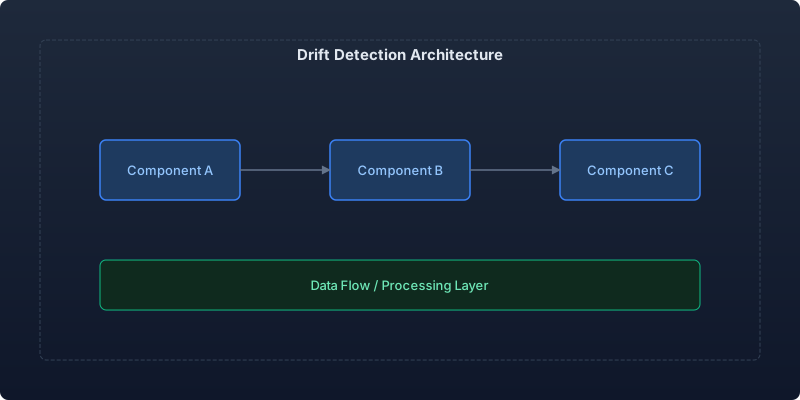
The system continuously samples production traffic, computes drift statistics against reference distributions, and triggers retraining when thresholds are breached.
Statistical Drift Detection Engine
The drift detector computes multiple statistical tests across feature distributions, combining them into a single drift score that accounts for feature importance.
import numpy as np
from scipy import stats
from dataclasses import dataclass
from typing import Optional
from enum import Enum

class DriftSeverity(Enum):
    NONE = "none"
    LOW = "low"
    MEDIUM = "medium"
    HIGH = "high"
    CRITICAL = "critical"

@dataclass
class DriftResult:
    feature_name: str
    test_statistic: float
    p_value: float
    drift_score: float
    severity: DriftSeverity
    reference_mean: float
    current_mean: float
    sample_size: int

class DriftDetector:
    SEVERITY_THRESHOLDS = {
        DriftSeverity.CRITICAL: 0.8,
        DriftSeverity.HIGH: 0.6,
        DriftSeverity.MEDIUM: 0.4,
        DriftSeverity.LOW: 0.2,
    }

    def __init__(self, reference_data: dict[str, np.ndarray],
                 feature_importance: Optional[dict[str, float]] = None):
        self.reference = reference_data
        self.importance = feature_importance or {k: 1.0 for k in reference_data}
        self._precompute_reference_stats()

    def _precompute_reference_stats(self):
        self.ref_stats = {}
        for feature, values in self.reference.items():
            self.ref_stats[feature] = {
                "mean": np.mean(values),
                "std": np.std(values),
                "quantiles": np.percentile(values, [25, 50, 75]),
                "histogram": np.histogram(values, bins=50),
            }

    def detect_drift(self, current_data: dict[str, np.ndarray]) -> list[DriftResult]:
        results = []
        for feature, current_values in current_data.items():
            if feature not in self.reference:
                continue
            ref_values = self.reference[feature]
            result = self._test_feature_drift(feature, ref_values, current_values)
            results.append(result)
        return sorted(results, key=lambda r: r.drift_score, reverse=True)

    def _test_feature_drift(self, feature: str, reference: np.ndarray,
                            current: np.ndarray) -> DriftResult:
        # Kolmogorov-Smirnov test for distribution shift
        ks_stat, ks_pvalue = stats.ks_2samp(reference, current)

        # Population Stability Index
        psi = self._compute_psi(reference, current)

        # Wasserstein distance (Earth Mover's Distance) normalized
        wasserstein = stats.wasserstein_distance(reference, current)
        ref_range = np.max(reference) - np.min(reference)
        normalized_wasserstein = wasserstein / ref_range if ref_range > 0 else 0

        # Combined drift score weighted by feature importance
        raw_score = 0.4 * min(psi / 0.25, 1.0) + \
                    0.3 * ks_stat + \
                    0.3 * min(normalized_wasserstein, 1.0)
        importance_weight = self.importance.get(feature, 1.0)
        drift_score = raw_score * importance_weight

        severity = DriftSeverity.NONE
        for sev, threshold in self.SEVERITY_THRESHOLDS.items():
            if drift_score >= threshold:
                severity = sev
                break

        return DriftResult(
            feature_name=feature,
            test_statistic=ks_stat,
            p_value=ks_pvalue,
            drift_score=drift_score,
            severity=severity,
            reference_mean=float(np.mean(reference)),
            current_mean=float(np.mean(current)),
            sample_size=len(current),
        )

    def _compute_psi(self, reference: np.ndarray, current: np.ndarray,
                     bins: int = 20) -> float:
        ref_hist, bin_edges = np.histogram(reference, bins=bins)
        curr_hist, _ = np.histogram(current, bins=bin_edges)

        ref_pct = (ref_hist + 1) / (len(reference) + bins)
        curr_pct = (curr_hist + 1) / (len(current) + bins)

        psi = np.sum((curr_pct - ref_pct) * np.log(curr_pct / ref_pct))
        return float(psi)

    def get_aggregate_drift_score(self, results: list[DriftResult]) -> float:
        if not results:
            return 0.0
        weighted_scores = [r.drift_score * self.importance.get(r.feature_name, 1.0)
                          for r in results]
        total_weight = sum(self.importance.get(r.feature_name, 1.0) for r in results)
        return sum(weighted_scores) / total_weight
Automated Retraining Orchestrator
When drift exceeds thresholds, the retraining orchestrator launches a new training job, validates the resulting model, and promotes it through the deployment pipeline.
import { EventBridge } from '@aws-sdk/client-eventbridge';
import { SFN } from '@aws-sdk/client-sfn';
import { SageMaker } from '@aws-sdk/client-sagemaker';

interface DriftAlert {
  modelId: string;
  aggregateDriftScore: number;
  severity: 'low' | 'medium' | 'high' | 'critical';
  driftedFeatures: Array<{ name: string; score: number }>;
  detectedAt: string;
  sampleWindow: { start: string; end: string };
}

interface RetrainingConfig {
  modelId: string;
  trainingPipelineArn: string;
  datasetQuery: string;
  validationThresholds: Record<string, number>;
  autoPromote: boolean;
  cooldownHours: number;
  maxRetrainsPerWeek: number;
}

interface RetrainingJob {
  jobId: string;
  modelId: string;
  triggeredBy: string;
  status: 'queued' | 'training' | 'validating' | 'promoting' | 'completed' | 'failed';
  startedAt: string;
  metrics?: Record<string, number>;
}

class RetrainingOrchestrator {
  private sfn: SFN;
  private sagemaker: SageMaker;
  private eventbridge: EventBridge;
  private configs: Map<string, RetrainingConfig>;
  private recentJobs: Map<string, RetrainingJob[]>;

  constructor(configs: RetrainingConfig[]) {
    this.sfn = new SFN({});
    this.sagemaker = new SageMaker({});
    this.eventbridge = new EventBridge({});
    this.configs = new Map(configs.map(c => [c.modelId, c]));
    this.recentJobs = new Map();
  }

  async handleDriftAlert(alert: DriftAlert): Promise<RetrainingJob | null> {
    const config = this.configs.get(alert.modelId);
    if (!config) {
      console.warn(`No retraining config for model ${alert.modelId}`);
      return null;
    }

    if (this.isInCooldown(alert.modelId, config.cooldownHours)) {
      console.log(`Model ${alert.modelId} in cooldown period, skipping`);
      return null;
    }

    if (this.exceedsWeeklyLimit(alert.modelId, config.maxRetrainsPerWeek)) {
      console.log(`Model ${alert.modelId} exceeded weekly retrain limit`);
      await this.notifyTeam(alert, 'weekly_limit_exceeded');
      return null;
    }

    const job: RetrainingJob = {
      jobId: `retrain-${alert.modelId}-${Date.now()}`,
      modelId: alert.modelId,
      triggeredBy: `drift_alert_${alert.severity}`,
      status: 'queued',
      startedAt: new Date().toISOString(),
    };

    await this.sfn.startExecution({
      stateMachineArn: config.trainingPipelineArn,
      name: job.jobId,
      input: JSON.stringify({
        modelId: alert.modelId,
        jobId: job.jobId,
        datasetQuery: config.datasetQuery,
        validationThresholds: config.validationThresholds,
        autoPromote: config.autoPromote,
        driftContext: {
          score: alert.aggregateDriftScore,
          features: alert.driftedFeatures,
          window: alert.sampleWindow,
        },
      }),
    });

    this.trackJob(alert.modelId, job);
    return job;
  }

  private isInCooldown(modelId: string, cooldownHours: number): boolean {
    const jobs = this.recentJobs.get(modelId) || [];
    const lastJob = jobs[jobs.length - 1];
    if (!lastJob) return false;

    const hoursSince = (Date.now() - new Date(lastJob.startedAt).getTime()) / 3600000;
    return hoursSince < cooldownHours;
  }

  private exceedsWeeklyLimit(modelId: string, limit: number): boolean {
    const jobs = this.recentJobs.get(modelId) || [];
    const oneWeekAgo = Date.now() - 7 * 24 * 3600000;
    const recentCount = jobs.filter(j => new Date(j.startedAt).getTime() > oneWeekAgo).length;
    return recentCount >= limit;
  }

  private trackJob(modelId: string, job: RetrainingJob): void {
    const jobs = this.recentJobs.get(modelId) || [];
    jobs.push(job);
    this.recentJobs.set(modelId, jobs);
  }

  private async notifyTeam(alert: DriftAlert, reason: string): Promise<void> {
    await this.eventbridge.putEvents({
      Entries: [{
        Source: 'ml.retraining',
        DetailType: 'RetrainingSkipped',
        Detail: JSON.stringify({ alert, reason }),
      }],
    });
  }
}
Drift Detection Strategies by Model Type
Classification Models
Monitor prediction confidence distribution shifts. A well-calibrated model should have stable confidence distributions. When confidence scores cluster toward 0.5, the model is increasingly uncertain.
Regression Models
Track residual distribution changes. If residuals shift from zero-centered to systematically positive or negative, concept drift is occurring.
Recommendation Models
Monitor coverage metrics (fraction of catalog recommended), popularity bias shifts, and user engagement rate changes as proxies for drift.
Benchmarks: Drift Detection Performance
Across our production fleet of 60+ models over 12 months:
| Metric | Value |
|---|---|
| Mean detection latency (drift onset to alert) | 4.2 hours |
| False positive rate | 3.1% |
| False negative rate (missed drift events) | 1.8% |
| Mean retraining time (data prep to validation) | 2.4 hours |
| Automated retraining success rate | 91% |
| Model freshness (time since last retrain) | 5.3 days (median) |
| Performance recovery after retraining | 94% of original metrics |
Design Decisions and Trade-offs
Reference window selection: Use the training data distribution as the initial reference, then update the reference after each successful retraining. Stale references cause false positives as the natural distribution evolves.
Sampling rate: Sample 1-5% of production traffic for drift analysis. Higher rates increase detection sensitivity but also cost. For high-volume models (>1M predictions/day), 1% provides sufficient statistical power.
Cooldown periods: Prevent retraining storms by enforcing minimum time between retraining triggers. 24-48 hours works for most models. Shorter cooldowns for rapidly-evolving domains like real-time pricing.
Validation gates: Never auto-promote a retrained model without validation. Compare against the current production model on a holdout set. Require improvement on primary metrics and no regression on guardrails.
Lessons Learned
Feature importance weighting matters enormously. Drift in a low-importance feature is noise. Drift in your top-3 features is a fire alarm. Weight your drift scores by SHAP importance.
Sudden drift and gradual drift need different responses. Sudden drift (e.g., a data pipeline schema change) needs immediate retraining. Gradual drift (seasonal patterns) benefits from scheduled retraining with fresh data windows.
Not all drift requires retraining. Sometimes drift indicates a legitimate distribution shift that the model handles well. Monitor downstream business metrics alongside statistical drift. Only retrain when model performance actually degrades.
Data quality issues masquerade as drift. Before triggering retraining, validate that the drift isn't caused by a broken upstream data pipeline filling features with nulls or stale values. A data quality check should precede the drift detector.
Conclusion
Automated drift detection and retraining transforms ML maintenance from reactive firefighting to proactive model care. The key components are statistical drift detection weighted by feature importance, intelligent retraining triggers with cooldowns and rate limits, and automated validation before promotion. Start by monitoring your highest-impact models, establish baseline drift rates, and gradually expand automation as confidence in the system grows.
Recommended reading
The State of Agentic AI in 2026: Capabilities, Limitations, and Production Readiness
Comprehensive analysis of agentic AI in 2026 covering production capabilities, current limitations, and enterprise readiness benchmarks with real deployment data.
Observability for AI Agents: Tracing Multi-Step Reasoning Chains in Production
How to implement production observability for AI agents including distributed tracing, reasoning chain analysis, and debugging multi-step failures.
Measuring and Reducing AI Workload Carbon Emissions: A Practical Engineering Guide
Building a carbon-aware scheduling system for ML training and inference workloads that reduced our AI infrastructure emissions by 42% while maintaining SLA commitments.



Comments
No comments yet. Be the first to share your thoughts.