The Scope Creep Playbook: Protecting Delivery Without Being a Gatekeeper
A practical framework for managing scope creep in engineering projects — when to say yes, when to push back, and how to protect timelines without killing innovation.

Scope creep killed our Q4 release. What started as a "simple API redesign" grew from 6 weeks to 14 weeks because we said yes to every good idea along the way. Each addition made sense individually — better error handling, a caching layer, a new endpoint for mobile, webhook support. None were unreasonable. Together, they doubled the project timeline and exhausted the team. This is the playbook I developed afterward to protect delivery without becoming the person who says no to everything.
Understanding Why Scope Creeps
Scope creep isn't random. It follows predictable patterns rooted in organizational behavior:
| Creep Pattern | Trigger | Who Introduces It | Why It Happens |
|---|---|---|---|
| Discovery creep | Building reveals unknowns | Engineering | Technical reality differs from assumptions |
| Stakeholder creep | "Since you're already in there..." | Product/business | Adjacent opportunities seem cheap |
| Perfectionism creep | "Let's do it right" | Engineering | Professional pride + avoiding future debt |
| Edge case creep | "What about X scenario?" | QA/security | Legitimate concerns, infinite in number |
| Integration creep | Dependencies surface | Other teams | Interconnected systems create scope chains |
The critical insight: most scope creep comes from good intentions. It's not sabotage. It's people seeing opportunities and wanting to capture them. Fighting scope creep means working against human nature — which is why willpower alone doesn't work. You need systems.
The Scope Management Framework
I use a three-part framework: Capture, Classify, Commit.
Part 1: Capture — Never Lose the Idea
When someone suggests an addition, never say "no" immediately. Say "yes, and let me put it in the right place." Every scope suggestion goes into a living document:
# Project: API v2 Redesign
## Scope Additions Proposed

| # | Proposal | Source | Date | Business Value (1-5) | Effort (S/M/L/XL) | Status |
|---|----------|--------|------|---------------------|-------------------|--------|
| 1 | Add webhook support for events | Sarah (PM) | Apr 3 | 4 | L | Phase 2 ✓ |
| 2 | Implement response caching layer | Dev team | Apr 5 | 3 | M | Phase 1 ✓ |
| 3 | Support GraphQL alongside REST | CEO | Apr 8 | 2 | XL | Declined |
| 4 | Add rate limiting per API key | Security | Apr 10 | 5 | M | Phase 1 ✓ |
| 5 | Bulk operations endpoint | Customer X | Apr 12 | 3 | L | Phase 2 ✓ |
| 6 | Real-time streaming responses | Product | Apr 15 | 4 | XL | Phase 3 |
| 7 | Retry logic with exponential backoff | Dev team | Apr 18 | 4 | S | Phase 1 ✓ |
Capturing everything accomplishes three things:
- The person feels heard (their idea isn't dismissed)
- You have a record of scope growth for retrospectives
- You can make prioritization decisions with full visibility
Part 2: Classify — Use the Impact/Effort Matrix
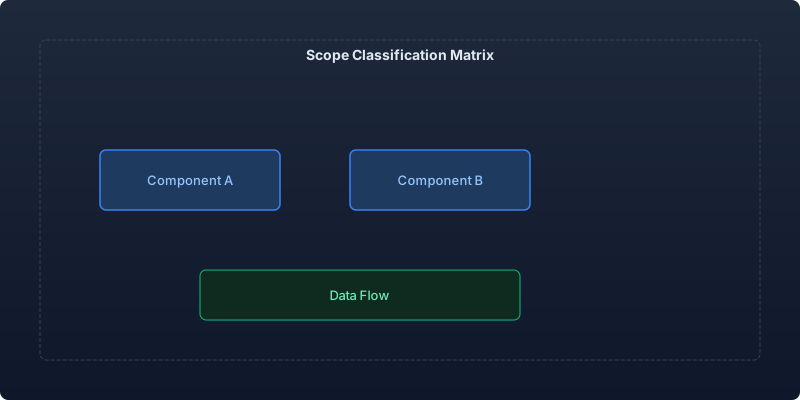
Not all scope additions are equal. We classify using a modified impact/effort framework with a time dimension:
// scope-classifier.ts - Decision framework
interface ScopeAddition {
  description: string;
  businessValue: 1 | 2 | 3 | 4 | 5;
  effort: 'S' | 'M' | 'L' | 'XL';
  deadline_sensitivity: 'blocks_launch' | 'nice_before_launch' | 'can_follow';
  reversibility: 'easy_to_add_later' | 'hard_to_add_later' | 'impossible_later';
}

function classifyScope(addition: ScopeAddition): ScopeDecision {
  // Must include: high value + blocks launch + hard to add later
  if (
    addition.businessValue >= 4 &&
    addition.deadline_sensitivity === 'blocks_launch' &&
    addition.reversibility === 'hard_to_add_later'
  ) {
    return 'INCLUDE_IN_CURRENT_PHASE';
  }

  // Fast wins: small effort, any value
  if (addition.effort === 'S' && addition.businessValue >= 3) {
    return 'INCLUDE_IN_CURRENT_PHASE';
  }

  // Defer: high value but can be added later
  if (addition.businessValue >= 3 && addition.reversibility === 'easy_to_add_later') {
    return 'PHASE_2';
  }

  // Decline: low value or enormous effort
  if (addition.businessValue <= 2 || addition.effort === 'XL') {
    return 'DECLINED_WITH_REASONING';
  }

  return 'NEEDS_DISCUSSION';
}
The reversibility dimension is the secret weapon. Many scope additions feel urgent but can be added in a follow-up release without significant rework. When something is easy to add later, it almost always should be deferred.
Part 3: Commit — The Phase Contract
Once classified, we commit to a concrete phase plan:
## Phase 1 (Original scope + approved additions)
**Deadline**: May 15 (6 weeks)
**Scope is FROZEN as of April 20**

Included:
- Core API v2 endpoints (original scope)
- Response caching layer (#2) — small effort, immediate perf benefit
- Rate limiting per API key (#4) — security requirement, blocks launch
- Retry logic (#7) — small effort, high value

## Phase 2 (Approved for follow-up)
**Target**: June 15 (4 weeks after Phase 1)

Included:
- Webhook support (#1)
- Bulk operations endpoint (#5)

## Phase 3 (Tentative, pending Phase 1 learnings)
- Real-time streaming (#6)

## Declined (with reasoning)
- GraphQL support (#3): ROI doesn't justify XL effort. Revisit in Q1 2027
  if customer demand increases.
The phrase "scope is FROZEN as of [date]" is powerful. It creates a clear line after which new additions go to Phase 2 automatically — no discussion needed.
The Conversation Playbook
Different stakeholders require different conversations:
When a PM adds scope:
Don't say: "No, we can't add that." Say: "That's a great idea. Let me add it to our scope tracker. Based on our current timeline, it would either push our deadline by [X days] or displace [specific item]. Which tradeoff do you prefer?"
This forces the proposer to make the tradeoff — not you. You're not the blocker; they're the prioritizer.
When the CEO adds scope:
Don't say: "We can't do that in time." Say: "I want to make sure we can deliver this well. Here's what our current plan delivers by [date]. Adding [request] would change the delivery to [new date], or we could move [item] to phase 2. I recommend [option] because [reasoning]. What would you prefer?"
Same structure, but with explicit recommendation. CEOs want you to have a perspective, not just present tradeoffs.
When engineers add scope (perfectionism):
Don't say: "We don't have time to do it right." Say: "I share your instinct to do this properly. Let's define 'good enough for now' and 'ideal future state.' Can we ship the 80% version that serves users and schedule the remaining 20% as a fast-follow?"
Engineers respond to quality framing. Acknowledging their instinct while proposing a phased approach respects their professionalism.
Measuring Scope Management
We track scope health metrics for every project:
| Metric | Healthy | Warning | Critical |
|---|---|---|---|
| Scope additions/week | 0-2 | 3-5 | 6+ |
| % original scope completed | > 90% | 70-90% | < 70% |
| Timeline deviation from original estimate | < 15% | 15-30% | > 30% |
| "Phase 2" backlog growth rate | Stable | Growing slowly | Growing rapidly |
| Team confidence in deadline | "Confident" | "Possible" | "Unlikely" |
We review these in weekly project syncs. When metrics hit "warning," we have an explicit scope review conversation. When they hit "critical," I escalate to the project sponsor.
The Frozen Scope Ceremony
Two weeks into any project longer than 4 weeks, we hold a "scope freeze" ceremony:
- Review the scope tracker with all stakeholders
- Classify everything proposed so far
- Make explicit Phase 1/2/3 decisions
- Get verbal agreement from all stakeholders
- Send a written summary: "As of [date], Phase 1 scope is frozen. Additions go to Phase 2."
After the freeze, any new request gets a standard response: "Added to Phase 2 backlog. We'll prioritize it after Phase 1 ships."
The 10% buffer rule: When estimating Phase 1, we include a 10% buffer for "essential discoveries" — things you can't know until you're building. This buffer is NOT for new features. It's for "the API we depend on doesn't work as documented" type surprises.
When to Say Yes to Scope Creep
Not all scope additions should be deferred. Include scope additions when:
-
It's genuinely cheaper now — if you're already in the code and the addition takes 2 hours now vs. 2 days later, do it now.
-
Security or compliance requires it — if you can't ship without it, it's not scope creep — it's a missed requirement.
-
Customer feedback is immediate — if you're iterating with a beta user and they identify a blocking gap, that's product discovery, not scope creep.
-
The team has slack — if you're ahead of schedule (rare but it happens), burning down Phase 2 items builds team confidence.
Retrospective: Learning from Q4
After our failed Q4 release, we did a scope creep retrospective. The data was illuminating:
| Scope Category | Items | Weeks Added | Value Delivered |
|---|---|---|---|
| Original scope | 12 items | 6 weeks (planned) | Core value |
| Approved additions (would include again) | 4 items | 2 weeks | High (security, perf) |
| Additions we should have deferred | 6 items | 4 weeks | Medium (nice-to-have) |
| Additions we shouldn't have done at all | 3 items | 2 weeks | Low (unused by users) |
8 out of 14 weeks of scope growth could have been Phase 2. The project would have shipped on time, and those features could have followed 4 weeks later. Instead, everything shipped 8 weeks late — and 3 of those additions were never used by customers.
Key Takeaways
-
Capture every suggestion, classify before committing — never dismiss ideas outright. Track them, classify them, and let data drive inclusion decisions.
-
Reversibility is the best prioritization heuristic — if it's easy to add later, defer it. If it's hard to add later and high value, include it now.
-
Force the proposer to own the tradeoff — "Adding X means either pushing the deadline or cutting Y. Which do you prefer?" makes scope decisions collaborative, not adversarial.
-
Freeze scope explicitly with a ceremony — a vague "let's not add more" doesn't work. A dated, documented, agreed-upon scope freeze creates accountability.
-
10% buffer for discoveries, not features — reserve time for technical unknowns, not for "one more thing."
-
Measure scope health weekly — by the time scope creep is visible in timeline deviation, it's already too late. Track leading indicators (additions/week, team confidence).
Protecting delivery isn't about saying no. It's about saying "yes, in the right phase." Engineers want to ship. Stakeholders want results. The scope playbook gives everyone what they need: ideas captured, quality maintained, and deadlines met.
Recommended reading
The Legacy of Leadership: What Remains When You Leave
The thing people remember is not your architecture. It is not your processes. It is how you made them feel. Reflections on what actually endures from engineering leadership.
What 3 A.M. Incidents Taught Me That AWS Certifications Never Did
Twenty production incidents reviewed: why understanding beats fixing, what certifications actually train, and the habits that keep a team calm at 3 a.m.
An Engineering Leader's Sustainable Weekly Rhythm
A realistic weekly rhythm that balances strategy, people, and operational work — without burning out or losing yourself in back-to-back meetings.



Comments
No comments yet. Be the first to share your thoughts.