The 30-60-90 Day Engineering Onboarding Plan That Gets Engineers Shipping in Week 2
A structured onboarding framework that balances speed-to-productivity with depth of context, designed for engineering teams scaling from 10 to 100.

The average engineering onboarding takes 3-6 months before a new hire reaches full productivity. At a startup burning $200K+/month, that's unacceptable. Every month an engineer isn't shipping is $15-25K in loaded cost producing zero customer value.
I've refined an onboarding system across three companies that gets engineers shipping meaningful code in week 2 while still building the deep context they need for long-term effectiveness. The framework treats onboarding as a funnel: narrow focus early (ship fast), then expand context progressively (build understanding).
The result: our median time-to-first-meaningful-PR dropped from 21 days to 8 days. Time-to-full-productivity (independently leading features) dropped from 4.5 months to 2.5 months.
Why Most Onboarding Fails
The typical engineering onboarding has one of two failure modes:
The Fire Hose: New hire gets access to everything on day 1. Twenty Slack channels, a 200-page wiki, six architecture diagrams, and a "just ask if you have questions!" from their manager. Result: information overload, imposter syndrome, and hesitancy to contribute for weeks.
The Slow Roll: New hire sits in meetings for 2-3 weeks, "getting context." They read documentation, attend architecture reviews, shadow other engineers. By week 4 they finally get their first ticket—a trivial bug fix. They feel babied, the team feels like they're carrying dead weight, and the new hire is already questioning whether they made the right choice.
Both approaches conflate context with capability. You don't need to understand the entire system to ship your first feature. You need a narrow slice of context and permission to be productive.
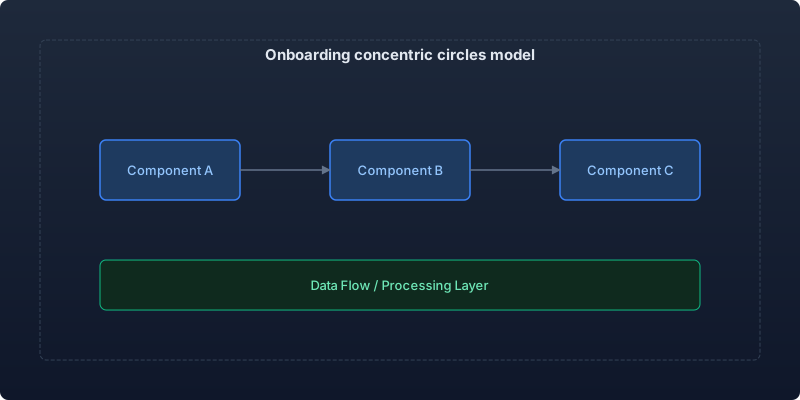
The Framework: Concentric Circles of Context
Think of onboarding as concentric circles expanding outward:
| Circle | Timeline | Scope | Goal |
|---|---|---|---|
| Core | Days 1-5 | One service, one feature area | Ship first meaningful PR |
| Team | Days 6-30 | Team's domain, 3-5 services | Independently take sprint tickets |
| Organization | Days 31-60 | Cross-team dependencies, architecture | Lead a feature end-to-end |
| Strategic | Days 61-90 | Technical strategy, product roadmap | Contribute to architectural decisions |
Days 1-5: The Core Circle
Objective: Ship a meaningful pull request by end of week 1.
This is the most important week. A new engineer who ships code in week 1 develops confidence and momentum that compounds for months. An engineer who doesn't ship until week 3 often struggles with imposter syndrome through their entire first quarter.
Day 1: Environment and Access
| Task | Owner | Duration |
|---|---|---|
| Laptop configured, all accounts provisioned | IT/Platform | Pre-arrival |
| Clone target repo, run tests locally | New hire + buddy | 2 hours |
| Dev environment working (build, test, deploy to staging) | New hire + buddy | 2 hours |
| Meet manager, discuss 30-60-90 expectations | Manager | 45 minutes |
| Meet onboarding buddy | Buddy | 30 minutes |
Critical: The dev environment must work on day 1. If your setup takes more than 4 hours, your developer experience is broken. Fix it before your next hire.
Day 2: First Code Context
The new hire reads one service's code—not the whole codebase. Their buddy walks them through:
- The service's responsibility (one sentence)
- The request lifecycle (how data flows through)
- The test strategy (where tests live, how to run them)
- The deploy process (how code reaches production)
They should be able to answer: "If I change this file and push, what happens?"
Day 3-4: The Starter Ticket
Before the new hire starts, their manager pre-selects 2-3 "starter tickets." These tickets must be:
- Real work (not made-up busy work—something the team actually needs)
- Narrow scope (touches 1-3 files maximum)
- Well-defined (clear acceptance criteria, no ambiguity)
- Low-risk (won't break production if done wrong)
- Context-local (within the service they studied on day 2)
Good starter tickets: fix a UI bug, add a new field to an API response, improve an error message, add a missing test case, update a dependency.
Bad starter tickets: refactor a module, implement a new feature, fix a flaky test (requires too much context).
Day 5: Ship It
The new hire's first PR gets priority review—within 4 hours, not the usual queue. The reviewer's job is to be encouraging while maintaining quality standards. Ship to production by end of day.
Celebrate the deploy. Post in the team channel. This seems trivial, but it signals "you're a contributor now" in a way that weeks of orientation never will.
Days 6-30: The Team Circle
Objective: Independently take and complete sprint tickets without hand-holding.
Week 2: Expanding Context
| Activity | Frequency | Purpose |
|---|---|---|
| Daily 15-min check-in with buddy | Daily | Unblock questions, build trust |
| Architecture walkthrough of team's domain | Once (1 hour) | Understand service boundaries |
| Attend team ceremonies (standup, planning, retro) | As scheduled | Absorb team norms |
| Take 2-3 normal sprint tickets | Throughout week | Build independence |
The buddy relationship is crucial in week 2. The buddy isn't the manager—they're a peer who answers "dumb questions" without judgment. I pair new hires with engineers who are 6-12 months tenured. They remember what was confusing recently and can empathize with the learning curve.
Weeks 3-4: Progressive Complexity
By week 3, tickets should involve:
- Multi-file changes within one service
- Minor cross-service interactions (calling an API, consuming an event)
- Small design decisions ("should I add this to the existing endpoint or create a new one?")
The manager checks in weekly during the first month—not to micromanage, but to:
- Confirm the new hire has adequate context
- Remove any systemic blockers
- Calibrate difficulty of assigned work
- Check for early signs of cultural mismatch
The 30-Day Checkpoint
At day 30, the manager and new hire have a structured conversation:
- What's going well? (Identify strengths to leverage)
- What's confusing? (Identify context gaps to fill)
- What's frustrating? (Identify process problems to fix)
- Are expectations aligned? (Course-correct if needed)
Deliverable from this meeting: a written list of 3 skills or knowledge areas to develop in days 31-60.
Days 31-60: The Organization Circle
Objective: Lead a feature from design to production, including cross-team coordination.
Feature Ownership
Between days 31-60, the new hire should own at least one feature that touches multiple services or requires coordination with another team. This is where they learn:
- How to write an RFC or design doc for their team
- How to communicate cross-team dependencies
- How to manage scope when reality diverges from the plan
- How to push back on requirements that don't make sense
Broadening Technical Context
| Activity | When | Goal |
|---|---|---|
| Read 3-5 architecture decision records (ADRs) | Week 5 | Understand why things are built this way |
| Shadow an on-call shift | Week 6 | Understand production failure modes |
| Attend an architecture review | Week 7 | See how technical decisions get made |
| Present a small tech talk or demo | Week 8 | Teach something, solidify knowledge |
The 60-Day Checkpoint
By day 60, the new hire should be able to:
- Estimate work accurately (within 30% of actual)
- Identify and escalate risks independently
- Navigate the codebase without guidance for their team's domain
- Form opinions about technical decisions in their area
If they can't do these things, something went wrong earlier—usually insufficient context building in days 6-30 or tickets that were too narrowly scoped.
Days 61-90: The Strategic Circle
Objective: Contribute to architectural decisions and mentor newer hires.
Strategic Participation
In the final month, the new hire should:
- Participate in technical strategy discussions with informed opinions
- Understand the product roadmap and its technical implications
- Identify technical debt or improvement opportunities in their area
- Begin mentoring the next new hire (if timing aligns)
The 90-Day Graduation
At day 90, the onboarding is officially complete. The final conversation covers:
- Performance against expectations: Are they where we expected at 90 days?
- Growth trajectory: What's their development plan for the next 6 months?
- Feedback on onboarding: What should we change for the next hire?
That last question is critical. Every new hire improves the onboarding for the next one. Our onboarding documentation has been through 30+ iterations, each one contributed by someone who just experienced it with fresh eyes.
The Manager's Onboarding Checklist
| Timeline | Manager Action | If Missed, Consequence |
|---|---|---|
| Pre-arrival | Starter tickets selected, buddy assigned, access provisioned | Day 1 wasted on setup |
| Day 1 | 1:1 meeting, set expectations, confirm environment works | New hire feels abandoned |
| Day 5 | Confirm first PR shipped, celebrate | Momentum lost |
| Week 2 | Confirm buddy relationship is working | Questions go unasked |
| Day 30 | Structured checkpoint conversation | Context gaps compound |
| Day 60 | Feature ownership assessment | Autonomy delayed |
| Day 90 | Graduation conversation, onboarding feedback captured | Growth plan unclear |
Metrics That Matter
Track these to know if your onboarding is working:
| Metric | Good | Needs Work |
|---|---|---|
| Time to first PR | <7 days | >14 days |
| Time to first solo feature | <6 weeks | >10 weeks |
| 30-day satisfaction score (new hire survey) | >4.0/5.0 | <3.5/5.0 |
| 90-day retention | >95% | <85% |
| Buddy effectiveness rating | >4.0/5.0 | <3.5/5.0 |
| Ramp ratio (new hire velocity / team average at 90 days) | >70% | <50% |
Actionable Takeaways
- Ship code in week 1. Pre-select starter tickets, priority-review the PR, and celebrate the deploy.
- Expand context in concentric circles. Narrow focus first, then broaden progressively. Never firehose.
- Assign a buddy, not just a manager. Peers answer "dumb questions" better than authority figures.
- Conduct structured checkpoints at 30, 60, and 90 days. Course-correct early, not at the 6-month review.
- Iterate the onboarding with every new hire. Fresh eyes see problems that tenured engineers have normalized.
Every day an engineer spends "getting context" without shipping is a day of wasted salary. Respect their time, give them a narrow path to impact, and then expand from there. They'll thank you by being productive months sooner—and by staying longer because they felt valued from day one.
Recommended reading
The Legacy of Leadership: What Remains When You Leave
The thing people remember is not your architecture. It is not your processes. It is how you made them feel. Reflections on what actually endures from engineering leadership.
What 3 A.M. Incidents Taught Me That AWS Certifications Never Did
Twenty production incidents reviewed: why understanding beats fixing, what certifications actually train, and the habits that keep a team calm at 3 a.m.
An Engineering Leader's Sustainable Weekly Rhythm
A realistic weekly rhythm that balances strategy, people, and operational work — without burning out or losing yourself in back-to-back meetings.



Comments
No comments yet. Be the first to share your thoughts.