Engineering Succession Planning
How to prepare your engineering organization for leadership transitions, develop internal candidates, and ensure continuity without creating shadow org charts

Three years into building my engineering organization, I was offered a new role at another company. The transition should have been straightforward—I'd hired strong people and built good systems. Instead, it was chaotic. Nobody knew how to handle escalations without me. Key relationships with stakeholders had no backup. Decisions that I'd been making implicitly suddenly had no owner.
I'd built a team that was excellent at engineering but entirely dependent on my presence for leadership continuity. That's not a well-built organization—it's a fragile one with a single point of failure wearing a manager's hat.
Since then, I've made succession planning a continuous practice, not something I scramble to do when I'm leaving. The result: my teams are resilient through leadership transitions, and people grow faster because they're being prepared for larger roles.
Why Engineers Resist Succession Planning
Succession planning has a perception problem in engineering. It sounds corporate, political, and implies that someone is being "chosen" over others. Let me reframe it:
| Common Objection | Reframe |
|---|---|
| "It's too political" | It's development planning with a continuity lens |
| "It creates favorites" | It creates growth opportunities for everyone |
| "I'm not leaving" | You might get promoted, take leave, or get sick |
| "It's HR's job" | HR supports the process; leaders own it |
| "My team is too small" | Even 3-person teams need backup for the lead |
The honest truth: you could be unavailable tomorrow due to illness, family emergency, or a sudden opportunity. Your team shouldn't suffer because you didn't think about who would step in.
The Continuity Map
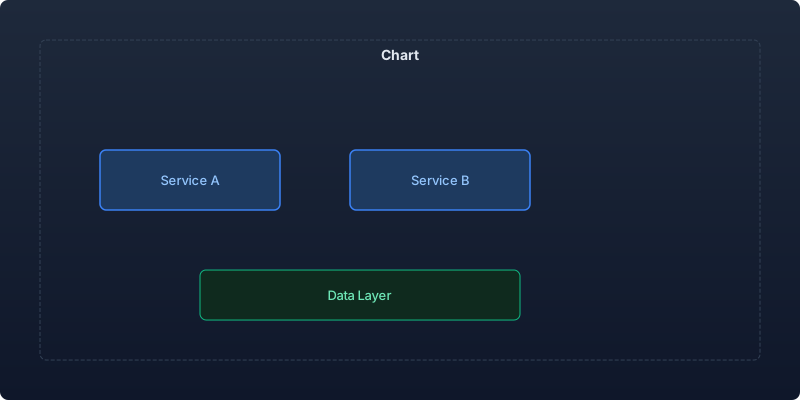
My succession planning starts with a continuity map—an honest assessment of what happens if key people (including me) are unavailable for 30+ days.
For each leadership role on the team, I document:
Current state:
- What decisions only this person can make today?
- What relationships are exclusive to this person?
- What institutional knowledge do they hold alone?
- What processes depend on their personal judgment?
Risk assessment:
- How long could the team function without this person?
- What would break first?
- Who could step in partially? Who could step in fully?
Gap analysis:
- What skills or relationships does the potential successor need?
- What authority would need to be delegated?
- What documentation doesn't exist yet?
I update this map quarterly. It's not a succession chart (which implies fixed futures)—it's a risk assessment that drives development priorities.
Developing Successors Without "Anointing"
The biggest mistake in succession planning is visibly anointing a successor. This creates political dynamics, demotivates others, and puts unfair pressure on the chosen person. Instead, I develop multiple people simultaneously through "stretch assignments" that build leadership capacity:
For potential engineering managers:
- Leading a cross-team technical initiative
- Running sprint planning for a month while I observe
- Handling a performance concern with my coaching support
- Representing the team in a stakeholder meeting
For potential tech leads:
- Owning an architectural decision process end-to-end
- Mentoring two junior engineers with structured check-ins
- Leading a technical deep dive for the broader org
- Writing and shepherding an RFC through approval
For potential directors:
- Managing the team during my vacation (two weeks, full authority)
- Leading a quarterly planning process
- Building a stakeholder relationship independently
- Handling a hiring process from req to offer
None of these assignments are labeled "succession development." They're framed as growth opportunities that benefit the individual and the team. The fact that they also build succession depth is a side effect—at least in how I communicate them.
The "Vacation Test"
My most effective succession-building practice is what I call the "vacation test": taking a genuine two-week vacation at least once a year where I'm truly unreachable. No checking Slack, no "just one quick question" exceptions.
Before the vacation, I explicitly delegate all my responsibilities:
- Decision-making authority goes to [named person]
- Escalation path changes to [named person → named backup]
- Stakeholder communication handled by [named person]
- 1:1s continued by [named person] or rescheduled
When I return, I learn enormously from what happened:
- What decisions were made well without me?
- What was deferred unnecessarily because people weren't sure of their authority?
- What broke because of undocumented process or missing context?
- What did the team discover they didn't actually need me for?
Each of these learnings improves the team's resilience and tells me where to invest in further development.
Knowledge Transfer as Ongoing Practice
Succession planning fails when knowledge lives in one person's head. My continuous knowledge transfer practices:
| Knowledge Type | Transfer Method | Frequency |
|---|---|---|
| Decision-making criteria | Thinking out loud in 1:1s | Weekly |
| Stakeholder relationships | Joint meetings, then handoff | Monthly |
| Strategic context | Written strategy documents | Quarterly |
| Judgment calls | Post-decision debriefs | As-needed |
| Organizational navigation | Explicit teaching of "how things work" | Ongoing |
The most important and hardest to transfer is judgment—knowing when to push back vs. accommodate, when to escalate vs. handle locally, when to invest vs. ship quickly. I teach judgment by narrating my reasoning in real-time: "Here's why I'm choosing to push back on this stakeholder request rather than accepting it..."
Planning for Different Scenarios
Succession planning should cover multiple scenarios, not just "leader leaves voluntarily":
Planned departure (promotion, new role, retirement): 4-6 week transition with full handoff. Ideal scenario.
Unexpected short absence (illness, family emergency, 1-4 weeks): Deputy takes over temporarily. No structural changes needed, but authority must be clearly delegated.
Unexpected long absence (extended medical leave, 1-6 months): Interim leadership with decision-making authority. May require role restructuring.
Sudden permanent departure (resignation with short notice): Most challenging. Tests whether knowledge transfer and development have been sufficient.
Each scenario requires different preparation depth. I plan for all four, knowing that the most likely scenario is the planned departure but the most damaging is the sudden one.
Measuring Succession Readiness
I evaluate succession health using these indicators:
- Delegation comfort: Can I delegate any of my responsibilities for a week without preparation?
- Decision independence: How often does the team need me for decisions vs. making them autonomously?
- Relationship coverage: For each key stakeholder, does at least one other person have a working relationship?
- Knowledge distribution: For each critical system or process, can at least two people handle it?
- Leadership pipeline: At each level, is there at least one person actively developing toward the next level?
If any of these indicators are weak, it tells me exactly where to invest development effort.
The Emotional Dimension
Succession planning surfaces uncomfortable emotions. For the leader, it can trigger: "Am I making myself replaceable?" (Yes, and that's excellence, not vulnerability.) "Does planning for my departure mean I should leave?" (No, it means you're a responsible leader.)
For potential successors: "Am I being set up to take over?" (You're being developed—the future isn't predetermined.) "What if I'm not ready?" (That's what development is for—nobody's ready until they're supported into readiness.)
For the broader team: "Is our leader leaving?" (Communicate clearly that succession planning is continuous practice, not a departure signal.)
I address these emotions directly rather than letting them fester as unspoken concerns.
Key Takeaways
- Succession planning is continuity practice, not departure preparation—start it now, not when you're leaving
- Build a continuity map: what breaks if key people are unavailable for 30+ days?
- Develop multiple people simultaneously through stretch assignments rather than visibly anointing one successor
- Use the "vacation test" (two weeks, fully offline) to reveal dependencies and development gaps
- Transfer judgment and decision-making criteria through narrating your reasoning, not just documenting decisions
- Plan for multiple scenarios: planned departure, short absence, long absence, and sudden departure
- Measure succession readiness through delegation comfort, decision independence, and relationship coverage
- Address the emotional dimensions directly—for yourself, successors, and the broader team
The best measure of a leader isn't what happens while they're there—it's what happens after they leave. If your team struggles without you, you've built dependency, not organization. Succession planning is the practice of building something that thrives beyond your personal involvement.
Recommended reading
The Legacy of Leadership: What Remains When You Leave
The thing people remember is not your architecture. It is not your processes. It is how you made them feel. Reflections on what actually endures from engineering leadership.
What 3 A.M. Incidents Taught Me That AWS Certifications Never Did
Twenty production incidents reviewed: why understanding beats fixing, what certifications actually train, and the habits that keep a team calm at 3 a.m.
An Engineering Leader's Sustainable Weekly Rhythm
A realistic weekly rhythm that balances strategy, people, and operational work — without burning out or losing yourself in back-to-back meetings.



Comments
No comments yet. Be the first to share your thoughts.