Engineering Team Knowledge Sharing Practices
How to build sustainable knowledge sharing habits that prevent single points of failure, accelerate onboarding, and make your entire team more resilient

Last year, one of my senior engineers went on unexpected medical leave for three months. Within two weeks, three projects slowed to a crawl. Not because the team lacked skill—but because critical knowledge about system behavior, deployment quirks, and undocumented decisions existed only in that engineer's head.
It was a wake-up call. We had a bus factor of one on multiple critical systems, and I hadn't done anything about it until the consequences became painful. That crisis prompted me to build systematic knowledge-sharing practices that now make our team dramatically more resilient.
The Knowledge Distribution Problem
Most engineering teams have a Pareto distribution of knowledge: 80% of critical system understanding lives in 20% of the team's heads. This creates fragility, slows decision-making, and concentrates all the interesting work on the same few people.
| Knowledge Type | Where It Usually Lives | Risk Level |
|---|---|---|
| Architecture decisions | Original author's memory | High |
| Deployment quirks | Tribal knowledge | Critical |
| Business context | PM conversations never documented | Medium |
| Debug techniques | Senior engineer intuition | High |
| Integration behaviors | Discovered through incidents | Critical |
| Historical context | Long-tenured employees | Medium |
The danger isn't just that someone might leave. It's that concentrated knowledge creates bottlenecks in daily work. If only one person knows how the payment system works, they become a review bottleneck, an escalation magnet, and an interrupt target—which burns them out while the rest of the team remains dependent.
The Knowledge Sharing System
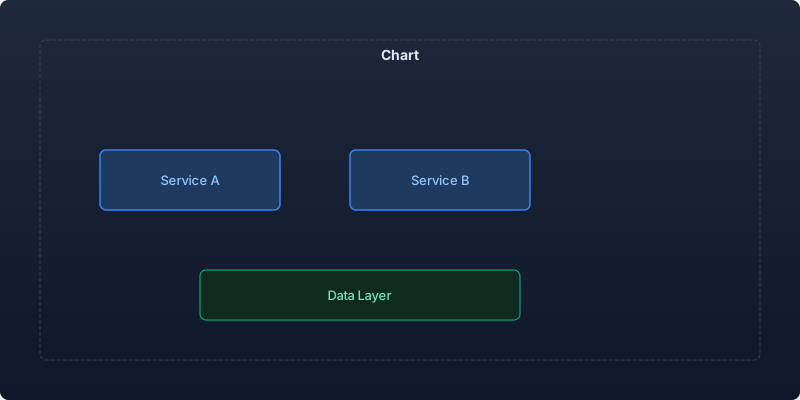
After the crisis, I built a multi-layered knowledge sharing system. Each layer addresses a different aspect of the problem:
Layer 1: Written Documentation The foundation. Every system has a living document covering: purpose, architecture overview, key decisions (with rationale), operational runbook, and known gotchas. These aren't comprehensive encyclopedias—they're "just enough" documents that give someone the context to start working effectively.
Layer 2: Structured Pairing Weekly pairing sessions where knowledge holders work alongside learners on real tasks. Not shadowing (watching is passive and forgettable) but genuine pair programming where the learner drives and the expert navigates.
Layer 3: Teaching Presentations Monthly "deep dive" presentations where an engineer explains a system they know well. The format: 30 minutes of teaching, 15 minutes of Q&A. Recorded for future reference.
Layer 4: Deliberate Rotation Quarterly, we rotate primary ownership of systems. The outgoing owner mentors the incoming owner for two weeks, then becomes available for questions but is no longer the default escalation point.
Making Documentation Sustainable
The hardest part of documentation isn't writing it—it's keeping it current. Here's what makes our documentation sustainable:
Minimal viable docs: We document the minimum needed to be useful, not exhaustive references. A good system doc is 2-3 pages, not 20.
Documentation as onboarding: Every new team member improves the documentation for the system they onboard onto. Fresh eyes catch gaps that experts have become blind to.
Pull request documentation: Significant changes require a documentation update in the same PR. If you change behavior, update the doc. This is enforced in code review.
Quarterly doc reviews: Each system's documentation gets a 30-minute review every quarter. The owner reads it fresh and updates anything that's drifted from reality.
"Doc debt" tracking: We track documentation gaps as tech debt items. They compete with code tech debt for sprint time, which ensures they get addressed.
The Pairing Program
Our structured pairing program runs on a simple rotation:
Each sprint, every engineer has at least one 90-minute pairing session with someone who knows a system they don't. The pairs are assigned based on our knowledge matrix (more on this below).
What makes pairing effective for knowledge transfer:
- The learner drives: They have the keyboard. They make decisions. The expert guides rather than demonstrates.
- Real work, not exercises: They work on actual tickets for that system. Learning happens best in context.
- Notes taken by learner: After the session, the learner writes up what they learned and adds it to the system documentation.
- Progressive difficulty: First sessions are simple bug fixes or small features. Later sessions tackle architectural changes or complex debugging.
The Knowledge Matrix
I maintain a knowledge matrix—a simple spreadsheet that maps team members against systems/domains with a competency rating:
- 0: No exposure—would need full onboarding
- 1: Basic understanding—can review code, needs help to make changes
- 2: Working knowledge—can make changes independently for most tasks
- 3: Deep expertise—can make architectural decisions, debug complex issues
The matrix lives in our team wiki and is updated quarterly. I use it to:
- Identify dangerous single points of failure (only one person at level 3)
- Plan pairing assignments (pair level 1 with level 3)
- Distribute interesting work (don't always give complex tasks to the expert)
- Assess hiring needs (do we need someone who knows area X?)
Lightning Talks and Deep Dives
Monthly, we run two types of knowledge-sharing presentations:
Lightning talks (10 minutes each, 3-4 per session): Short, informal presentations on anything interesting. Recent topics: "A debugging technique I learned this month," "How our feature flag system actually works," "What I learned from the last incident."
Deep dives (45 minutes, once per month): Longer exploration of a specific system or concept. The presenter prepares a walkthrough with architecture diagrams, code examples, and live demos. Recent topics: "Our payment processing pipeline end-to-end," "How event sourcing works in our order system."
Both formats are recorded and added to a searchable knowledge base. New hires watch relevant deep dives as part of onboarding.
Incentivizing Knowledge Sharing
Knowledge sharing competes with feature work for attention. If you don't explicitly value it, it won't happen. How I incentivize it:
- Performance reviews include knowledge sharing: Our rubric explicitly evaluates "Did you make the team more knowledgeable?"
- Recognition in team meetings: I call out specific knowledge-sharing contributions. "Thanks to Jasmine's deep dive last month, three people can now independently debug payment issues."
- Protected time: Every sprint has allocated capacity for documentation and pairing. It's not "extra" work squeezed into margins.
- Career ladder requirement: Advancing to senior levels requires demonstrating knowledge multiplication—making others effective, not just being effective yourself.
Onboarding as Knowledge Sharing
Every new hire is a knowledge-sharing opportunity in both directions:
- They receive knowledge through documentation, pairing, and deep dive recordings
- They contribute knowledge by documenting what confused them (which reveals documentation gaps)
Our onboarding checklist includes:
- Read system docs for your team's primary services
- Pair with an expert on your first three tickets
- After your first month, present a "fresh eyes" review of what confused you and what the documentation missed
- Update three documentation pages based on your onboarding experience
This creates a positive loop: each new hire makes onboarding better for the next one.
Key Takeaways
- Knowledge concentration creates fragility, bottlenecks, and burnout for the few who hold it
- Build a multi-layered system: documentation, structured pairing, teaching presentations, and deliberate rotation
- Keep documentation minimal and sustainable—2-3 pages per system, updated in the same PR as code changes
- Maintain a knowledge matrix to identify single points of failure and plan pairing assignments
- Run monthly deep dives (recorded) and lightning talks to distribute understanding across the team
- Explicitly incentivize knowledge sharing through performance reviews, recognition, and protected time
- Use every new hire as both a knowledge receiver and a documentation auditor
- Quarterly system ownership rotation breaks dependencies and develops T-shaped engineers
Knowledge sharing isn't generosity—it's infrastructure. A team where knowledge is distributed is a team that can move fast without being fragile, make decisions without waiting for one person, and survive unexpected absences without crisis. Invest in it like you invest in your CI pipeline: systematically, consistently, and with maintenance in mind.
Recommended reading
The Legacy of Leadership: What Remains When You Leave
The thing people remember is not your architecture. It is not your processes. It is how you made them feel. Reflections on what actually endures from engineering leadership.
What 3 A.M. Incidents Taught Me That AWS Certifications Never Did
Twenty production incidents reviewed: why understanding beats fixing, what certifications actually train, and the habits that keep a team calm at 3 a.m.
An Engineering Leader's Sustainable Weekly Rhythm
A realistic weekly rhythm that balances strategy, people, and operational work — without burning out or losing yourself in back-to-back meetings.



Comments
No comments yet. Be the first to share your thoughts.