Giving Engineers Autonomy Without Chaos
How to create the right balance of freedom and structure so your engineering team moves fast without creating a maintenance nightmare

I once managed a team where I gave engineers complete freedom to make technical decisions. Choose your own frameworks, design your own APIs, structure your code however you want. I thought I was being the enlightened engineering leader—trusting my people, staying out of their way.
Six months later, we had three different state management libraries, two competing API styles, and a deployment process that required reading four different READMEs depending on which service you were deploying. New hires took three months to become productive because they had to learn the team's decisions one service at a time.
That experience taught me that autonomy without guardrails isn't freedom—it's chaos wearing a freedom costume.
The Autonomy Spectrum
Most engineering leaders think about autonomy as a binary: either you prescribe everything or you let people decide everything. In reality, it's a spectrum, and the right position varies by decision type.
| Decision Type | Autonomy Level | Example |
|---|---|---|
| Implementation details | Full autonomy | How to structure a function |
| Local architecture | High autonomy with review | Service-internal patterns |
| Cross-service contracts | Bounded autonomy | API design within standards |
| Technology selection | Guided autonomy | Choose from approved list |
| Infrastructure decisions | Low autonomy | Must use shared platform |
| Security practices | No autonomy | Must follow security policy |
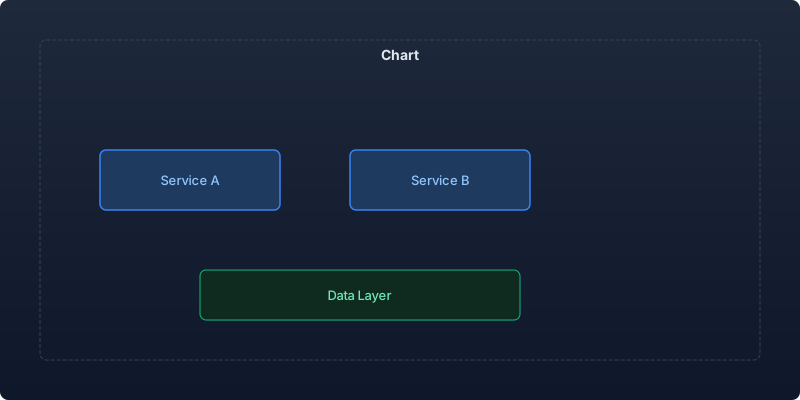
The insight is that autonomy should be highest where the blast radius is lowest. An engineer's choice of variable names affects nobody else. Their choice of database affects everyone for years.
Guardrails vs. Gates
There's a crucial distinction between guardrails and gates. Gates block progress until approval is granted. Guardrails prevent going off-road while allowing full speed ahead. High-performing teams use guardrails; bureaucratic teams use gates.
Gates look like:
- "Submit a ticket and wait for platform team approval"
- "Schedule an architecture review before starting"
- "Get sign-off from three senior engineers"
Guardrails look like:
- Automated linting that enforces coding standards
- CI checks that validate API contracts
- Template repositories that embed best practices
- Self-service tooling with safe defaults
The difference is speed. Guardrails maintain quality without introducing waiting. When I replaced our architecture approval gate with a set of automated guardrails and an optional advisory review, our time-to-first-commit on new services dropped from two weeks to two days.
The "Paved Road" Approach
I borrowed this concept from large-scale engineering organizations and adapted it for my 20-person team. The idea is simple: provide an extremely well-maintained default path that handles 80% of use cases, then allow teams to leave the road when they have a compelling reason.
Our paved road includes:
- A service template with logging, monitoring, health checks, and deployment pre-configured
- A standard tech stack (language, framework, database) for new services
- Shared libraries for common patterns (auth, events, configuration)
- Documented deployment pipeline that "just works" for standard services
The critical principle: the paved road must be genuinely easier than the alternative. If engineers go off-road because the paved road is slow or painful, you have a road quality problem, not an autonomy problem.
When Engineers Should Go Off-Road
Going off-road isn't bad—it's how innovation happens. But it should be a deliberate decision with understood tradeoffs, not a casual one. I ask engineers to answer three questions before diverging from the standard path:
- What specific requirement makes the standard approach inadequate?
- What's the ongoing maintenance cost of this divergence?
- Who will support this choice when you're not available?
If they can answer all three thoughtfully, I almost always approve the divergence. The questions aren't designed to block—they're designed to ensure the decision is intentional rather than driven by preference alone.
Ownership Models That Scale
Autonomy works best when paired with clear ownership. If everyone owns everything, nobody owns anything. I've experimented with several ownership models:
Service ownership: Each service has a designated owning team responsible for its health, evolution, and operational characteristics. The owning team has autonomy over internal decisions within the guardrails.
Domain ownership: Teams own business domains rather than services. This gives them freedom to restructure services within their domain without cross-team coordination.
Rotating ownership: For shared infrastructure, we rotate primary ownership quarterly. This prevents knowledge silos while maintaining clear accountability at any given time.
The model that worked best for my teams is domain ownership with a quarterly rotation for shared concerns. It maximizes autonomy while preventing the "that's not my problem" drift.
Building Trust Incrementally
I don't give new teams or new engineers full autonomy on day one. Trust is built through demonstrated judgment. Here's the progression I use:
First month: Work within the established patterns. Follow the paved road. Ask questions freely.
Months 2-3: Propose small improvements to existing patterns. Lead discussions about alternative approaches. Demonstrate understanding of tradeoffs.
Months 4-6: Take ownership of architectural decisions within your service. Mentor newer team members on the established patterns.
Six months+: Propose and lead off-road experiments. Influence the paved road itself based on learnings.
This isn't a rigid gate system—it's a natural progression. Engineers who demonstrate good judgment earlier move through it faster. The key is that I'm explicit about this progression so people know what's expected and how to grow their autonomy.
Coordination Without Control
The hardest aspect of autonomy is coordination. When teams can make independent decisions, how do you prevent fragmentation? I use three lightweight mechanisms:
Architecture Advisory Group: A rotating group of senior engineers who review cross-cutting decisions. They advise—they don't approve. Their input is valued but not required.
Technology Radar: A shared document listing our technology choices as "adopt," "trial," "assess," or "hold." Teams can freely use "adopt" technologies, experiment with "trial" technologies, and need to make a case for "assess" technologies.
Weekly Architecture Brief: A 15-minute async write-up of significant technical decisions made that week. Any engineer can read these, comment, or raise concerns. It's information sharing, not approval seeking.
The "Undo" Test
One mental model I've found helpful: before granting autonomy on a decision, ask "how hard is this to undo?" If the decision is easily reversible (choosing a library for a single service), grant full autonomy. If it's difficult to reverse (choosing a primary database technology), require more structure.
| Reversibility | Autonomy Approach | Example |
|---|---|---|
| Trivially reversible | Full autonomy, no review needed | Code style choices |
| Moderately reversible | Autonomy with async review | Service architecture |
| Difficult to reverse | Collaborative decision-making | Data model design |
| Practically irreversible | Formal RFC process | Technology migrations |
This framework helps me avoid both extremes: over-controlling reversible decisions (which frustrates engineers) and under-controlling irreversible ones (which creates long-term problems).
When Autonomy Goes Wrong
Even with good guardrails, autonomy sometimes produces bad outcomes. I've learned to distinguish between:
- Bad outcome, good process: The engineer made a thoughtful decision that didn't work out. This is fine—support them, learn together, adjust.
- Bad outcome, bad process: The engineer made a careless decision without considering tradeoffs. This needs coaching and potentially tighter guardrails for a period.
- Good outcome, bad process: The engineer got lucky with a reckless decision. This is actually the most dangerous case because it reinforces bad habits.
My response differs significantly based on which category the situation falls into. Punishing thoughtful decisions that didn't work out is the fastest way to kill a culture of autonomy.
Key Takeaways
- Autonomy should scale inversely with blast radius—more freedom for decisions that affect fewer people
- Replace approval gates with automated guardrails that maintain quality without blocking speed
- Build a "paved road" that's genuinely easier than the alternative so engineers choose it willingly
- Require three questions before going off-road: why, what's the cost, and who maintains it
- Build trust incrementally through demonstrated judgment rather than granting full autonomy immediately
- Use lightweight coordination mechanisms like technology radars and architecture briefs
- Apply the "undo test" to calibrate how much structure a decision needs
- Respond to outcomes based on process quality, not just results
The goal isn't maximum autonomy—it's maximum effective autonomy. That means the right amount of freedom at the right level of decision-making, supported by the right guardrails to prevent costly mistakes while preserving speed and ownership.
Recommended reading
The Legacy of Leadership: What Remains When You Leave
The thing people remember is not your architecture. It is not your processes. It is how you made them feel. Reflections on what actually endures from engineering leadership.
What 3 A.M. Incidents Taught Me That AWS Certifications Never Did
Twenty production incidents reviewed: why understanding beats fixing, what certifications actually train, and the habits that keep a team calm at 3 a.m.
An Engineering Leader's Sustainable Weekly Rhythm
A realistic weekly rhythm that balances strategy, people, and operational work — without burning out or losing yourself in back-to-back meetings.



Comments
No comments yet. Be the first to share your thoughts.