Having Career Conversations That Matter
Beyond "where do you see yourself in 5 years" — how to have career development talks that actually help your engineers grow and feel supported.

Early in my management career, I had a career development conversation that still makes me cringe.
I'd read all the management books. I'd prepared my questions. I sat down with a talented mid-level engineer and said, with manufactured enthusiasm: "So! Where do you see yourself in five years?"
She stared at me for a moment, then said: "Honestly? I have no idea. I don't know what's even possible. I just know I like solving hard problems and I want to get better at it."
I had no idea what to do with that answer. My framework assumed people had clear goals I could help them achieve. I stumbled through some generic talk about the IC ladder versus the management track and we both left the conversation feeling like we'd wasted each other's time.
That night I realized something: most career conversations fail because they assume people know what they want. The reality is that most engineers — especially early and mid-career — are figuring it out as they go. They don't need you to execute their five-year plan. They need you to help them discover what they want by expanding their sense of what's possible.
Why Most Career Conversations Are Useless
Let's be honest about what usually happens in career development meetings:
The manager asks a question from a list. The engineer gives an answer they think the manager wants to hear. The manager suggests some training or a stretch project. Both parties leave feeling like they checked a box. Nothing changes.
This happens because:
| The problem | What's really going on |
|---|---|
| "Where do you see yourself in 5 years?" | Too abstract, too distant, assumes linear paths exist |
| "Do you want to go into management?" | Presents a false binary |
| "What skills do you want to develop?" | Requires self-awareness that takes years to build |
| "Here's what you need for the next level" | Reduces growth to a checklist |
| Conversations happen once a year | Growth is continuous; annual talks are too infrequent |
The best career conversations I've had — both as a mentor and mentee — didn't follow a template. They were genuine explorations. They were curious and open-ended. They made space for uncertainty while still being productive.
A Better Framework: Explore, Expand, Enable
After years of experimenting with career conversations, I've landed on a framework that actually works. It's not a script — it's a mindset.
Phase 1: Explore (understand where they are)
Before you can help someone grow, you need to genuinely understand their current experience. Not their title or their project — their experience. What gives them energy? What drains them? What parts of their work feel meaningful?
Questions I ask:
- "Tell me about a recent week where you felt really energized at work. What were you doing?"
- "When was the last time you lost track of time because you were so absorbed in something?"
- "What parts of your current work feel like a grind — the stuff you do because you have to, not because it lights you up?"
- "When you imagine an ideal Tuesday, what does it look like?"
- "What's something you're curious about but haven't had the chance to explore?"
These questions are easier to answer than "where do you want to be in five years" because they're grounded in lived experience. And they reveal patterns that point toward what someone values and what kind of growth would feel meaningful to them.
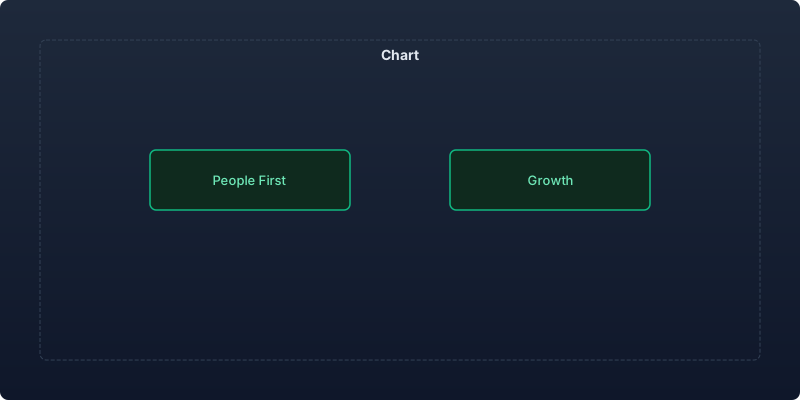
Phase 2: Expand (widen their sense of what's possible)
Most people's career imagination is limited by what they've seen. If they've only worked in one kind of team, with one kind of leadership structure, doing one kind of work — they literally don't know what else exists.
This is where you, as a leader with broader context, can be incredibly valuable. Not by prescribing a path, but by painting pictures of possibilities they haven't considered.
Things I share in this phase:
- "There's a role I've seen at some companies called a 'staff engineer' that's different from what you might think — let me describe what it looks like in practice."
- "I know someone who moved from backend engineering into developer experience. Would you be interested in hearing about their path?"
- "Based on what you just told me about loving system design, you might find platform engineering really fulfilling. Want me to tell you what that world looks like?"
- "Have you considered that the things you do naturally — mentoring, explaining complex things simply, bridging between teams — are actually skills that some people build entire careers around?"
I'm not telling them what to do. I'm expanding the menu they're ordering from.
Phase 3: Enable (create conditions for growth)
Once you've explored what energizes someone and expanded their sense of what's possible, the practical question is: "How do we create opportunities for them to move in a direction that excites them?"
This is where your power as a leader matters most. You control (or influence):
- What projects get assigned to whom
- Who gets exposure to senior leadership
- Which cross-team collaborations happen
- Who represents the team at conferences or working groups
- What kind of work is recognized and rewarded
- What training budgets get spent on
The best career development doesn't happen in a conversation — it happens in the opportunities that follow the conversation. When you give someone a stretch project that aligns with the energy you identified in Phase 1 and the possibilities you discussed in Phase 2, you're actually enabling growth rather than just talking about it.
Career Conversations for Different Stages
The conversation looks different depending on where someone is:
Early career (0-3 years)
These folks often don't know what they don't know. They might not have enough experience to identify patterns in what energizes them.
Focus on: broad exposure, helping them develop a sense of their strengths, normalizing that not knowing your path is normal at this stage.
Key question: "What have you tried so far that you'd want more of?"
Mid-career (3-7 years)
These engineers are often at an inflection point. They're technically strong and now facing choices about specialization, breadth, management, or something else entirely.
Focus on: expanding their imagination, connecting them with people in roles they're curious about, creating safe experiments (can they try leading a project before committing to management?).
Key question: "If you could design your role from scratch — same company, same team — what would it look like?"
Senior/Staff (7+ years)
These people often have clarity about what they value but may feel stuck or pigeonholed. They might be looking for meaning and impact beyond just technical problems.
Focus on: organizational influence, cross-functional impact, mentoring others, finding the unique contribution only they can make.
Key question: "What would need to be true about your work for you to feel genuinely proud when you look back in ten years?"
The Conversations Nobody Has (But Should)
Here are some career conversation topics that I've found profoundly valuable but that most managers never touch:
"What are you afraid of?" — Understanding someone's fears reveals what's holding them back from the growth they want. Fear of public speaking. Fear of failure. Fear of being found out as "not technical enough." These are real barriers that compassionate coaching can address.
"What does success look like outside of work?" — Someone who's about to start a family has different career needs than someone training for a marathon. Understanding the whole person helps you support growth that fits their life, not just their resume.
"What would you do if you weren't here?" — This isn't a trick question or a loyalty test. It reveals what someone values. "I'd start a company" tells you they want ownership and autonomy. "I'd teach" tells you they value knowledge sharing. "I don't know" tells you they might need more exploration.
"What have you outgrown?" — Sometimes people are ready for change but haven't named it yet. Asking what no longer challenges them can surface readiness for the next step.
Making It Ongoing, Not Annual
The worst thing you can do is have one big career conversation per year and then ignore the topic for eleven months. Growth doesn't work on an annual schedule.
My approach:
- Monthly: A few minutes in a one-on-one to check in on growth. "How are you feeling about your development? Anything you're wanting more of?"
- Quarterly: A dedicated 45-minute career conversation. Pull up your notes from last time. Revisit what was discussed. Celebrate progress. Adjust direction.
- As opportunities arise: "Hey, there's a cross-team project coming up that touches on the platform work you said you were curious about. Would you want to be our representative?"
The last one is the most important. Real career development happens in the moments between formal conversations — when you see an opportunity and think of the right person, when you make an introduction, when you advocate for someone in a room they're not in.
Your Role: Gardener, Not Architect
I used to think career development was about helping people build a clear plan and execute it. Now I think it's more like gardening: you create the conditions for growth, you provide nourishment and support, you remove obstacles — but you don't get to decide what shape the plant takes.
Some of the best outcomes I've been part of were entirely unexpected. The backend engineer who discovered a passion for developer relations. The junior developer who became an incredible engineering manager. The senior architect who stepped back to a smaller role because they wanted more time to mentor.
None of these were "planned." But they were all enabled by conversations that started with curiosity and continued with genuine support.
Your job isn't to have all the answers about someone's career. Your job is to care enough to keep asking good questions, to see potential they can't see in themselves yet, and to use your position to create opportunities for them to discover what brings them alive.
That's the career conversation that matters. Not the one with the five-year plan. The one where someone leaves feeling seen, supported, and excited about possibilities they hadn't imagined before they sat down.
Have that conversation. Have it often. Watch what unfolds.
Recommended reading
The Legacy of Leadership: What Remains When You Leave
The thing people remember is not your architecture. It is not your processes. It is how you made them feel. Reflections on what actually endures from engineering leadership.
What 3 A.M. Incidents Taught Me That AWS Certifications Never Did
Twenty production incidents reviewed: why understanding beats fixing, what certifications actually train, and the habits that keep a team calm at 3 a.m.
An Engineering Leader's Sustainable Weekly Rhythm
A realistic weekly rhythm that balances strategy, people, and operational work — without burning out or losing yourself in back-to-back meetings.



Comments
No comments yet. Be the first to share your thoughts.