I Reviewed 400 CVs to Hire 5 Engineers in Qatar. Here''s What Stood Out
One quarter of hiring in Doha: the funnel numbers, the signals that predicted great engineers, the red flags that never failed, and what did not matter.

Last quarter we opened five engineering roles at Rafeeq. Four hundred applications later, five offers were signed, nobody declined, and I personally read every CV that made it past the first filter. This is what the process taught me about hiring in the Gulf, and what I now look for in the first thirty seconds of reading a CV.
The funnel, honestly
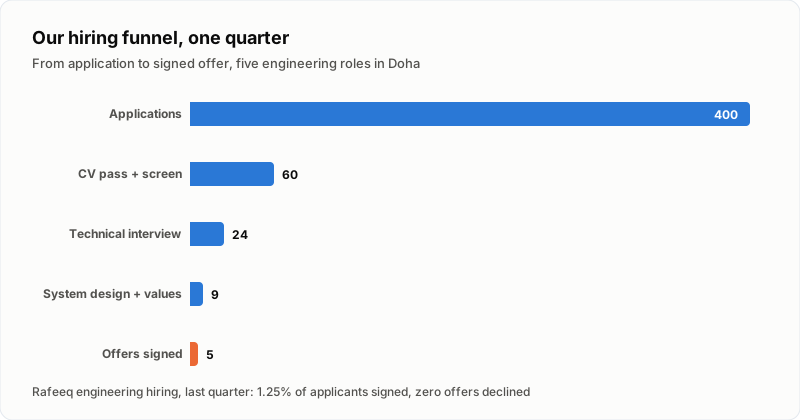
That is a 1.25% conversion rate, which sounds brutal until you see why. Roughly half of the 400 applications had no connection to the role at all. Of the serious half, most fell at the same few hurdles, and those hurdles are the useful part of this article.
What made candidates stand out
- Evidence of things running in production. Not "built a React app" but "this is live, here is the link, it has 300 users and here is what broke last month." One candidate walked me through a side project's Postgres slow-query log. She got an offer.
- Incident stories told with ownership. The best candidates could describe an outage they caused or fixed, what they changed afterward, and what they still do not know. The word "we" for credit and "I" for mistakes is a remarkably reliable signal.
- Specifics instead of adjectives. "Reduced API p95 from 800 ms to 220 ms by adding a Redis cache and fixing an N+1 query" beats "performance optimization expert" every single time. Numbers are how engineers tell the truth.
- Questions that showed they were choosing us too. The strongest candidates interviewed us back: about on-call load, deployment frequency, how decisions get made. People who ask nothing usually leave within a year.
The red flags that never failed
- Keyword soup. Forty technologies listed, none with context. Nobody is senior in twelve databases.
- Framework tourism. Every job change tracked whatever was trendy that year, with no depth anywhere. Fine for year two of a career, worrying for year eight.
- Blaming every previous employer. One bad company is bad luck. Four is a pattern that will soon include us.
- CV claims that dissolved under one follow-up question. "Led the migration" becoming "was on the team that watched the migration" in one sentence. We stopped the interview politely, twice, for this.
What genuinely did not matter
This is the part that surprises people:
| Signal | Predictive value we observed |
|---|---|
| Production war stories with numbers | Very high |
| Quality of questions asked to us | High |
| Code exercise on realistic problems | High |
| University prestige | Low |
| Number of certifications | Low |
| Years of experience beyond ~4 | Surprisingly low |
Certifications tell me someone can study, which is not nothing. But the correlation between certificate count and interview performance in our data was effectively zero. Meanwhile the correlation between "has debugged production at 2 a.m." and interview performance was the strongest signal we had.
Hiring in Qatar, specifically
A few things are different here, and pretending otherwise wastes everyone's time:
- Relocation honesty up front. Most of our pipeline is international. We state salary range, housing reality, and visa timeline in the first call. Candidates who discover Doha's cost of living at the offer stage do not sign, so surface it in week one, not week five.
- Visa timelines shape the process. From signed offer to first day is often six to ten weeks for international hires. Plan roles a quarter ahead, because "we need someone next month" is not a thing.
- The market is smaller and remembers. Treat a rejected candidate badly and three future candidates hear about it. We send personal rejection notes past the technical stage, with real feedback. Two people we rejected referred friends we later hired.
What I'd tell other hiring managers
Write the CV filter down and score against it, because gut feel degrades exactly when application volume rises. Put a realistic problem in the technical round, not puzzles: ours is a simplified version of our actual dispatch problem, and it predicts job performance better than anything algorithmic ever did. And move fast at the end: all five of our signed offers went out within 48 hours of the final interview. Good engineers in this market have three conversations running. Speed is respect.
Four hundred CVs taught me less about candidates than it did about us. The clearer we became about what actually matters, the shorter this article's first section got, and the better the people who joined.
Recommended reading
The Legacy of Leadership: What Remains When You Leave
The thing people remember is not your architecture. It is not your processes. It is how you made them feel. Reflections on what actually endures from engineering leadership.
What 3 A.M. Incidents Taught Me That AWS Certifications Never Did
Twenty production incidents reviewed: why understanding beats fixing, what certifications actually train, and the habits that keep a team calm at 3 a.m.
An Engineering Leader's Sustainable Weekly Rhythm
A realistic weekly rhythm that balances strategy, people, and operational work — without burning out or losing yourself in back-to-back meetings.



Comments
No comments yet. Be the first to share your thoughts.