Kiro Is the DevOps Engineer I Didn''t Know I Needed
AWS''s agentic IDE became our platform team''s strongest member: Terraform, IAM, CI/CD, runbooks, and real coding skills, with production use cases.

Every engineering team has a wish: one more DevOps engineer. Someone who knows AWS deeply, writes clean Terraform, never gets bored of IAM policies, and is somehow available at 2 a.m. We stopped wishing. We gave that job to Kiro, AWS's agentic IDE, and after a year of production use I can describe exactly what it's good at — and where it still needs a human watching.
What makes it different
Kiro isn't autocomplete. Its core idea is spec-driven development: you describe what you want, it turns that into requirements, a design, and a task list, then works through the tasks while you watch, redirect, or take over. For DevOps work, where the job is mostly translating intent into large amounts of precise configuration, that model fits perfectly.
It also has agent hooks: event-driven automations in the IDE. Ours run tests when a handler changes, regenerate docs when an API schema moves, and lint Terraform on every save. Small things, compounding daily.
The third differentiator is steering files — markdown documents in the repo that teach Kiro your conventions. We have steering files for our naming standards, tagging requirements, and security policies. When Kiro generates Terraform, it already knows we use module. prefixes, require team and environment tags, and encrypt everything by default. Zero prompting needed.
The use cases that earn its keep
- Infrastructure as Code, end to end. "Create the Terraform for a new SQS-driven Lambda service with a DLQ, alarms, and our tagging standard" produces a module that matches our conventions, because Kiro reads the repo's existing patterns first. What took an afternoon takes a review.
- IAM, the least-loved job in the cloud. Least-privilege policies, debugging
AccessDeniedchains across roles and resource policies, explaining why a permission fails. This alone changed our security posture: engineers stopped copy-pasting*because the right policy became the easy path. - CI/CD pipelines. New service pipelines (build, test, scan, deploy, rollback) generated from our golden template and adapted per stack (GitHub Actions or CodePipeline).
- Incident support. Feed it a CloudWatch alarm and the service repo; it drafts the runbook, the dashboard, and the fix PR. During our emergency region migration, it generated cutover runbooks for 54 of 63 services.
- Cost housekeeping. "Find unattached EBS volumes, oversized instances, and gp2 that should be gp3, then draft the change set." A monthly ritual now measured in minutes.
- Documentation that stays current. Architecture decision records, API docs, and runbooks generated directly from the code. When the code changes, the docs change in the same PR.
The hours, from our internal tracking:
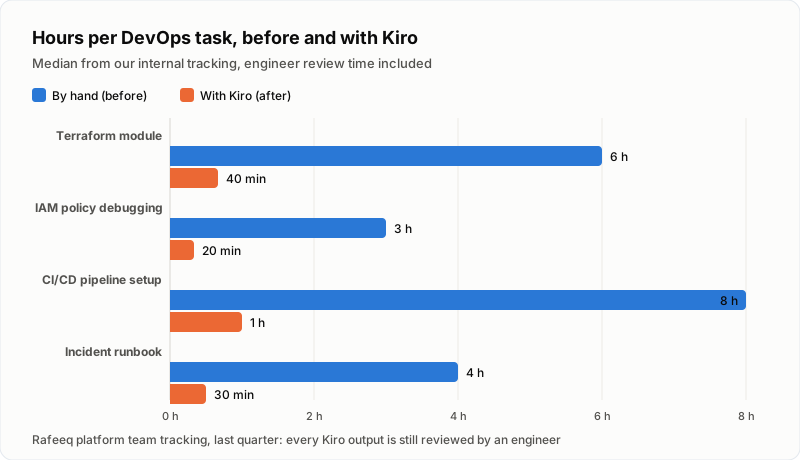
Total time saved per week across the platform team: 32 hours. That's the equivalent of almost one full-time engineer's output, without the hiring timeline or salary.
And it genuinely codes
Calling Kiro a DevOps tool undersells it. It's a full coding agent: it refactors across files, writes the tests it just made necessary, chases a bug through three services, and documents what it changed. Our platform team uses it for the Go and TypeScript glue that holds infrastructure together: custom operators, Lambda functions, migration scripts. The spec-first workflow means the code arrives with its reasoning attached, which makes review faster than reading a colleague's surprise PR.
Where it really shines is multi-file changes. Renaming a service across Terraform, CI/CD configs, monitoring dashboards, and documentation — Kiro does this in one pass where a human would context-switch across 15 files and inevitably miss one.
The rules we follow
Same rules as any powerful teammate:
- Review everything. Kiro drafts; an engineer approves. IAM and anything touching money get a second human.
- Scoped credentials. The agent works with the permissions of the engineer driving it, never an admin role of its own.
- Specs beat vibes. Ten minutes writing a clear spec saves an hour steering a vague one.
- Never bypass pre-commit hooks. Kiro respects our linting, security scanning, and test gates. If a hook fails, the agent fixes the issue — it doesn't skip the hook.
- Audit trail. Every change Kiro makes is in a commit with full context. We never accept "the AI did it" as an explanation in review.
What it's not good at (yet)
Honest assessment of the gaps:
- Novel architecture decisions. If you're choosing between ECS and EKS for a new workload, Kiro will give you a well-reasoned answer, but it won't have the organizational context of why your team chose one before. Steering files help, but they can't capture everything.
- Cross-team coordination. It doesn't know that the networking team is in the middle of a VPC redesign, or that the security audit is next week. Humans still own the timeline.
- Cost intuition. It can find waste, but it can't tell you "this architecture choice will cost $40K more next year" unless you've taught it your pricing model.
The real impact
A year in, the honest summary: Kiro didn't replace our DevOps engineers; it turned every engineer into one. The platform team stopped being a ticket queue and started being architects. That's the trade you want.
Before Kiro, infrastructure changes went into a backlog and waited 2-3 sprints. Now, the engineer who needs a new service creates it themselves, with Kiro handling the Terraform, IAM, and CI/CD while they focus on the business logic. The platform team reviews rather than writes.
If you're evaluating AI-assisted infrastructure tooling, my advice: don't measure it by "did it write correct Terraform." Measure it by "did engineers stop waiting for the platform team." That's the metric that compounds.
Recommended reading
The State of Agentic AI in 2026: Capabilities, Limitations, and Production Readiness
Comprehensive analysis of agentic AI in 2026 covering production capabilities, current limitations, and enterprise readiness benchmarks with real deployment data.
Observability for AI Agents: Tracing Multi-Step Reasoning Chains in Production
How to implement production observability for AI agents including distributed tracing, reasoning chain analysis, and debugging multi-step failures.
Measuring and Reducing AI Workload Carbon Emissions: A Practical Engineering Guide
Building a carbon-aware scheduling system for ML training and inference workloads that reduced our AI infrastructure emissions by 42% while maintaining SLA commitments.



Comments
No comments yet. Be the first to share your thoughts.