Refactoring Monorepos Safely with Kiro and AI-Guided Dependency Analysis
How Kiro maps implicit dependencies across monorepo packages and guides safe refactoring without breaking downstream consumers.

Refactoring Monorepos Safely with Kiro and AI-Guided Dependency Analysis
Monorepos promise simplified dependency management and atomic cross-package changes. In practice, they often become a different kind of mess: implicit dependencies that no package.json tracks, shared utilities that fifty services import differently, and the ever-present fear that renaming a function in package A will silently break packages B through Z. Our monorepo had grown to 127 packages over four years. Refactoring anything non-trivial required a full-time archaeologist.
Kiro transformed our approach to monorepo maintenance by providing AI-guided dependency analysis that maps not just explicit imports but implicit coupling — shared type assumptions, convention-based contracts, and runtime dependencies that static analysis tools miss.
The Monorepo That Grew Teeth
Our monorepo started as a sensible architecture decision. Shared libraries, consistent tooling, atomic commits across services. By year four, it had become something else:
- 127 packages with varying levels of maintenance
- ~340 cross-package imports that the package graph showed, plus an estimated 200+ implicit dependencies
- Build times of 45 minutes because the dependency graph made it impossible to determine safe build boundaries
- Average refactoring PR size: 47 files across 12 packages
The implicit dependencies were the real killer. A utility package exported a formatDate function that 23 services used. But those services also depended on its specific error-throwing behavior, its locale handling, and its treatment of null inputs — none of which were part of any documented contract. Changing the function's behavior was technically a non-breaking change to its type signature, but practically broke half the monorepo.
How Kiro Maps Implicit Dependencies
Kiro analyzes your codebase beyond import statements. It reads through test files, error handling patterns, and actual usage patterns to build a comprehensive dependency map that includes behavioral coupling.
We pointed Kiro at our @shared/utils package and asked it to analyze the refactoring impact of splitting it into focused packages:
## Kiro Analysis: @shared/utils Decomposition

### Package: @shared/utils/formatDate

**Explicit consumers**: 23 packages (via import)
**Implicit behavioral dependencies detected**:
- 8 packages catch and re-throw DateFormatError (coupling to error type)
- 5 packages pass null and expect empty string return (undocumented behavior)
- 3 packages depend on en-US locale default (not in type signature)
- 12 packages import alongside parseDate (co-usage pattern suggests
  these should remain in same sub-package)

**Recommended split**:
- @shared/date-formatting (formatDate, parseDate, DateFormatError)
- Breaking change risk: MEDIUM (null-handling behavior should be
  explicitly documented before split)

### Migration steps (ordered by risk):
1. Add explicit null handling to formatDate signature
2. Add tests in consuming packages for current null behavior
3. Extract to new package with re-export from original
4. Migrate consumers package-by-package
5. Remove re-export after all consumers migrated
This analysis would have taken an engineer 2-3 days of manual code archaeology. Kiro produced it in minutes by tracing actual usage patterns, test assertions, and error handling across the entire monorepo.
Safe Refactoring with Generated Migration Plans
Once Kiro identifies the dependency landscape, it generates step-by-step migration plans with rollback points. Here is the migration plan it generated for extracting our authentication middleware into a standalone package:
// Step 1: Create the new package with identical interface
// packages/auth-middleware/src/index.ts

export { authenticate } from './authenticate';
export { authorize } from './authorize';
export { AuthError, ForbiddenError } from './errors';
export type { AuthContext, Permission, Role } from './types';

// Step 2: Re-export from original location (zero consumer changes)
// packages/shared-middleware/src/auth.ts

// @deprecated - Import from @company/auth-middleware instead
export * from '@company/auth-middleware';

// Step 3: Kiro-generated codemod for consumer migration
// codemods/migrate-auth-imports.ts
import { API, FileInfo } from 'jscodeshift';

export default function transform(file: FileInfo, api: API) {
  const j = api.jscodeshift;
  const root = j(file.source);

  // Find imports from the old path
  root
    .find(j.ImportDeclaration, {
      source: { value: '@company/shared-middleware/auth' },
    })
    .forEach((path) => {
      path.node.source.value = '@company/auth-middleware';
    });

  return root.toSource();
}
Kiro also generated the test commands to validate each step:
# Validate Step 1: New package builds and passes its own tests
npx nx run auth-middleware:build
npx nx run auth-middleware:test

# Validate Step 2: All existing consumers still pass
npx nx affected:test --base=main

# Validate Step 3: Codemod produces valid output
npx jscodeshift --dry --print -t codemods/migrate-auth-imports.ts \
  packages/*/src/**/*.ts | head -50

# Validate Step 4: Full build after migration
npx nx run-many --target=build --all
Before and After: Refactoring Velocity
| Metric | Before Kiro | After Kiro | Improvement |
|---|---|---|---|
| Time to map dependencies for refactor | 2-3 days | 15-30 minutes | 95% reduction |
| Average refactoring PR review cycles | 3.8 | 1.4 | 63% reduction |
| Post-refactor bugs (within 2 weeks) | 4.2 per refactor | 0.6 per refactor | 86% reduction |
| Packages successfully extracted/quarter | 2-3 | 8-12 | 4x increase |
| Build time after dependency cleanup | 45 min | 18 min | 60% reduction |
The build time improvement deserves emphasis. By correctly mapping dependency boundaries, we could finally configure our build system to skip unaffected packages. The implicit dependencies that previously forced full rebuilds were now explicit — and in many cases, eliminated entirely.
Handling the Hard Cases: Circular Dependencies
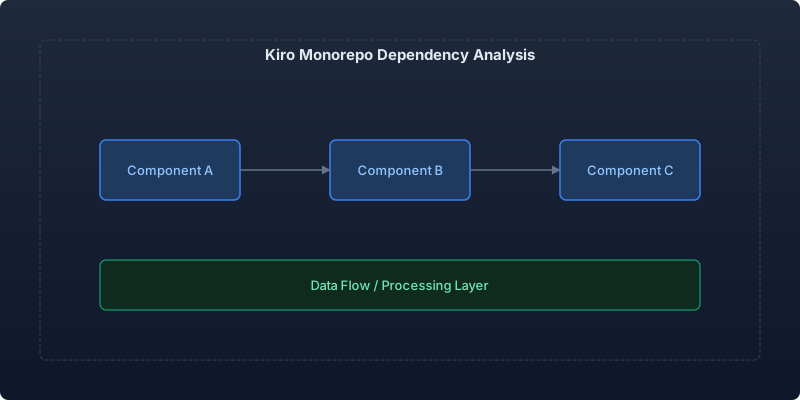
Kiro excels at identifying and resolving circular dependencies that humans struggle to untangle. Our monorepo had 7 circular dependency cycles, some spanning 4-5 packages. Kiro analyzed each cycle, identified the minimum set of interfaces that needed extraction to break the cycle, and generated the extraction plan.
For a cycle between @company/orders, @company/payments, and @company/notifications:
Circular dependency detected:
  orders → payments (for refund processing)
  payments → notifications (for payment confirmations)
  notifications → orders (for order status in notification templates)

Resolution: Extract @company/order-types (interfaces only)
  - Move OrderStatus, OrderSummary types to new package
  - notifications depends on order-types (not orders)
  - Cycle broken with 2 file moves, 0 behavior changes
This kind of analysis — identifying the minimum extraction set — is exactly the type of structural reasoning that takes experienced engineers hours and Kiro minutes.
Confidence Through Verification
The critical difference between Kiro-guided refactoring and manual refactoring is confidence. Every migration step Kiro generates includes verification commands. Every dependency it identifies comes with the evidence (specific file paths, line numbers, and usage patterns) that substantiates the claim.
Engineers no longer need to hold the entire dependency graph in their heads. They can trust Kiro's analysis, verify each step incrementally, and ship refactoring PRs that reviewers can approve with confidence because the impact is fully mapped.
Conclusion
Monorepo refactoring used to be the kind of work that only the most senior engineers attempted, and even they approached it with trepidation. Kiro democratizes this work by providing the dependency intelligence that previously required deep institutional knowledge. Junior engineers can now execute complex refactoring safely because Kiro has mapped the terrain and generated the migration path.
For engineering leaders managing growing monorepos, the strategic value is clear: you can maintain architectural health without dedicating your most experienced engineers to full-time code archaeology. The monorepo stays a benefit rather than becoming a liability.
Recommended reading
The State of Agentic AI in 2026: Capabilities, Limitations, and Production Readiness
Comprehensive analysis of agentic AI in 2026 covering production capabilities, current limitations, and enterprise readiness benchmarks with real deployment data.
Observability for AI Agents: Tracing Multi-Step Reasoning Chains in Production
How to implement production observability for AI agents including distributed tracing, reasoning chain analysis, and debugging multi-step failures.

Measuring and Reducing AI Workload Carbon Emissions: A Practical Engineering Guide
Building a carbon-aware scheduling system for ML training and inference workloads that reduced our AI infrastructure emissions by 42% while maintaining SLA commitments.



Comments
No comments yet. Be the first to share your thoughts.