Letting Go of Technical Control as a Leader
The hardest lesson in engineering leadership: your team will do it differently than you would, and that's not just okay — it's the whole point.

I rewrote my engineer's pull request on a Saturday night.
I told myself it was because the approach had "architectural issues." That the patterns weren't quite right. That if we merged it as-is, we'd accumulate tech debt we'd regret later.
But here's the truth I wasn't ready to admit: the code was fine. It just wasn't how I would have written it. And somewhere in my brain, "different from what I'd do" had become synonymous with "wrong."
That engineer — a talented mid-level developer who'd spent four days on the feature — came in Monday morning to find his PR closed and replaced with my version. He didn't say anything. He just pulled it down, reviewed it, and marked it approved. But something changed between us that day. The enthusiasm dimmed. The creative proposals stopped. He became someone who waited for my direction instead of someone who took initiative.
It took me months to understand what I'd done. I hadn't just rewritten some code — I'd communicated that his judgment wasn't trusted, that his approach didn't matter, that he was hands to execute my vision rather than a mind with valuable perspectives of his own.
That was the most expensive Saturday night of my leadership career.
Why Control Feels So Natural
Let's be compassionate about this: the urge to maintain technical control isn't a character flaw. It's a completely understandable response to how most of us became leaders in the first place.
We got promoted because of our technical excellence. For years, our value came from knowing the right answer, building the right solution, catching the problems others missed. That pattern was reinforced hundreds of times. Of course it's hard to let go.
And there's a legitimate fear underneath it: "If the architecture goes in a direction I wouldn't choose, and something breaks, I'll be responsible for a mess I didn't create." That fear isn't irrational. It's just not a good enough reason to strangle your team's autonomy.
Here's what I've learned about why leaders struggle with this:
| What we tell ourselves | What's actually happening |
|---|---|
| "The quality will drop" | We're conflating "different" with "worse" |
| "I'm preventing tech debt" | We're preventing learning and ownership |
| "Nobody else sees the full picture" | We haven't shared the full picture |
| "It's faster if I just do it" | We're optimizing for this week at the cost of next year |
| "The team isn't ready" | We haven't given them the chance to become ready |
The Real Cost of Not Letting Go
When a leader maintains tight technical control, the damage compounds:
Your team stops growing. Engineers who are never trusted with meaningful decisions don't develop decision-making skills. You end up with a team of experienced people who act like they need permission for everything — because they do.
You become a bottleneck. Every decision waiting for your review, every design needing your blessing, every PR requiring your approval. You've created a system that literally cannot scale beyond your personal bandwidth.
People leave. Strong engineers don't want to be code typists. They want ownership, agency, and the opportunity to shape technical direction. If they can't get that on your team, they'll find a team where they can.
You burn out. Maintaining control over everything is exhausting. You're doing your job and part of everyone else's. This is not sustainable, and it's not what leadership is.
Innovation dies. Your team will never surprise you with a better approach if they're always building to your specification. The ceiling of your team becomes your own imagination — and one brain is always limited compared to many.
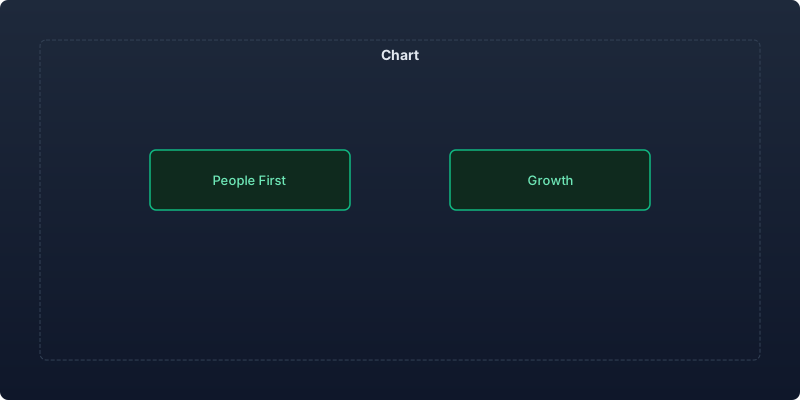
The Letting Go Framework
Here's the progression I've used to gradually release control without throwing my team into chaos:
Level 1: Outcome delegation (not task delegation)
Instead of telling someone how to build something, tell them what needs to be true when it's done.
Before: "Build this using the repository pattern with interfaces for each data source, use dependency injection, and make sure there's a caching layer using Redis."
After: "We need this to handle 1000 requests per second, be testable without a live database, and not add more than 50ms of latency. Here are the constraints — how would you approach it?"
The second version gives them a clear target while leaving the path open. They might choose a different pattern than you would. And that's fine. If it meets the requirements, the implementation details are their decision.
Level 2: Decision-making with context
Share the "why" behind your instincts. When you'd normally say "use Redis here," instead say: "In the past, we've struggled with response times when the database is under load. How are you thinking about keeping this fast under heavy traffic?"
This gives them your context and experience without dictating the solution. They might choose Redis. They might choose something better that you hadn't considered.
Level 3: Let them make decisions you disagree with
This is the hardest level. There will come a time when your engineer proposes an approach you wouldn't choose, and you need to let them proceed anyway.
The key question is: "Is this approach harmful, or just different?"
If it's harmful — it will create security vulnerabilities, data loss risks, or unmaintainable complexity — that's a legitimate reason to intervene. Not as a dictator, but as a mentor: "Here's a concern I have about this approach. Can we talk through how you'd handle [specific scenario]?"
If it's just different — it uses patterns you don't prefer, or structures code in a way that's unfamiliar to you — let it go. Seriously. Let it go. They might be right. And even if it's slightly less optimal than your approach, the ownership and learning they gain is worth more than the marginal improvement you'd get from overriding them.
Level 4: Let them fail safely
Some lessons can only be learned by experiencing the consequences. A design that seems clean but doesn't scale well under production load. A testing strategy that misses an edge case category. An architecture choice that makes the next feature harder.
Your job isn't to prevent all failures — it's to ensure failures happen in safe contexts where the cost is learning rather than catastrophe. Create sandbox environments. Scope high-risk experiments to limited blast radius. Set up checkpoints where you can course-correct if something's going genuinely wrong.
How I Do Code Review Differently Now
I used to review code by asking: "Is this how I would have written it?" Now I ask:
- Does it work correctly? (Functional requirements met)
- Is it maintainable? (Could another engineer understand and modify this?)
- Does it follow our team's agreed-upon standards? (Not my personal preferences — the team's shared norms)
- Are there risks they might not have considered? (Security, performance, edge cases)
If the answer to all four is yes, I approve it — even if I'd have structured it differently. My preferences are not standards. I have to remind myself of this regularly.
When I do have suggestions, I frame them as optional learning opportunities: "Here's an alternative approach you might want to consider for future situations like this. Not blocking — just sharing a pattern I've found useful."
The Conversation With Your Team
If you've been a controlling leader and want to change, be honest with your team. They've adapted to your style — they won't automatically change just because you internally decided to loosen your grip.
I had this conversation with my team: "I've realized I've been too controlling with technical decisions, and I think it's holding you back. I want to change this. Going forward, I'm going to be more intentional about letting you own the how. If I slip back into old patterns — and I will, because habits are hard — please call me on it. I give you explicit permission to say 'Is this something you need to decide, or something I can own?'"
That conversation was uncomfortable. But it worked. Slowly, over months, my team started taking more ownership. They made some decisions I didn't love. And the team got dramatically better.
What Remains Your Job
Letting go of control doesn't mean abdicating responsibility. Here's what stays firmly in your domain:
- Setting technical vision and direction — the big picture, the multi-year trajectory
- Defining constraints and requirements — what must be true, not how to make it true
- Establishing team standards and practices — collaboratively, not unilaterally
- Mentoring and developing technical judgment — helping people think, not telling them what to think
- Making irreversible or high-stakes decisions — the ones where the cost of getting it wrong is very high
- Creating the environment for good decisions — documentation, design review processes, knowledge sharing
The Moment It Clicks
There's a moment — and you'll recognize it when it happens — where your team builds something better than you would have. Where the solution is more elegant, more robust, more creative than what you'd have designed alone. Where you look at it and think, "I never would have thought of this."
That moment is the reward for letting go. Not just that the team built something great, but that you created the conditions for greatness you couldn't have produced yourself.
When I look at the systems my current team has built, at least 60% of the architectural decisions are ones I wouldn't have made. And the systems are better for it. Diverse approaches, diverse thinking, diverse experiences — all contributing to something richer than any single person's vision.
That Saturday night when I rewrote my engineer's PR? The code I wrote was maybe 10% "better" by some abstract measure. But the cost was his engagement, his growth, his sense of ownership. It was the worst trade I've ever made.
Your team's slightly-different approach, built with full ownership and engagement, will always outperform your "perfect" approach imposed from above. Always.
Let go. Trust them. Watch what happens.
Recommended reading
The Legacy of Leadership: What Remains When You Leave
The thing people remember is not your architecture. It is not your processes. It is how you made them feel. Reflections on what actually endures from engineering leadership.
What 3 A.M. Incidents Taught Me That AWS Certifications Never Did
Twenty production incidents reviewed: why understanding beats fixing, what certifications actually train, and the habits that keep a team calm at 3 a.m.
An Engineering Leader's Sustainable Weekly Rhythm
A realistic weekly rhythm that balances strategy, people, and operational work — without burning out or losing yourself in back-to-back meetings.



Comments
No comments yet. Be the first to share your thoughts.