Managing Distributed Engineering Teams Across Time Zones
Practical strategies for leading engineering teams spread across multiple time zones without burning out your people or sacrificing collaboration quality

When I first managed a team spanning San Francisco, London, and Bangalore, I made the naive mistake of scheduling "compromise" meetings at times that were bad for everyone. 7 AM Pacific, 3 PM London, 8:30 PM Bangalore. Nobody was happy, nobody was alert, and the meetings produced worse outcomes than if we'd just used a shared document.
Managing across time zones isn't about finding compromise times. It's about redesigning how work flows so that synchronous overlap is used surgically for what truly requires it, and everything else happens asynchronously by default.
The Overlap Problem
Most distributed teams have limited synchronous overlap. Understanding your actual overlap is the first step:
| Team Configuration | Usable Overlap | Challenge |
|---|---|---|
| US + Europe (5-6 hour gap) | 3-4 hours | Europe's afternoon = US's morning |
| US + India (10-13 hour gap) | 1-2 hours | Requires one side to flex |
| Europe + APAC (7-9 hour gap) | 1-2 hours | Early morning or late evening |
| US + Europe + APAC | ~0 hours all-together | No single time works for everyone |
When you have zero all-team overlap (which is common for truly global teams), you need a fundamentally different operating model than what works for co-located or single-timezone teams.
The Follow-the-Sun Model
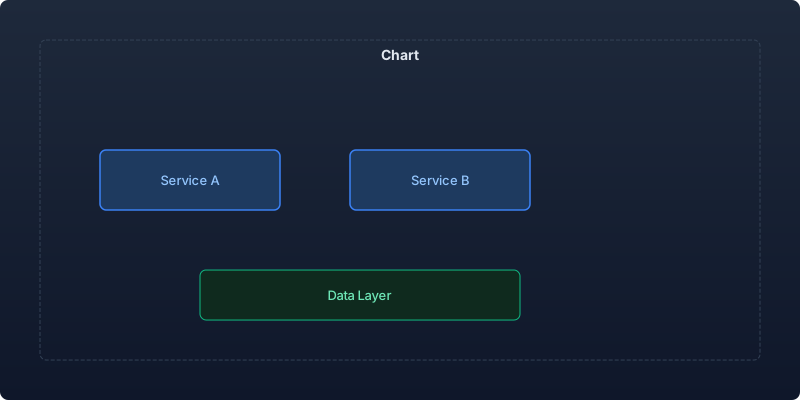
My most effective distributed team operated on a "follow-the-sun" model. Instead of trying to sync everyone simultaneously, work flowed from one region to the next:
APAC starts the day working on items, documenting progress and blockers before their end of day.
Europe picks up where APAC left off, advances the work, and hands off to Americas.
Americas continues, and by their end of day, APAC starts again with full context from both regions.
This requires one non-negotiable practice: excellent handoff documentation. Every work-in-progress item needs a written status update at the end of each region's day. Not "worked on feature X" but "completed the database schema changes, PR #456 is ready for review, blocked on the API response format decision—options documented in RFC-23."
Scheduling Principles
When synchronous time is necessary, I follow these principles:
Rotate the burden: No single region should always take the inconvenient meeting time. If US-India meetings alternate between early morning US and late evening India, each side shares the sacrifice.
Consolidate sync time: Rather than scattering meetings throughout the week, bundle them into "sync windows." Our team had two sync windows: Tuesday 9 AM Pacific (covering US-Europe overlap) and Thursday 8 PM Pacific (covering US-India overlap).
Make sync time high-value: When you only have 1-2 hours of overlap, you can't waste it on status updates. Sync time is exclusively for decisions that are blocked on async discussion, relationship building, and celebrations.
Record everything: Every synchronous meeting is recorded with notes. If someone couldn't attend due to timezone, they can catch up asynchronously.
Decision-Making Across Zones
The biggest challenge in distributed teams is decision-making speed. If every decision requires synchronous discussion, progress crawls because you're limited to overlap hours. Here's my decision-making framework:
Tier 1 - Individual decisions: Any engineer can make these immediately without consulting others. Examples: implementation approach within a ticket, code structure decisions, local refactoring.
Tier 2 - Regional team decisions: The engineers in one timezone make these together during their working hours. Examples: sprint task ordering, pair programming assignments, local architecture within their services.
Tier 3 - Cross-team async decisions: Written proposals with 48-hour review windows. Examples: API contract changes, shared library modifications, cross-team dependencies.
Tier 4 - Cross-team sync decisions: Reserved for overlap hours. Examples: major architectural direction, interpersonal conflicts, planning commitments.
Most decisions should be Tier 1 or 2. If too many decisions require Tier 3 or 4, your team's architecture has too many cross-team dependencies.
Documentation as the Equalizer
In a distributed team, documentation quality determines whether non-overlapping team members are first-class participants or second-class citizens. I invest heavily in documentation culture:
- Decision logs: Every significant decision is documented with context, options considered, and rationale
- Running project status: Updated daily, accessible anytime, with explicit "for [region]" callouts when something needs their attention
- Recorded video walkthroughs: For complex features or architectural changes, a 10-minute video explanation that async team members can watch
- Async standups: Written daily updates that each region posts at their start of day
- Working documents: Designs and proposals developed in shared docs with comment-based discussion
The rule: if it wasn't documented, it didn't happen. No hallway decisions, no verbal agreements, no "we discussed this on the call" without a written summary.
Building Culture Across Distance
The hardest part of distributed teams isn't coordination—it's culture and belonging. People in minority timezones (the single person in APAC on a mostly-US team) often feel isolated and excluded from the "real" team.
What I do to prevent this:
- Equal representation in leadership: If you have engineers in three regions, ensure at least one senior voice from each region is part of leadership discussions
- Regional team rituals: Each sub-team has their own social time that doesn't require anyone to be awake at odd hours
- Cross-timezone pairing rotation: Engineers regularly pair with someone from another region, building 1:1 relationships across the distance
- In-person meetups: Budget for quarterly in-person time. Two days together builds more trust than months of video calls
- Timezone awareness in Slack: We display local time in profiles so people instinctively know when they're pinging someone at midnight
Handling Urgent Issues
Production incidents don't respect time zones. Here's our approach:
- Follow-the-sun on-call: Primary on-call rotates to whoever's in business hours. Nobody gets paged at 3 AM as the norm.
- Escalation paths by timezone: Clear documentation of who to escalate to during each region's hours
- Incident handoff protocol: When one region's on-call ends, they write a handoff summary for the next region's on-call
- Post-incident reviews: Scheduled during overlap hours so all affected parties can participate
This approach means nobody is regularly woken at night, which is essential for sustainable distributed work. The tradeoff is that incident resolution sometimes takes longer because of handoffs—but the quality of work from rested engineers more than compensates.
Common Mistakes I've Made
Lessons from my own failures managing across time zones:
- Assuming async skills: Not everyone is naturally good at written communication. Invest in coaching.
- Forgetting social isolation: The person working alone in their timezone needs extra intentional connection.
- Over-syncing US team while under-syncing with others: If your US sub-team meets daily but the global team only meets weekly, you've created an information asymmetry.
- Not adjusting meeting times seasonally: Daylight saving changes shift overlap windows. Review your schedule twice a year.
- Treating timezone as a disadvantage: Reframe it as a coverage advantage—your team can respond to issues during all business hours.
Key Takeaways
- Don't seek "compromise" meeting times—redesign work to minimize synchronous requirements
- Implement follow-the-sun workflows with excellent handoff documentation
- Rotate the timezone burden for necessary sync meetings—no single region always sacrifices
- Create a tiered decision-making framework that empowers local decisions without requiring cross-timezone sync
- Invest heavily in documentation as the equalizer between overlapping and non-overlapping team members
- Build culture through regional rituals, cross-timezone pairing, and in-person meetups
- Implement follow-the-sun on-call so nobody is regularly paged during sleeping hours
- Treat timezone spread as a coverage advantage, not just a coordination challenge
Distributed teams aren't harder—they're different. The practices that make co-located teams effective (spontaneous conversations, whiteboard sessions, lunch discussions) don't translate directly. But the practices that make distributed teams effective (clear documentation, intentional communication, autonomous decision-making) actually produce better engineering organizations regardless of location.
Recommended reading
The Legacy of Leadership: What Remains When You Leave
The thing people remember is not your architecture. It is not your processes. It is how you made them feel. Reflections on what actually endures from engineering leadership.

What 3 A.M. Incidents Taught Me That AWS Certifications Never Did
Twenty production incidents reviewed: why understanding beats fixing, what certifications actually train, and the habits that keep a team calm at 3 a.m.
An Engineering Leader's Sustainable Weekly Rhythm
A realistic weekly rhythm that balances strategy, people, and operational work — without burning out or losing yourself in back-to-back meetings.



Comments
No comments yet. Be the first to share your thoughts.