Promoting From Within vs. Hiring Senior: When to Grow Your Own Leaders
The hardest talent decision engineering leaders face — when to promote someone who has earned it versus bringing in outside experience that accelerates the team.

I still remember the look on Marcus's face when I told him we were hiring a Director of Engineering from outside. He'd been my tech lead for two years. He'd held the team together through a brutal migration, mentored three junior engineers into solid mid-levels, and stayed late more nights than I'd like to admit. He thought — reasonably — that he was next in line.
He didn't say much. Just nodded. Said "makes sense." But I could see something dim in his eyes. Within four months, Marcus was gone. Took a director role at a competitor. And the external hire? She lasted eight months before the culture mismatch became unbearable.
That was my most expensive leadership mistake. Not because of the recruiting costs or the backfill scramble — but because I lost someone irreplaceable by failing to see what was right in front of me.
The False Binary
Here's what took me years to understand: this isn't actually a binary decision. It's not "promote or hire." It's "what does this person need, what does this team need, and what does this moment need?"
Sometimes those three answers point in the same direction. Often they don't. And the hardest part of leadership is sitting with that tension instead of defaulting to whatever feels easiest.
The easy path is usually hiring external. You get a polished resume, impressive credentials, someone who's "done it before." It feels safe. It feels like you're being rigorous. But safe and rigorous aren't always the same thing as right.
When Promoting From Within Works Beautifully
Let me paint you a picture of when internal promotion is the obvious choice — even when it doesn't feel obvious at first.
They already have the trust. The single hardest thing for a new leader to build is trust. It takes months, sometimes a year. An internal candidate walks in with trust already banked. They know who's struggling quietly, who needs public recognition versus private praise, who's about to burn out. That contextual knowledge is worth more than any framework they could learn from a management book.
The team is stable and needs continuity. If your team is in a good rhythm — shipping reliably, morale is healthy, people are growing — the last thing you want is a new leader who "shakes things up" because that's what they think leaders are supposed to do. Sometimes the bravest move is continuity.
The candidate has demonstrated leadership already. Look for the signals: Do other engineers go to them with problems? Do they de-escalate conflicts naturally? Have they taken ownership of something messy without being asked? These are better predictors than interview performance.
Here's a framework I use now:
| Signal | Promote Internal | Hire External |
|---|---|---|
| Team trust level | High trust in candidate | Trust needs rebuilding |
| Current trajectory | Team growing steadily | Team needs direction change |
| Skills gap | Coachable in 3-6 months | Needs expertise now |
| Culture | Strong, needs preservation | Needs intentional shift |
| Candidate readiness | 70%+ ready | No viable internal candidate |
| Timeline pressure | Can afford ramp-up | Urgent capability needed |
When External Hiring Is the Right Call
I want to be honest: sometimes you genuinely need to hire from outside. Not because your people aren't good enough, but because the situation demands something specific.
You're entering territory nobody on the team has navigated. If you're scaling from 10 to 50 engineers and nobody on your team has done that before, you need someone who's lived through those growing pains. Not because your internal folks couldn't figure it out — but because the cost of learning on the job at that scale is often measured in people burning out or leaving.
The team needs a specific technical shift. When we pivoted from monolith to microservices, I needed someone who'd been through that migration at scale. Not because our engineers couldn't learn — they absolutely could — but because they deserved a leader who could protect them from the predictable pitfalls instead of discovering each one the hard way.
You need to break a dysfunctional pattern. Sometimes teams develop habits that are hard to break from the inside. An external leader with fresh eyes can name what's happening without the baggage of having participated in it.
The Part Nobody Talks About: The Conversation
Whether you promote or hire external, someone is going to be disappointed. And how you handle that disappointment defines you as a leader more than the decision itself.
If you're passing over an internal candidate to hire externally, you owe them three things:
-
Honesty about why. Not corporate-speak. Real reasons. "We need someone who's scaled a team past 50 people, and I don't think it's fair to put you in that position without that experience to draw on."
-
A concrete path forward. "Here's what I want to do: let's work together to get you the experience you need. I want you in a leadership role. Let's map out what that looks like in the next 12 months."
-
Genuine acknowledgment of their contribution. "I need you to know that what you've built here is exceptional. This decision isn't a reflection of your ability."
And then — this is critical — you have to follow through. If you promise a development plan, you build that plan. If you say they'll be ready in 12 months, you create the conditions for that to happen.
The Hybrid Approach: What I Do Now
After the Marcus situation, I changed my approach entirely. Now I think about it as a portfolio:
For every external hire at a leadership level, I commit to developing at least one internal candidate for a future leadership role. This isn't just feel-good nonsense — it's risk management. External hires have a higher failure rate (some studies suggest 40-60% don't work out within 18 months). Internal promotions have higher retention and faster ramp-up.
My current process:
-
Identify internal candidates 12-18 months before you need them. Don't wait until a role opens. Start the development conversation early.
-
Give them stretch assignments that simulate the next role. Let them lead a cross-team initiative. Have them represent the team in a planning meeting. Give them a direct report.
-
Be transparent about the gap. "Here's where you are. Here's where you need to be. Here's what I'm going to do to help you get there."
-
When the role opens, assess honestly. Are they ready? Not perfect — nobody's perfect — but ready enough that the learning curve won't damage them or the team?
The 70% Rule
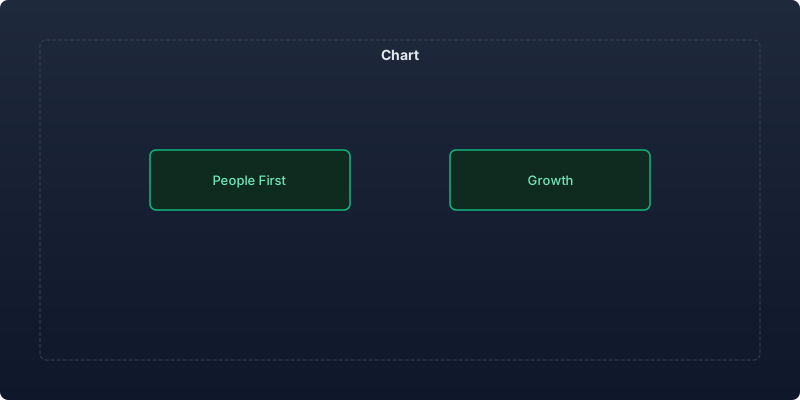
Here's my personal heuristic: if an internal candidate is 70% ready for the next role, promote them. The remaining 30% they'll learn faster on the job than in any development program. And the confidence boost of being trusted with a stretch will accelerate their growth in ways you can't predict.
Below 70%? You're setting them up for a painful experience. That's not a kindness — that's abdication dressed up as support.
But here's the nuance: "ready" doesn't mean "already doing the job perfectly." It means they have the judgment, the self-awareness, the learning orientation, and the relational skills to grow into it. Technical gaps are the easiest to fill. Character gaps are nearly impossible.
What I Wish I'd Known
Looking back at Marcus, what I missed wasn't a framework problem. It was a seeing problem. I was so focused on what the "ideal candidate" looked like on paper that I couldn't see the real leader standing right in front of me.
Marcus had something no external hire could bring: he'd bled for that team. He'd earned every ounce of trust through late nights and hard conversations and quiet acts of service. And I treated that like it was worth less than a decade of experience at a FAANG company.
The external hire had the resume. Marcus had the relationships. In engineering leadership, relationships win. Every time.
Your Takeaway
Next time you're facing this decision, ask yourself three questions:
-
Is there someone on my team who's already leading, just without the title? Look for influence, not just output.
-
Am I defaulting to external because it feels safer, or because it's genuinely better for the team? Be honest with yourself about which fear is driving you.
-
If I hire externally, am I prepared to do the emotional work of supporting the person I'm passing over? If you're not, you'll lose them — and you'll deserve to.
The best engineering leaders I know aren't the ones who always make the right call. They're the ones who make the wrong call, own it, learn from it, and do better next time.
Marcus, wherever you are — I'm sorry. You were ready. I just couldn't see it yet.
Recommended reading
The Legacy of Leadership: What Remains When You Leave
The thing people remember is not your architecture. It is not your processes. It is how you made them feel. Reflections on what actually endures from engineering leadership.
What 3 A.M. Incidents Taught Me That AWS Certifications Never Did
Twenty production incidents reviewed: why understanding beats fixing, what certifications actually train, and the habits that keep a team calm at 3 a.m.
An Engineering Leader's Sustainable Weekly Rhythm
A realistic weekly rhythm that balances strategy, people, and operational work — without burning out or losing yourself in back-to-back meetings.



Comments
No comments yet. Be the first to share your thoughts.