API-First Product Strategy for Startups
Why building your startup API-first creates compounding advantages in partnerships, developer adoption, and long-term platform value

The most successful developer-facing companies of the last decade — Stripe, Twilio, Plaid — share a common architectural philosophy: they built APIs first and interfaces second. This was not an accident of engineering culture. It was a deliberate product strategy that created compounding network effects, reduced integration friction, and ultimately built moats their competitors could not replicate.
As a CTO advising early-stage startups, I consistently recommend API-first thinking even for companies that do not consider themselves "developer tools." Here is why, and how to execute it without over-engineering your MVP.
What API-First Actually Means
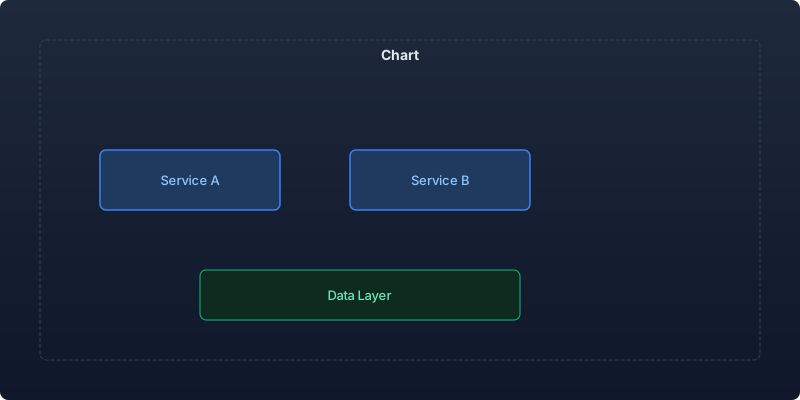
API-first does not mean "we have an API." It means your API is the product, and every other interface — web app, mobile app, integrations — is a client of that same API. The distinction matters because it forces architectural discipline from day one.
| Approach | Definition | Benefit | Risk |
|---|---|---|---|
| API-first | API designed before any UI | Maximum flexibility, partnership-ready | Slower initial MVP |
| API-alongside | API built simultaneously with UI | Balanced approach | Inconsistent contracts |
| API-after | API bolted on after product works | Fastest to first user | Technical debt, brittle integrations |
The Compounding Advantages
1. Partnership Velocity
When a potential partner asks "can we integrate with you?", an API-first company answers in hours. An API-after company answers in sprints. In startup timelines, this difference can mean winning or losing a design partnership that defines your category.
I watched a startup lose a Fortune 500 pilot because their competitor had clean API documentation and a sandbox environment ready. The product was arguably inferior, but the integration timeline was 2 weeks versus 3 months.
2. Developer Adoption as Distribution
APIs create a unique distribution channel: developers adopting your product become advocates within their organizations. Each integration is sticky — the switching cost is not just UI familiarity but embedded code across multiple systems.
3. Platform Optionality
An API-first architecture gives you optionality to evolve from a product into a platform without a rewrite. You can layer marketplaces, app stores, and ecosystem partnerships on top of a well-designed API. Trying to retrofit this later is extraordinarily expensive.
Executing API-First at the Seed Stage
Start with the API Contract
Before writing implementation code, design your API contract using OpenAPI (Swagger) or similar specification tools. This gives you:
- A machine-readable spec for generating documentation
- A mock server for frontend development in parallel
- A contract for integration partners to develop against
- Automated testing against the specification
The Minimum API Surface
Resist the temptation to expose everything. Your initial API should cover:
- Core resource CRUD — The primary objects your product manages
- Authentication — OAuth 2.0 or API keys with proper scoping
- Webhooks — Event-driven notifications for state changes
- Rate limiting — Protect your infrastructure and set usage expectations
Versioning from Day One
Implement API versioning before your first external consumer. The cost of adding it later is exponentially higher because you must maintain backward compatibility with unversioned consumers forever.
| Versioning Strategy | Pros | Cons | Best For |
|---|---|---|---|
| URL path (/v1/resource) | Simple, visible | URL proliferation | Public APIs |
| Header-based | Clean URLs | Less discoverable | Internal APIs |
| Query parameter | Easy to test | Caching complexity | Transitional use |
My recommendation: URL path versioning for external APIs. It is the most explicit and easiest for developers to understand.
Documentation as Product
Your API documentation is not a technical afterthought — it is a product surface. For developer-facing startups, documentation quality directly correlates with adoption rate.
Essential documentation components:
- Getting started guide — Zero to first API call in under 5 minutes
- Authentication guide — Clear, copy-paste examples
- API reference — Auto-generated from your OpenAPI spec
- Code examples — In the top 3-4 languages your users write
- Changelog — Every change, every version, clearly communicated
The Documentation Investment Pays Dividends
Companies with excellent API documentation spend 40-60% less on developer support. Each documentation page is a support ticket that never gets filed.
The Business Case for Non-Developer-Tool Startups
Even if your end users are not developers, API-first architecture creates business value:
Faster feature development. When your frontend and backend teams work against a shared contract, they can develop in parallel. This alone can cut feature delivery time by 30-40%.
Integration marketplace potential. Zapier, Make, and n8n integrations become trivial when you have a well-designed API. These no-code platforms extend your reach to non-technical users without additional engineering effort.
Enterprise sales readiness. Enterprise buyers evaluate integration capabilities as a top-3 purchase criterion. Having a production-ready API with documentation moves you past a common objection in sales cycles.
Common Mistakes to Avoid
Over-designing the initial API
Your first API version will be wrong. That is fine. Design for evolution, not perfection. Use versioning to give yourself permission to learn and iterate.
Ignoring developer experience (DX)
Error messages, response codes, pagination, and filtering all matter. A developer who gets a 500 error with no context will not file a bug report — they will evaluate your competitor.
Building an SDK too early
SDKs are maintenance burdens. Wait until you have stable API patterns and genuine demand from your developer community before investing in client libraries.
Neglecting rate limiting and abuse prevention
One misbehaving integration partner can take down your entire platform. Implement rate limiting, request throttling, and usage monitoring from the first external consumer.
Measuring API-First Success
Track these metrics to validate your API-first investment:
| Metric | Seed Stage Target | Series A Target |
|---|---|---|
| Time to first API call | < 5 minutes | < 3 minutes |
| API uptime | 99.5% | 99.9% |
| Active API consumers | 5-20 | 50-200 |
| Integration partnerships | 2-5 | 10-30 |
| Support tickets per consumer | < 3/month | < 1/month |
Key Takeaways
- API-first is a product strategy, not just an engineering architecture — it creates distribution, partnerships, and platform optionality
- Design your API contract before writing implementation code to enable parallel frontend/backend development
- Implement versioning from day one — the cost of adding it later is exponentially higher
- Documentation is a product surface that directly reduces support costs and accelerates developer adoption
- Even non-developer-tool startups benefit from API-first thinking through faster internal development and enterprise sales readiness
- Resist over-engineering the initial API — design for evolution using versioning, not perfection in v1
- Measure success through developer experience metrics like time-to-first-call, not just uptime
The API-first approach requires slightly more upfront investment, but the compounding returns in partnership velocity, developer adoption, and architectural flexibility make it one of the highest-leverage decisions a startup CTO can make.
Recommended reading

Why the Gulf Will Produce the Next Wave of Logistics Tech Unicorns
Capital, demographics, infrastructure, and regulation are converging in the GCC. A thesis from inside a Qatari delivery platform doing 16M orders a year.
Post-Acquisition Technical Integration Playbook
How CTOs navigate the technical integration process after an acquisition, from day-one decisions through full platform consolidation
Landing Your First Enterprise Customer as a Startup: The Technical Credibility Playbook
A tactical guide for startup CTOs navigating enterprise sales cycles, from security questionnaires to architecture reviews, with timelines and preparation checklists.



Comments
No comments yet. Be the first to share your thoughts.