Compliance Engineering at the Early Stage
How startup CTOs can build compliance into the product architecture from day one without slowing down velocity

Compliance feels like a large-company problem until it blocks your first enterprise deal. I have watched startups lose six-figure contracts because they could not produce a SOC 2 report, scramble to retrofit GDPR compliance after a regulatory inquiry, and burn months of engineering time on security remediations that could have been prevented with early architectural decisions.
The conventional wisdom says startups should ignore compliance until they need it. This is wrong. The right approach is compliance engineering — building the architectural foundations that make future compliance achievable without slowing down your current velocity.
The Compliance Landscape for Startups
Different markets require different compliance frameworks. Understanding which ones matter for your business determines where to invest early:
| Framework | When You Need It | Time to Achieve | Engineering Effort | Business Impact |
|---|---|---|---|---|
| SOC 2 Type I | First enterprise deal | 3-6 months | Medium | Revenue unlock |
| SOC 2 Type II | Enterprise scaling | 6-12 months | Medium-High | Trust building |
| GDPR | Any EU users | Ongoing | Medium | Legal requirement |
| HIPAA | Healthcare data | 6-12 months | High | Market access |
| PCI DSS | Payment processing | 3-9 months | High | Revenue enablement |
| ISO 27001 | Global enterprise | 9-18 months | High | International deals |
The Architecture-First Approach
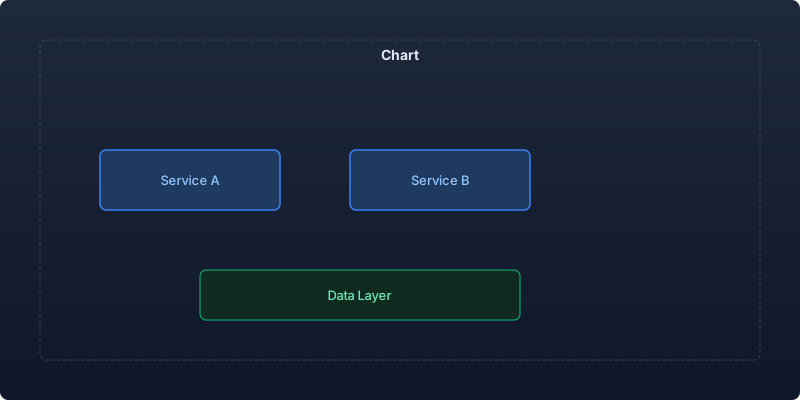
The most expensive compliance failures are architectural. When your application stores PII in six different databases without access controls, achieving GDPR compliance requires a rewrite. When your authentication system has no audit logging, SOC 2 requires retroactive infrastructure work.
The solution is not to achieve full compliance at the seed stage. It is to make architectural decisions that do not block future compliance.
Data Architecture Decisions
Centralize PII storage. Even if you only have one database, designate specific tables and columns as PII-containing. Document this. When you need to implement data deletion requests or access controls, you know exactly where to look.
Implement soft deletes. Hard deletes make compliance auditing impossible. Soft deletes with configurable retention policies give you flexibility to meet various regulatory requirements.
Separate data planes. If you handle customer data, architect your system so that different customers' data can be isolated. This does not mean multi-tenancy from day one — it means the data model supports it.
Access Control Foundations
Build these into your system before your first external user:
- Role-based access control (RBAC) — Even if you only have "admin" and "user" roles initially
- Audit logging — Every data access and modification, with timestamp and actor
- API authentication scoping — Tokens with limited permissions rather than god-mode keys
- Environment separation — Production data never accessible from development environments
Encryption Standards
| Data State | Minimum Standard | Implementation |
|---|---|---|
| At rest | AES-256 | Managed database encryption |
| In transit | TLS 1.3 | Load balancer termination |
| In application | Field-level for sensitive data | Application-layer encryption |
| In backups | Same as at rest | Encrypted backup storage |
The Compliance Engineering Playbook
Month 1-3: Foundations
These investments cost minimal engineering time but pay enormous dividends later:
- Enable cloud provider audit logging (AWS CloudTrail, GCP Audit Logs)
- Implement application-level audit logging for all data mutations
- Set up centralized log aggregation with configurable retention
- Document your data flow — where does user data enter, move, and rest?
- Implement HTTPS everywhere with automatic certificate management
- Enable database encryption at rest (usually a single configuration flag)
Month 4-6: Controls
Once your product has real users and you are approaching enterprise conversations:
- Implement proper RBAC with documented role definitions
- Build data export functionality (GDPR right to portability)
- Build data deletion functionality (GDPR right to erasure)
- Set up vulnerability scanning in your CI/CD pipeline
- Document your incident response process (even if simple)
- Implement session management with configurable timeouts
Month 7-12: Certification Readiness
When enterprise deals are on the horizon and compliance becomes revenue-blocking:
- Engage a SOC 2 readiness assessor
- Implement formal change management processes
- Build security monitoring and alerting
- Conduct penetration testing
- Formalize your vendor management process
- Write security policies (many templates available for startups)
Tools That Reduce Compliance Burden
The compliance tooling ecosystem has matured significantly. These tools can reduce your engineering investment by 60-70%:
Compliance automation platforms: Vanta, Drata, or Secureframe automate evidence collection, policy management, and audit preparation. They cost $10-30K/year but save months of engineering time.
Infrastructure-as-code: Terraform or Pulumi configurations serve as living documentation of your infrastructure controls. Auditors love seeing infrastructure defined in code.
Identity providers: Auth0, Okta, or similar platforms handle SSO, MFA, and session management with built-in compliance features.
The Business Case for Early Compliance
Frame compliance investment to your board and co-founders in business terms:
Revenue acceleration. Enterprise sales cycles shorten by 4-8 weeks when you can present existing compliance certifications rather than promising future ones.
Valuation protection. Acquirers discount valuations for companies with compliance debt. A clean compliance posture protects your exit value.
Reduced incident cost. The average data breach costs $4.45 million (IBM 2023). Early compliance reduces both probability and blast radius of incidents.
Competitive differentiation. In crowded markets, compliance readiness becomes a genuine differentiator for enterprise buyers evaluating similar products.
Common Mistakes
Treating compliance as a checkbox. Compliance is continuous, not a one-time achievement. Build processes that maintain compliance as your product evolves.
Over-investing too early. Full ISO 27001 certification at the seed stage is wasteful. Match your compliance investment to your current and near-term market requirements.
Ignoring employee access. The most common SOC 2 finding is overly permissive employee access to production systems. Implement least-privilege principles from the start.
Neglecting vendor compliance. Your compliance posture is only as strong as your weakest vendor. Evaluate third-party tools for their own compliance certifications.
Key Takeaways
- Compliance engineering is about making architectural decisions today that do not block regulatory requirements tomorrow
- Centralize PII storage, implement audit logging, and enable encryption from day one — these cost minimal effort but prevent expensive retrofitting
- The most expensive compliance failures are architectural, not procedural — fixing data architecture post-launch can require a complete rewrite
- Match compliance investment to your market timing: foundations first, controls second, certification when enterprise revenue is imminent
- Compliance automation platforms (Vanta, Drata) reduce engineering burden by 60-70% and are worth the annual cost for Series A+ companies
- Frame compliance investment in business terms: revenue acceleration, valuation protection, and competitive differentiation
- Build for continuous compliance, not one-time certification — your processes must evolve with your product
Start with architecture. Let the certifications follow naturally from good engineering foundations rather than attempting to retrofit security into a system designed without it.
Recommended reading

Why the Gulf Will Produce the Next Wave of Logistics Tech Unicorns
Capital, demographics, infrastructure, and regulation are converging in the GCC. A thesis from inside a Qatari delivery platform doing 16M orders a year.
Post-Acquisition Technical Integration Playbook
How CTOs navigate the technical integration process after an acquisition, from day-one decisions through full platform consolidation
Landing Your First Enterprise Customer as a Startup: The Technical Credibility Playbook
A tactical guide for startup CTOs navigating enterprise sales cycles, from security questionnaires to architecture reviews, with timelines and preparation checklists.



Comments
No comments yet. Be the first to share your thoughts.