Building Your Data Strategy From Day One
Why startups that treat data as a strategic asset from the beginning build stronger moats and make better decisions than those who retrofit analytics later

Most startups treat data as an afterthought. They build features, acquire users, and only think about analytics when an investor asks "what are your metrics?" or when a product decision requires data they never collected. By that point, months of user behavior have evaporated — signals that could have informed pivots, validated hypotheses, or demonstrated traction to investors.
As a CTO, your data strategy does not need to be sophisticated at the seed stage. But it needs to exist. The decisions you make about what to track, how to store it, and when to analyze it compound over time in ways that create genuine competitive advantage.
What Data Strategy Means at the Seed Stage
Data strategy is not building a data warehouse. It is not hiring a data engineer. It is making deliberate decisions about three things:
- What events and behaviors do we capture?
- How do we store data to enable future analysis?
- What decisions will we make differently because of data?
| Data Maturity Level | Infrastructure | Team | Investment |
|---|---|---|---|
| Level 0: Flying blind | No tracking | N/A | $0 |
| Level 1: Basic analytics | Product analytics tool | Founder-led | $0-200/mo |
| Level 2: Structured events | Event tracking + warehouse | Part-time data work | $200-1000/mo |
| Level 3: Data-informed | Full pipeline + dashboards | Dedicated analyst | $1000-5000/mo |
| Level 4: Data-driven | ML + experimentation | Data team | $5000+/mo |
Most seed-stage startups should be at Level 1-2. Level 3 is a Series A investment. Level 4 is Series B+.
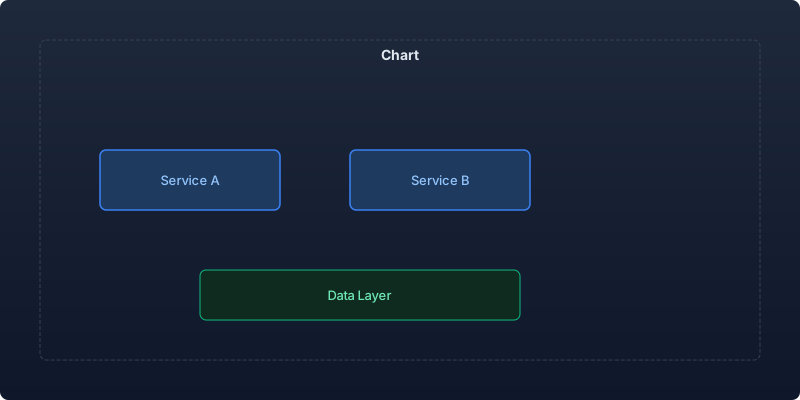
The Minimum Viable Data Stack
Event Tracking (Week 1)
Implement event tracking before your first user signs up. You cannot retroactively capture behavior that already happened.
What to track from day one:
- User signup and activation events
- Core product actions (the 3-5 things that define product usage)
- Feature discovery and engagement depth
- Error events and failure modes
- Conversion funnel steps
Tool recommendation: Start with a product analytics tool (Mixpanel, Amplitude, PostHog) that provides both event tracking and basic analysis. Do not build your own analytics at the seed stage.
Data Model Design
Your production database schema is your first data asset. Design it with future analysis in mind:
Timestamps on everything. Every row should have created_at and updated_at. This enables time-series analysis later without schema migrations.
Immutable event logs. For critical user actions, write to an append-only events table rather than mutating state. This creates an audit trail and enables behavioral analysis.
User identity stitching. Assign anonymous IDs from first page view and merge them with authenticated IDs at signup. Losing pre-signup behavior is losing your funnel visibility.
The Event Schema
Standardize your event schema from the start:
event_name: string (e.g., "feature_used")
user_id: string
anonymous_id: string
timestamp: ISO 8601
properties: {
  feature: string,
  context: string,
  value: number (optional)
}
Consistency in event structure makes future analysis dramatically easier.
Data as Competitive Moat
Network Effects Through Data
The most powerful moats in technology are built on data:
| Data Moat Type | How It Works | Example |
|---|---|---|
| Aggregation | More users = better service for all users | Waze traffic data |
| Personalization | Usage improves individual experience | Spotify recommendations |
| Benchmarking | Customer data enables cross-company insights | Glassdoor salary data |
| Training data | User interactions improve AI models | GitHub Copilot |
If your product can capture data that improves with more users, you have the foundation for a data-driven moat. Architect for this from the beginning, even if you do not exploit it initially.
Proprietary Data Sets
Your product generates unique data that no one else has. Identify what that data is and protect it:
- User behavior patterns specific to your domain
- Relationship graphs between entities in your system
- Outcome data (what worked, what failed, why)
- Industry-specific benchmarks derived from your customer base
Making Data-Informed Decisions
The Decision Log
Maintain a simple decision log that connects product decisions to data:
| Date | Decision | Data Used | Outcome |
|---|---|---|---|
| Week 4 | Prioritize Feature X | 40% of active users attempted it | Usage grew 3x |
| Week 6 | Kill Feature Y | < 2% engagement after 3 weeks | Reduced maintenance |
| Week 8 | Change onboarding flow | 60% drop-off at step 3 | Completion +25% |
This creates accountability and builds institutional memory about what works.
Avoiding Data Traps
Vanity metrics. Total signups, page views, and registered accounts tell you almost nothing about product health. Focus on activation, engagement, and retention metrics.
Survivorship bias. You can only analyze users who stayed. The users who left — and why — are often more informative. Build exit surveys and churn analysis into your product early.
Premature optimization. Do not A/B test with 50 users. You need statistical significance. Until you have meaningful sample sizes, make decisions based on qualitative research and directional data.
Building the Data Foundation for AI
If your product will incorporate AI/ML features, your data architecture decisions today determine what is possible in 12-18 months:
Capture raw data, not just aggregations. ML models need granular training data. Store individual events, not just daily summaries.
Label data implicitly. User behavior creates implicit labels — what they clicked, what they ignored, what they completed, what they abandoned. Capture these signals.
Version your data schemas. When your event schema evolves, maintain backward compatibility so historical data remains useful for model training.
Separate operational and analytical stores. Your production database should serve your application. Replicate to an analytical store for heavy queries and model training.
The Privacy-First Data Approach
Data strategy in 2026 must be privacy-aware from the start:
- Implement data minimization — capture what you need, not everything possible
- Provide user data export and deletion from day one (GDPR requires this anyway)
- Anonymize data for analytics where individual identity is not needed
- Document your data retention policies before regulators ask
- Use first-party data collection rather than third-party trackers
Scaling Your Data Practice
From Seed to Series A
| Phase | Focus | Tooling |
|---|---|---|
| Pre-seed | Event tracking, basic analytics | PostHog or Mixpanel |
| Seed | Structured events, funnel analysis | + data warehouse (BigQuery) |
| Series A | Dashboards, cohort analysis, segmentation | + BI tool (Metabase, Looker) |
| Series B | Experimentation, ML features, data team | + experimentation platform |
Do not jump ahead. Each phase builds on the previous one. Premature data infrastructure investment is as wasteful as premature feature development.
Key Takeaways
- Implement event tracking before your first user — you cannot retroactively capture behavior that already happened
- Your minimum viable data stack is a product analytics tool with structured event tracking and timestamps on every database row
- Data creates competitive moats through aggregation, personalization, benchmarking, and AI model training — architect for these from the beginning
- Maintain a decision log connecting product decisions to supporting data to build institutional accountability
- Focus on activation, engagement, and retention metrics rather than vanity metrics like total signups
- Design your data model with AI/ML readiness in mind: capture raw events, create implicit labels, and version your schemas
- Build privacy-first from day one — data minimization and user control are both ethical and strategically sound
Your data strategy at the seed stage is not about sophistication. It is about intentionality. Capture the right signals, store them in a structured way, and use them to make better decisions faster than competitors who are flying blind.
Recommended reading

Why the Gulf Will Produce the Next Wave of Logistics Tech Unicorns
Capital, demographics, infrastructure, and regulation are converging in the GCC. A thesis from inside a Qatari delivery platform doing 16M orders a year.
Post-Acquisition Technical Integration Playbook
How CTOs navigate the technical integration process after an acquisition, from day-one decisions through full platform consolidation
Landing Your First Enterprise Customer as a Startup: The Technical Credibility Playbook
A tactical guide for startup CTOs navigating enterprise sales cycles, from security questionnaires to architecture reviews, with timelines and preparation checklists.



Comments
No comments yet. Be the first to share your thoughts.