Infrastructure Spending at Every Funding Stage: A Startup Guide
How much should you spend on infrastructure at each stage? Real benchmarks from seed to Series C with decision frameworks for when to invest and when to optimize.

I've reviewed infrastructure spending at 40+ startups across three accelerator cohorts and my own portfolio companies. The pattern is consistent: startups either overspend early (building for scale they'll never reach) or underspend late (breaking production because they outgrew their architecture).
Both mistakes are expensive. Over-engineering at seed stage burns 6-12 months of runway on infrastructure nobody uses. Under-investing at Series B means your fastest-growing quarter becomes your most unstable—and churn spikes right when investors are watching.
This guide provides concrete benchmarks and decision frameworks for infrastructure investment at each funding stage, based on real data from companies processing $10K to $50M in monthly revenue.
The Infrastructure Cost Curve
Infrastructure costs don't scale linearly with revenue. They follow an S-curve: high as a percentage early (fixed costs dominate), declining through product-market fit (revenue grows faster than infra), then rising again at scale (complexity and reliability requirements increase).
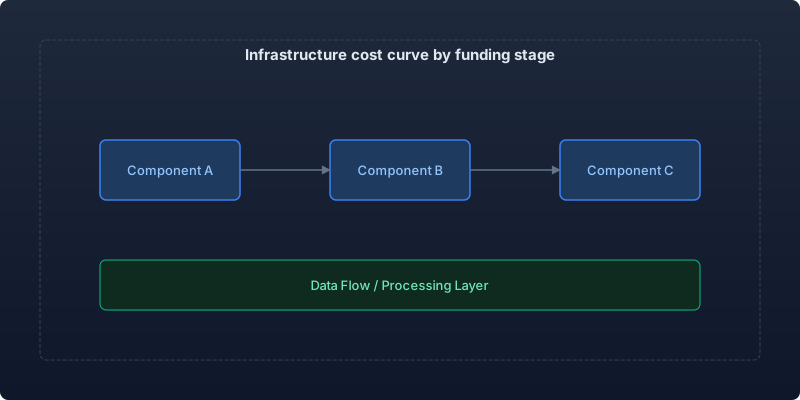
| Stage | Revenue Range | Healthy Infra Spend (% of Revenue) | Absolute Range (Monthly) |
|---|---|---|---|
| Pre-seed | $0 - $5K MRR | 40-100%+ | $500 - $2,000 |
| Seed | $5K - $50K MRR | 15-30% | $2,000 - $8,000 |
| Series A | $50K - $200K MRR | 8-15% | $8,000 - $25,000 |
| Series B | $200K - $1M MRR | 5-10% | $20,000 - $80,000 |
| Series C+ | $1M+ MRR | 3-7% | $50,000 - $200,000+ |
These numbers include compute, storage, networking, third-party SaaS tools for infrastructure (monitoring, logging, CI/CD), and the engineering time directly spent on infrastructure maintenance—not application development.
Pre-Seed to Seed: Minimize Fixed Costs
Goal: Ship product as fast as possible. Infrastructure should be invisible.
Budget: $500 - $2,000/month
At this stage, you have no users or very few users. Every dollar spent on infrastructure that isn't directly enabling faster shipping is waste.
What to Use
| Component | Recommendation | Monthly Cost |
|---|---|---|
| Compute | Vercel/Railway/Fly.io OR single cloud instance | $20-$100 |
| Database | Managed Postgres (Neon, Supabase, RDS) | $25-$100 |
| Auth | Auth0 free tier or Clerk | $0-$25 |
| Monitoring | Free tiers (Sentry, basic CloudWatch) | $0-$50 |
| CI/CD | GitHub Actions free tier | $0 |
| Storage | S3 or equivalent | $5-$20 |
| Email/Notifications | SendGrid/Resend free tier | $0-$20 |
Total: $50-$315/month for most pre-seed startups
Decision Framework
Ask one question: "Does this infrastructure decision speed up our next 10 feature releases?"
If yes, invest. If no, defer.
Do NOT at this stage:
- Set up Kubernetes
- Build multi-region failover
- Implement complex CI/CD pipelines
- Architect for 100x scale
- Run multiple environments (staging is fine; preprod + staging + QA is overkill)
Real Example
A pre-seed logistics startup I advised spent $4,200/month on AWS because they "needed" ECS, RDS Multi-AZ, ElastiCache, and CloudFront—for an app with 200 users. We moved them to a single $40/month Fly.io instance with a $50/month managed Postgres database. Same performance, $4,100/month saved, 14 months of extra runway.
Seed Stage: First Scaling Decisions
Goal: Support early growth without fragility. Start building operational foundations.
Budget: $2,000 - $8,000/month
You've found early traction. Users are growing 15-30% month-over-month. Things that were fine at 100 users start breaking at 1,000.
What Changes
| Component | Pre-seed | Seed | Why |
|---|---|---|---|
| Database | Single instance | Instance with read replica OR serverless scaling | Read-heavy queries start competing |
| Compute | Single service | 2-3 services with auto-scaling | First service decomposition |
| Monitoring | Basic alerts | APM + structured logging | Need to find bottlenecks |
| CI/CD | Manual or basic | Automated deployment pipeline | Multiple deploys per day required |
| Security | Nothing formal | Basic WAF + secrets management | First enterprise customers asking |
When to Start Spending More
Trigger these investments when you hit specific thresholds, not by calendar:
- Add monitoring/APM when you hit 3+ incidents per month that take >30 minutes to diagnose
- Add auto-scaling when your peak load exceeds 3x your baseline consistently
- Add a read replica when database CPU exceeds 60% during peak hours
- Invest in CI/CD when deploys take longer than 15 minutes or break more than 10% of the time
The Premature Optimization Trap
At seed stage, the most common mistake is solving scaling problems you don't have yet. I've seen seed-stage companies spend $15K/month on Kubernetes clusters serving 5,000 users. A single well-configured auto-scaling group would handle 50,000 users for $3K/month.
Rule of thumb: Solve for 10x your current scale, not 100x. You'll have more money (and more information) before you need the next 10x.
Series A: Reliability Becomes a Feature
Goal: Infrastructure that supports enterprise sales and rapid feature development without outages that damage reputation.
Budget: $8,000 - $25,000/month
At Series A, you likely have paying customers who expect uptime. You have an engineering team of 8-20 that needs productive development environments. And you have investors who will notice if your product goes down during a board meeting.
Critical Investments
| Investment | Cost Range | Trigger |
|---|---|---|
| Multi-AZ deployment | +$2,000-$5,000/month | First enterprise contract with SLA |
| Comprehensive monitoring stack | $1,500-$3,000/month | Team exceeds 10 engineers |
| Staging + production parity | +$3,000-$5,000/month | Change failure rate exceeds 10% |
| Security audit + hardening | $5K-$15K one-time | First SOC 2 or ISO 27001 request |
| Dedicated CI/CD infrastructure | $500-$2,000/month | Build times exceed 15 minutes |
The Platform Engineering Question
At Series A, you'll face pressure to hire a dedicated DevOps/platform engineer. Here's my decision framework:
Hire a platform engineer when:
- Engineers spend >20% of their time on infrastructure tasks
- Deployments are the bottleneck (less than 5/day when the team wants 15+)
- On-call burden is burning out application engineers
- You have 12+ engineers
Don't hire yet when:
- A managed platform (Railway, Render, or well-configured AWS with IaC) handles your needs
- Your infrastructure is stable and rarely changes
- You have <10 engineers—one person can handle it part-time
Cost Efficiency at Series A
Your Series A investors will start asking about unit economics. Infrastructure cost per customer becomes a metric that matters.
| Metric | Healthy Range (Series A SaaS) |
|---|---|
| Infra cost per customer | $0.50 - $5.00/month |
| Infra cost per $1 revenue | $0.08 - $0.15 |
| Infra cost per engineer | $800 - $2,000/month |
If you're above these ranges, you likely have architecture inefficiencies worth addressing. If you're below, you might be underinvesting in reliability.
Series B: Scale and Specialization
Goal: Infrastructure that scales to millions of users, supports multiple product lines, and enables engineering velocity at 30-60 engineers.
Budget: $20,000 - $80,000/month
Series B is where infrastructure becomes a competitive moat. Your architecture decisions now directly affect your ability to ship features fast, maintain reliability, and control costs as you grow 3-5x in the next 18 months.
Common Series B Infrastructure Investments
| Component | Investment | Monthly Cost | Business Justification |
|---|---|---|---|
| Data platform | Warehouse + ETL + BI | $5K-$15K | Product analytics, investor reporting |
| Global CDN | Multi-region content delivery | $2K-$8K | International expansion |
| Service mesh / API gateway | Traffic management + observability | $3K-$8K | Microservice reliability at scale |
| ML/AI infrastructure | GPU instances, feature stores | $5K-$20K | Product differentiation |
| Disaster recovery | Cross-region replication | $5K-$15K | Enterprise SLA requirements |
| Security operations | SIEM, vulnerability scanning, pen testing | $3K-$10K | SOC 2 Type II, enterprise sales |
The FinOps Discipline
At Series B spending levels, you need formal cost management. Appoint a FinOps owner (often a senior platform engineer) and implement:
- Tagging enforcement — Every resource tagged by team, service, and environment
- Monthly cost reviews — Engineering leadership reviews spending by team
- Reservation strategy — 1-year commits on stable workloads save 30-40%
- Rightsizing cadence — Quarterly review of instance utilization
Companies that implement FinOps discipline at Series B typically save 25-35% on infrastructure within 6 months. At $60K/month spend, that's $180K-$250K annually—often enough for 2-3 additional engineers.
Series C and Beyond: Efficiency at Scale
Goal: Infrastructure cost grows slower than revenue. Invest in platforms that enable the entire engineering org.
Budget: $50,000 - $200,000+/month
At Series C, you're likely running 100+ microservices across multiple regions. Your infrastructure team is 5-15 people. Cost efficiency and developer productivity are the primary concerns.
Key Metrics at Scale
| Metric | Target (Series C) | Red Flag |
|---|---|---|
| Infra cost as % of revenue | 3-7% | >10% and trending up |
| Cost per transaction | Declining quarterly | Flat or increasing |
| Developer deploy time | <10 minutes | >30 minutes |
| Incident recovery time | <15 minutes | >60 minutes |
| Infrastructure automation | >90% IaC | <60% IaC |
The Stage-Appropriate Architecture Decision Tree
When someone proposes an infrastructure change, run it through this filter:
- Does our current infrastructure fail to support a near-term (6-month) business goal? If no, defer.
- Will the investment reduce cost-per-unit as we scale? If no, find an alternative.
- Can we implement it incrementally? If yes, start with the smallest useful version.
- Does it require new expertise we don't have? If yes, factor in hiring timeline or managed service cost.
Actionable Takeaways
- Pre-seed: spend under $500/month. Use managed platforms. Don't architect for scale you don't have.
- Seed: spend $2K-$8K/month. Invest only when specific thresholds trigger the need.
- Series A: spend $8K-$25K/month. Reliability becomes a feature. Hire a platform engineer at 12+ engineers.
- Series B: implement FinOps. Formal cost management saves 25-35%. Start reservation strategy.
- Series C+: target 3-7% of revenue. Infrastructure cost should grow slower than revenue. Always.
The best infrastructure investment is the one that's exactly right for your current stage—not the one that prepares you for a stage you might never reach. Optimize for today's constraints with an eye toward next year's growth, and you'll navigate every funding stage without either burning runway or breaking production.
Recommended reading

Why the Gulf Will Produce the Next Wave of Logistics Tech Unicorns
Capital, demographics, infrastructure, and regulation are converging in the GCC. A thesis from inside a Qatari delivery platform doing 16M orders a year.
Post-Acquisition Technical Integration Playbook
How CTOs navigate the technical integration process after an acquisition, from day-one decisions through full platform consolidation
Landing Your First Enterprise Customer as a Startup: The Technical Credibility Playbook
A tactical guide for startup CTOs navigating enterprise sales cycles, from security questionnaires to architecture reviews, with timelines and preparation checklists.



Comments
No comments yet. Be the first to share your thoughts.