Platform vs Product: The Startup Decision Framework
When to build a focused product versus when to invest in platform capabilities and how this decision shapes your engineering strategy and market position

Every successful startup eventually faces a pivotal decision: remain a focused product that solves a specific problem, or evolve into a platform that enables others to build on top of you. This choice reshapes your engineering organization, your go-to-market motion, and your competitive dynamics. Make it too early and you spread thin before achieving product-market fit. Make it too late and competitors build the platform you should have owned.
The platform-versus-product decision is not binary or permanent. It is a spectrum, and where you sit on that spectrum should evolve with your stage, your market, and your users' demands.
Understanding the Spectrum
| Position | What It Means | Engineering Focus | Revenue Model |
|---|---|---|---|
| Pure product | Solves one problem end-to-end | Feature depth, UX polish | Subscriptions, usage |
| Product with API | Core product + programmatic access | Core product + API layer | Subscriptions + API usage |
| Platform-ready product | Product + extensions/integrations | Plugin system, marketplace | Subscriptions + ecosystem |
| Pure platform | Infrastructure others build on | APIs, SDKs, reliability | Usage-based, transactions |
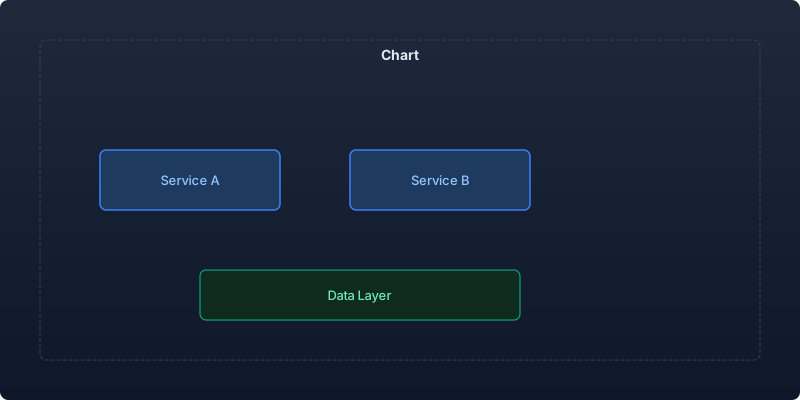
Most startups should start as pure products and evolve rightward only when clear signals indicate the market demands it.
When to Remain a Product
Signals That Product Focus Is Correct
Your value is in the workflow, not the data. If users love your product because of how it solves their problem (UX, automation, intelligence), a platform adds complexity without value.
Your market is well-defined and finite. If you can reach product-market fit by serving a specific persona deeply, platform investment dilutes focus.
Users want outcomes, not building blocks. When customers say "just solve it for me" rather than "let me customize it," they are telling you to be a product.
Your competitive advantage is opinionated design. Products like Linear and Superhuman win through deliberate constraints. A platform contradicts this.
The Product Advantage
Focused products have structural advantages at early stages:
- Faster iteration cycles (one UI, one user persona)
- Lower engineering complexity (no extension APIs to maintain)
- Clearer positioning (solves X for Y)
- Higher initial quality (all effort concentrated)
- Simpler support (fewer configuration possibilities)
When to Build a Platform
Signals That Platform Investment Is Warranted
Integration requests dominate your backlog. When the most-requested features are connections to other systems rather than core capabilities, users are asking you to be a platform.
Power users outgrow your product. When your best customers need customization beyond what any product can offer, extensibility creates retention.
You are mediating a multi-sided market. If your product naturally sits between suppliers and consumers (or developers and users), platform economics apply.
Partners want to build on you. When other companies approach you about embedding, integrating, or extending your product, the market is telling you something.
The Platform Advantage
At the right stage, platforms create compounding moats:
| Platform Effect | How It Works | Moat Strength |
|---|---|---|
| Network effects | More developers → more apps → more users | Very Strong |
| Switching costs | Customers invested in integrations cannot easily leave | Strong |
| Data advantages | Platform-wide data creates insights individual products cannot match | Strong |
| Ecosystem lock-in | Partner investments tied to your platform | Very Strong |
The Engineering Implications
Building a Platform Layer
If you decide to add platform capabilities, the engineering investment is substantial:
API design and stability. Your internal API is different from a public platform API. Public APIs require versioning, backward compatibility guarantees, deprecation policies, and documentation at a level internal APIs do not.
Extension model. How do third parties extend your product? Options include:
| Extension Model | Complexity | Flexibility | Security Risk |
|---|---|---|---|
| Webhooks | Low | Limited | Low |
| REST/GraphQL API | Medium | High | Medium |
| Plugin SDK | High | Very High | High |
| Embedded runtime (WASM/V8) | Very High | Maximum | Managed |
Multi-tenancy at scale. Platform implies multiple builders creating experiences for multiple end users. Your data isolation, rate limiting, and resource allocation must account for this.
Developer tooling. SDKs, CLIs, local development environments, sandbox/staging environments — the tooling investment for a healthy developer ecosystem is significant.
The Team Structure Shift
Moving from product to platform requires organizational change:
| Function | Product Company | Platform Company |
|---|---|---|
| Engineering | Feature teams | Platform team + feature teams |
| Product | User-focused PMs | Developer-focused + user-focused PMs |
| Support | End-user support | Developer support + end-user support |
| Marketing | User acquisition | Developer relations + user acquisition |
| Documentation | Help center | API docs + help center + guides |
This is not a small shift. It effectively requires building a second company inside your first.
The Timing Question
The Platform Premature Trap
Building platform capabilities before product-market fit is one of the most expensive mistakes in startup engineering:
- You invest months in extensibility nobody uses
- API design without real-world usage produces bad APIs
- Platform maintenance overhead slows product iteration
- You solve N hypothetical problems instead of the one real one
The Right Sequence
- Build a great product — Solve one problem exceptionally well
- Observe integration demand — Track what users build around your product
- Build an API — Expose core capabilities programmatically
- Observe developer behavior — What do developers build? What do they struggle with?
- Invest in platform — Only when demand clearly justifies the investment
Timing Indicators
| Indicator | Not Ready | Ready for Platform |
|---|---|---|
| Core product PMF | Uncertain | Proven (strong retention) |
| Integration requests | Occasional | Top-3 feature request |
| API usage | < 20% of total usage | > 40% of total usage |
| Partner interest | Inbound inquiries | Active partnerships |
| Team size | < 15 engineers | 25+ engineers |
| Revenue stability | Volatile | Predictable growth |
The Hybrid Approach
Most successful companies do not make a binary choice. They adopt a phased approach:
Phase 1: Product with API — Core product serves direct users. API allows programmatic access to the same capabilities. This is table stakes for B2B SaaS.
Phase 2: Product with integrations — Pre-built connectors to popular tools in your ecosystem. Still product-led, but with ecosystem awareness.
Phase 3: Product with extensions — Third parties can build on top of you. Marketplace emerges. Platform dynamics begin.
Phase 4: Platform with product — The platform becomes the primary strategic asset. Your own product is one application of the platform (often the first and most polished).
Key Takeaways
- Start as a product and evolve toward platform only when clear market signals demand it — premature platform investment is one of the most expensive startup mistakes
- Integration requests dominating your backlog, power users outgrowing your product, and partners wanting to build on you are strong platform signals
- The engineering investment for a genuine platform is substantial: public API design, extension models, multi-tenancy, and developer tooling
- Follow the sequence: product-market fit first, then API, then observe developer behavior, then invest in platform capabilities
- Moving from product to platform requires organizational change across engineering, product, support, marketing, and documentation
- Adopt a phased approach: product → product with API → product with integrations → product with extensions → platform with product
- Time the transition using concrete indicators: proven PMF, integration requests in top-3, API usage > 40%, active partnerships, team size 25+
The platform-versus-product decision is ultimately about where value accrues. If value comes from your opinionated solution to a specific problem, stay product-focused. If value comes from enabling an ecosystem of solutions, invest in platform. Let your users and the market guide the timing.
Recommended reading

Why the Gulf Will Produce the Next Wave of Logistics Tech Unicorns
Capital, demographics, infrastructure, and regulation are converging in the GCC. A thesis from inside a Qatari delivery platform doing 16M orders a year.
Post-Acquisition Technical Integration Playbook
How CTOs navigate the technical integration process after an acquisition, from day-one decisions through full platform consolidation
Landing Your First Enterprise Customer as a Startup: The Technical Credibility Playbook
A tactical guide for startup CTOs navigating enterprise sales cycles, from security questionnaires to architecture reviews, with timelines and preparation checklists.



Comments
No comments yet. Be the first to share your thoughts.