The Technical Strategy Document That Aligned 6 Teams in One Week
A proven technical strategy document template that creates alignment across engineering teams, with real examples, structure, and the process for getting buy-in fast.

Last year, six engineering teams were building in slightly different directions. Three were evaluating different databases. Two had conflicting microservices strategies. The platform team didn't know which runtime to optimize for. I needed alignment fast — not through authority ("just do what I say") but through shared understanding. The technical strategy document I wrote took one week to align all six teams on a coherent direction. This is the template, the process, and why most strategy docs fail.
Why Most Technical Strategy Documents Fail
I've read hundreds of strategy documents across my career. Most are ineffective for predictable reasons:
| Failure Mode | What It Looks Like | Why It Fails |
|---|---|---|
| The Research Paper | 40 pages of context, analysis, references | Nobody reads past page 5 |
| The Edict | "We will use X. Non-negotiable." | No buy-in, passive resistance |
| The Wish List | Every good idea, no prioritization | Teams can't extract actionable guidance |
| The Outdated Doc | Written 18 months ago, never updated | Doesn't reflect current reality |
| The Abstract Vision | "We'll be cloud-native and data-driven" | Too vague to guide decisions |
The effective strategy document has one job: help any engineer on any team make the right architectural decision without asking leadership.
The Template: 6 Sections, 8 Pages Maximum
I enforce an 8-page maximum. If you can't articulate your strategy in 8 pages, you haven't thought it through clearly enough.
Section 1: Context and Constraints (1 page)
What's true today that forces us to choose:
## Context & Constraints

**Where we are**: 35 engineers, 8 services, $340K/month infrastructure,
200K daily active users, growing 15% month-over-month.

**Business timeline**: Series B fundraise in Q4 2026. Need to demonstrate
scalable architecture and team efficiency to investors.

**Technical constraints**:
- Team expertise is primarily TypeScript/Node.js and Python
- Current infrastructure is 100% AWS (leveraging $300K in credits)
- We cannot afford more than 2 months of migration for any system
- On-call burden is already at maximum (6 rotations across 35 engineers)

**What prompted this strategy**:
- Three teams independently evaluating PostgreSQL alternatives
- Two conflicting proposals for event-driven architecture
- No shared understanding of our scaling bottlenecks
Section 2: Principles (1 page)
Principles are the decision-making heuristics. Engineers should be able to hold these in their head and apply them without referencing the full document.
## Principles (Ordered by Priority)

1. **Operational simplicity over theoretical perfection**
   If two solutions are comparable, choose the one with fewer operational
   moving parts. We are 35 engineers, not 350.

2. **Boring technology for infrastructure, new technology for differentiation**
   PostgreSQL for data storage. Proven queuing for events. AI/ML for
   product features where we compete on capability.

3. **One way to do each thing**
   One database technology for relational data. One message queue.
   One deployment pipeline. Variance creates operational burden.

4. **Optimize for team autonomy within boundaries**
   Teams own their services fully. They choose internal implementation
   details. They don't choose infrastructure primitives.

5. **Reversible over optimal**
   When uncertain, choose the option that's easiest to undo. Lock-in
   is worse than suboptimality.
Section 3: The Bets (2-3 pages)
These are the specific technological commitments. Each bet includes the decision, the reasoning, and what we're explicitly choosing NOT to do:
## Strategic Bets

### Bet 1: PostgreSQL as Universal Data Store

**Decision**: All new services use PostgreSQL. No new databases introduced
without CTO approval.

**Reasoning**:
- 3 teams evaluating alternatives (MongoDB, DynamoDB, CockroachDB)
  would create 4 different database operational models
- PostgreSQL handles document storage (JSONB), time-series (TimescaleDB
  extension), and full-text search adequately for our scale
- Team expertise is already strong in PostgreSQL
- AWS RDS provides managed operations, reducing on-call scope

**What we're giving up**:
- Purpose-built databases may perform 20-30% better for specific workloads
- DynamoDB's auto-scaling is more seamless for unpredictable traffic

**Reversal conditions**: If a workload exceeds 100K writes/second or
requires global multi-region active-active, we revisit with a specific proposal.

**Exceptions**: Redis for caching (already deployed). No other exceptions.

---

### Bet 2: Event-Driven Architecture via SQS + EventBridge

**Decision**: Service-to-service async communication uses SQS for
point-to-point and EventBridge for pub/sub. No Kafka.

**Reasoning**:
- Kafka requires dedicated operational expertise we don't have
- Two teams proposed Kafka, but their actual throughput needs (< 10K events/sec)
  are well within SQS/EventBridge capability
- SQS and EventBridge are serverless — zero operational overhead
- EventBridge's schema registry solves contract management

**What we're giving up**:
- Kafka's replay capability for event sourcing patterns
- Higher throughput ceiling (relevant only above 100K events/sec)

**Reversal conditions**: If we adopt event sourcing as a primary pattern
(currently no plans) or hit throughput limits.
Section 4: Non-Decisions (0.5 pages)
Equally important: what we're explicitly NOT deciding yet:
## Explicitly Not Decided

These topics are intentionally left open because we lack sufficient
information or the decision isn't urgent:

- **Frontend framework**: React is working. No need to evaluate alternatives
  until we have evidence of limitations.
- **Observability vendor**: Current Datadog contract expires Q1 2027.
  Evaluation will begin Q4 2026.
- **Multi-region**: Not needed until we exceed 1M DAU or have regulatory
  requirements outside US.
Section 5: Migration Plan (1-2 pages)
Strategy without execution is a wish. For each bet that requires change, include the migration path:
## Migration Paths

### MongoDB → PostgreSQL (Teams: Search, Notifications)

**Timeline**: 8 weeks
**Approach**: Dual-write with read switch

| Week | Activity | Risk Mitigation |
|------|----------|-----------------|
| 1-2 | Schema design, data mapping | Review with data team |
| 3-4 | Dual-write implementation | Shadow mode, compare outputs |
| 5-6 | Read traffic migration (10% → 50% → 100%) | Automatic rollback on error rate |
| 7 | Write traffic migration | Maintenance window for final sync |
| 8 | Decommission MongoDB | 2-week cool-down before deletion |

**Rollback plan**: Reverse dual-write direction. MongoDB remains
read-capable throughout migration.

**Owner**: Search team (Alice), with Platform team support for tooling.
Section 6: How We'll Know It's Working (0.5 pages)
Measurable outcomes within defined timeframes:
## Success Metrics

| Metric | Current | Target (6 months) | How Measured |
|--------|---------|-------------------|-------------|
| Database technologies in production | 4 | 2 (Postgres + Redis) | Infrastructure inventory |
| Avg time to resolve data incidents | 4.2 hours | 2 hours | PagerDuty |
| On-call escalations per week | 12 | 7 | PagerDuty |
| New service setup time | 3 days | 4 hours | Template → first deploy |
| Cross-team dependency conflicts/quarter | 8 | 2 | Quarterly retro |
The Alignment Process: One Week
The document alone doesn't create alignment. The process does:
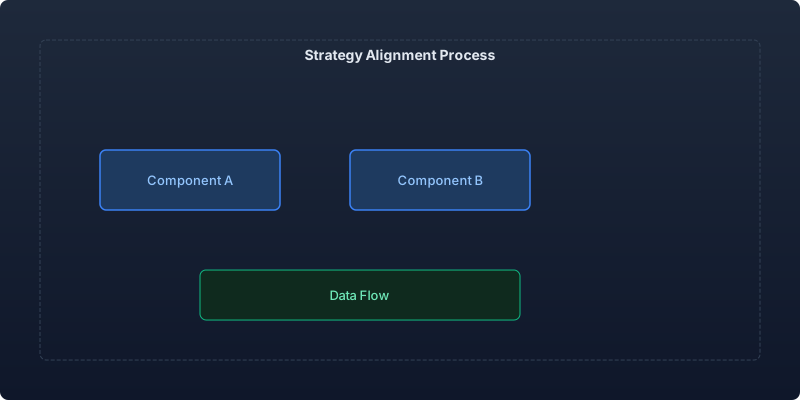
Day 1-2: Draft Write the document in isolation. This is the controversial part — I don't write by committee. A single author creates coherence. The document reflects one mind's model of how things fit together.
Day 3: Trusted Reviewers (3-4 people) Share with 3-4 senior engineers whose judgment I trust and who represent different teams. Ask specific questions: "Where does this conflict with your team's reality? What am I missing?"
Day 4: Revise and Publish Incorporate feedback, publish to the entire engineering org. Explicitly invite challenges: "If you disagree with a bet, write a one-page counterproposal with your reasoning."
Day 5-6: Open Discussion Hold two 1-hour sessions (for timezone coverage) where anyone can ask questions, challenge bets, or propose modifications. I take notes and commitments.
Day 7: Final Version Publish the final version with a change log showing what feedback changed. This demonstrates that input matters.
Key rule: People need to see their feedback reflected in the output. If you ignored their input, explain why. Otherwise they'll never give honest feedback again.
Common Objections and Responses
| Objection | Response |
|---|---|
| "This removes my autonomy" | "You have full autonomy within these boundaries. The boundaries exist so your autonomy doesn't collide with other teams' autonomy." |
| "What if a bet is wrong?" | "Every bet has explicit reversal conditions. If we hit them, we revisit. Strategy is not permanent." |
| "My team has unique requirements" | "Write a one-page exception proposal. If the reasoning is sound, we'll add it to the exceptions list." |
| "This is too prescriptive" | "What would you remove? Genuine question — maybe some bets should be non-decisions." |
Keeping the Strategy Alive
A strategy document is useless if it's written once and forgotten. We maintain ours through:
- Quarterly review: 30-minute session reviewing each bet. Still valid? Any reversal conditions met?
- Decision log: Every architecture decision references which strategy principle it follows
- New hire onboarding: Week-1 reading material with a 30-minute discussion with their manager
- Exception tracking: All approved exceptions are listed in the document's appendix
Key Takeaways
-
8 pages maximum — if leadership can't articulate strategy concisely, engineers won't internalize it. Brevity forces clarity.
-
Principles > rules — principles let engineers make new decisions without asking permission. Rules only cover cases you've already thought of.
-
Explicit non-decisions reduce anxiety — when teams know what's intentionally left open, they stop worrying about implicit mandates.
-
Single author, collaborative review — committee-written strategies lack coherence. Write it alone, refine it with input.
-
Reversal conditions prevent dogma — every bet should state when it would be wrong. This makes the strategy adaptable without making it wishy-washy.
-
Process creates buy-in, not the document — the week-long alignment process (review → discuss → incorporate feedback → publish) turns a document into shared understanding.
The best technical strategy doesn't feel like a constraint — it feels like clarity. Engineers stop debating infrastructure choices and start building product. That's the sign it's working.
Recommended reading
The Legacy of Leadership: What Remains When You Leave
The thing people remember is not your architecture. It is not your processes. It is how you made them feel. Reflections on what actually endures from engineering leadership.
What 3 A.M. Incidents Taught Me That AWS Certifications Never Did
Twenty production incidents reviewed: why understanding beats fixing, what certifications actually train, and the habits that keep a team calm at 3 a.m.
An Engineering Leader's Sustainable Weekly Rhythm
A realistic weekly rhythm that balances strategy, people, and operational work — without burning out or losing yourself in back-to-back meetings.



Comments
No comments yet. Be the first to share your thoughts.