When Your Best Engineer Wants to Leave: The Conversation That Actually Matters
The retention conversation that matters is not about counter-offers. It is about listening deeply enough to understand what someone needs — and being honest about whether you can provide it.

Aisha walked into our one-on-one with a look I'd seen before. That careful neutrality. The slightly rehearsed posture. Before she said a word, I knew.
"I've been talking to another company."
My stomach dropped. Aisha was our best systems engineer. She'd designed our event-driven architecture from scratch. She knew where every body was buried in the codebase. Losing her would set us back months — maybe more.
My instinct was immediate: match the offer. Give her a raise. A title bump. Whatever it takes. I'd seen other managers panic-counter their way into retention, and I almost did the same thing.
But something stopped me. A question my own mentor had asked me years earlier: "If you have to bribe someone to stay, have you already lost them?"
Instead of reaching for my wallet, I asked: "Tell me about what's pulling you toward them."
What followed was the most important 45 minutes of my year as a leader. And it changed everything about how I think about retention.
Why Counter-Offers Almost Always Fail
Let me share a painful statistic: according to multiple studies, 50-80% of people who accept a counter-offer leave within 12 months anyway. The money or title might address the symptom, but the underlying need — the thing that made them start looking in the first place — remains unmet.
By the time someone tells you they're leaving, they've been emotionally disengaging for weeks, sometimes months. They've imagined a different future. They've mentally checked out of certain aspects of the work. A counter-offer doesn't rewind that emotional journey. It just pauses it.
More insidiously, counter-offers create a terrible dynamic: the person learns that the only way to get what they need is to threaten to leave. And you learn that you only pay attention to people's needs when they're one foot out the door. Both lessons are toxic.
The Conversation That Actually Matters
When Aisha told me she was talking to another company, here's what I did instead of counter-offering:
I thanked her for telling me. Genuinely. "Thank you for being honest with me. I know this conversation isn't easy, and I respect that you told me directly instead of just leaving."
I asked what drew her to look. Not "what can I do to keep you?" — that's about me. But "what started this?" — that's about her. There's a universe of difference.
I listened without defending. This was the hardest part. Her answers included things that were partially my fault. "I feel like I've stopped growing." "I don't see a clear path forward." "I'm solving the same problems over and over." Every instinct in me wanted to say "but what about..." Instead, I said "tell me more."
I asked what the other opportunity offered. Not salary (though we got there eventually). But what did the opportunity represent? What need was it meeting that we weren't?
I was honest about what I could and couldn't change. Not "I'll fix everything by Monday." But "here's what I hear you saying, here's what I think I can genuinely improve, here's what's probably not going to change, and here's my honest timeline."
What People Actually Leave For
In my experience, when exceptional engineers leave, it's rarely just about money. The real reasons form a hierarchy:
| Real Reason | What They Say | What They Mean |
|---|---|---|
| Growth ceiling | "I'm not learning anymore" | "I've mastered my current challenges and need new ones" |
| Impact hunger | "I want to work on something bigger" | "My work doesn't feel consequential enough" |
| Autonomy loss | "Too much process / bureaucracy" | "I'm not trusted to make decisions" |
| Belonging gap | "Culture isn't what it used to be" | "I don't feel seen or valued here" |
| Manager relationship | "Looking for new challenges" | "My manager doesn't understand or support me" |
| Compensation misalignment | "I got an offer I can't refuse" | "I feel undervalued relative to my contribution" |
Notice that compensation is at the bottom, not the top. For most high-performers, money is the easiest reason to articulate, but it's rarely the primary driver. It becomes the reason when other needs go unmet for so long that money feels like the only tangible measure of worth.
Aisha's Story (The Rest of It)
When I asked Aisha what the other company offered, the answer wasn't money. It was: "They want me to build their entire platform from scratch. I'd be making architectural decisions at a scale I've never had here."
That was the real pull. Not compensation. Not title. The opportunity to do something new and bigger. To grow in a direction our current structure didn't offer.
I had a choice. I could try to manufacture a similar opportunity at our company. Or I could be honest.
I chose honest: "I hear you. You want to build something from zero again, at a bigger scale. I'm not sure I can offer that here in the next year. Our platform is built. What we need now is someone to evolve it, not rebuild it. And I wonder if that's honestly less exciting for you."
She looked relieved. Not because I'd given her permission to leave — but because I'd finally seen her. I'd named the thing she'd been feeling but hadn't been able to articulate.
We talked for another 20 minutes. I asked if there was any version of her role that would be exciting enough to stay. We brainstormed honestly. We found a possibility: leading the design of our new real-time data pipeline — greenfield work, high stakes, significant autonomy.
Aisha stayed. Not because of a counter-offer, but because the conversation helped both of us see what she actually needed, and we found a way to provide it.
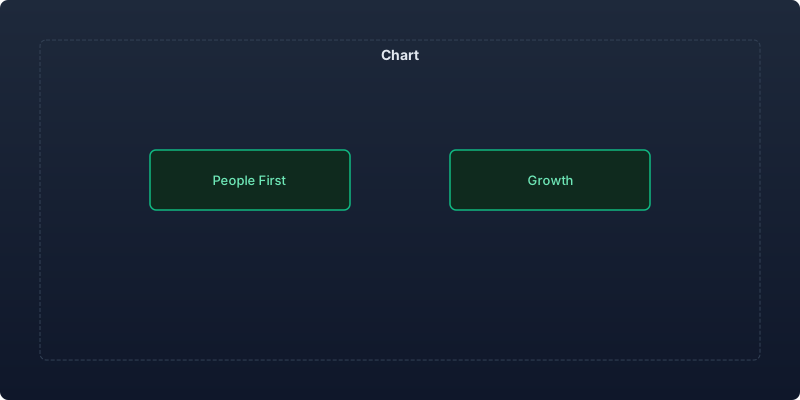
The Prevention Framework (Before They Start Looking)
The retention conversation that matters most isn't the one that happens when someone's already leaving. It's the one that happens six months earlier. Here's what I do now:
Monthly growth check-in. In every one-on-one, I ask some version of: "Are you learning? Are you energized? Is there something you want to be doing that you're not?" These three questions surface dissatisfaction early.
Quarterly career conversation. Separate from performance reviews. Purely forward-looking. "Where do you want to be in a year? What's exciting you? What's boring you? What would make you start looking?"
Annual "stay interview." Yes, literally. "What keeps you here? What might make you leave? What would your dream role look like?" This feels awkward the first time. It becomes invaluable.
Watch the engagement signals. When a high-performer starts declining optional meetings, stops contributing to discussions, or reduces their code review engagement — something has shifted. Don't wait for them to tell you. Ask.
When Staying Isn't the Right Answer
Sometimes the honest outcome of a retention conversation is: they should go.
This is incredibly hard to accept, especially with someone exceptional. But if what they need is genuinely something you can't provide — a different industry, a different stage of company, a role that doesn't exist in your structure — the most loving thing you can do is support their departure gracefully.
I've told people: "I don't want to lose you. But I hear what you're saying, and I think this other opportunity is right for you. Let's make this transition as smooth as possible, and I'll always be in your corner."
Those departures, handled with grace, create lifelong allies. People who refer candidates to you. People who return years later. People who speak well of you in the industry. The relationship doesn't end when the employment does.
The Leader's Self-Reflection
Every time someone exceptional considers leaving, it's worth asking yourself some uncomfortable questions:
- Did I miss the signals? Was this person quietly disengaging and I didn't notice? If so, why?
- Did I invest in their growth proactively? Or did I take their engagement for granted because they were self-sufficient?
- Is there a pattern? If your best people keep leaving for similar reasons, the problem isn't them. It's the environment.
- Am I holding them too tightly? Sometimes we keep people in roles they've outgrown because we depend on them there. That's not leadership — that's hoarding.
What Aisha Taught Me
A year after that conversation, Aisha built the real-time pipeline. It was excellent work — architecturally elegant, beautifully documented, and it solved a problem nobody else on the team could have tackled.
But more importantly, she told me something in a later one-on-one that I'll never forget: "The thing that made me stay wasn't the new project. It was that you actually listened. Nobody had asked me what I needed in years. You made me feel like my growth mattered to you personally."
That's the retention conversation that matters. Not "what will it take to keep you?" but "what do you need to thrive?" Not a transaction, but a genuine act of seeing another person.
You can't keep everyone. You shouldn't try. But you can create an environment where people feel so seen, so supported, so invested in, that leaving feels like losing something precious rather than escaping something draining.
Start with the next one-on-one. Ask the question you've been avoiding. Listen to the answer. And then do something about it — before they start looking.
Recommended reading
The Legacy of Leadership: What Remains When You Leave
The thing people remember is not your architecture. It is not your processes. It is how you made them feel. Reflections on what actually endures from engineering leadership.
What 3 A.M. Incidents Taught Me That AWS Certifications Never Did
Twenty production incidents reviewed: why understanding beats fixing, what certifications actually train, and the habits that keep a team calm at 3 a.m.
An Engineering Leader's Sustainable Weekly Rhythm
A realistic weekly rhythm that balances strategy, people, and operational work — without burning out or losing yourself in back-to-back meetings.



Comments
No comments yet. Be the first to share your thoughts.