Building Reusable CDK Construct Libraries for Platform Teams
Patterns for packaging, versioning, and distributing CDK constructs that enforce organizational standards while giving product teams deployment autonomy.

The Platform Engineering Problem
Every growing engineering organization hits the same inflection point: product teams need to deploy infrastructure independently, but without guardrails they'll create security gaps, cost explosions, and operational blind spots. The platform team becomes a bottleneck if they gate every deployment, but absent if they only write documentation.
CDK construct libraries solve this by encoding organizational standards into reusable, versioned abstractions. Product teams compose these constructs like building blocks — they get deployment autonomy while the platform team enforces compliance through the abstraction itself.
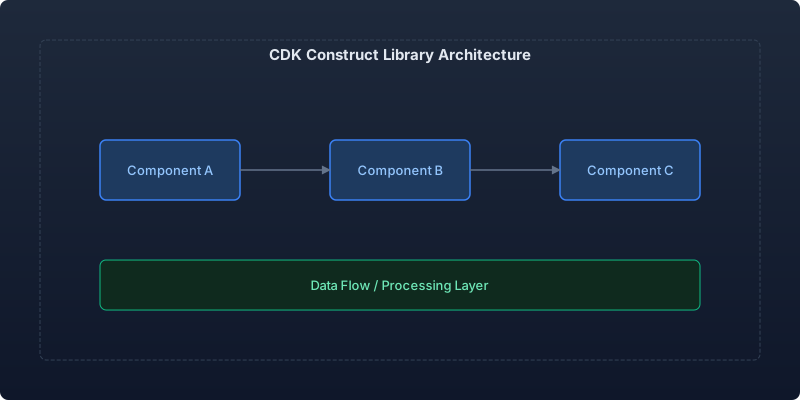
Architecture: The Three-Layer Construct Model
AWS CDK defines three levels of constructs. Your library should operate at L3 (patterns):
- L1 (CFN Resources) — Direct CloudFormation mappings. Raw, no opinions.
- L2 (AWS Constructs) — Sensible defaults, convenience methods. What CDK ships.
- L3 (Patterns) — Opinionated compositions of L2 constructs. This is where your library lives.
Our construct library provides L3 patterns for common deployment scenarios:
// packages/constructs/src/api-service.ts
// L3 Pattern: Production API Service
// Includes: Lambda, API Gateway, WAF, CloudWatch alarms, X-Ray tracing

import { Construct } from 'constructs';
import * as lambda from 'aws-cdk-lib/aws-lambda';
import * as apigateway from 'aws-cdk-lib/aws-apigateway';
import * as wafv2 from 'aws-cdk-lib/aws-wafv2';
import * as cloudwatch from 'aws-cdk-lib/aws-cloudwatch';

export interface ApiServiceProps {
  /** Service name — used for naming, tagging, and alarm namespaces */
  serviceName: string;
  /** Lambda handler path */
  handler: string;
  /** Code asset directory */
  codeDirectory: string;
  /** Memory allocation in MB (default: 512) */
  memorySize?: number;
  /** Custom domain configuration */
  domainName?: string;
  /** Team tag for cost allocation */
  team: string;
  /** Alert SNS topic ARN */
  alertTopicArn: string;
  /** Disable WAF for internal APIs */
  disableWaf?: boolean;
}

export class ApiService extends Construct {
  public readonly function: lambda.Function;
  public readonly api: apigateway.RestApi;

  constructor(scope: Construct, id: string, props: ApiServiceProps) {
    super(scope, id);

    // Enforce organizational standards
    this.function = new lambda.Function(this, 'Handler', {
      runtime: lambda.Runtime.NODEJS_20_X, // Enforced: no older runtimes
      handler: props.handler,
      code: lambda.Code.fromAsset(props.codeDirectory),
      memorySize: props.memorySize ?? 512,
      timeout: cdk.Duration.seconds(29), // Enforced: under API GW limit
      tracing: lambda.Tracing.ACTIVE, // Enforced: always trace
      environment: {
        SERVICE_NAME: props.serviceName,
        NODE_OPTIONS: '--enable-source-maps',
      },
      insightsVersion: lambda.LambdaInsightsVersion.VERSION_1_0_229_0,
    });

    // Standard tags for cost allocation
    cdk.Tags.of(this).add('Service', props.serviceName);
    cdk.Tags.of(this).add('Team', props.team);
    cdk.Tags.of(this).add('ManagedBy', 'platform-constructs');

    this.api = new apigateway.RestApi(this, 'Api', {
      restApiName: props.serviceName,
      deployOptions: {
        tracingEnabled: true,
        metricsEnabled: true,
        loggingLevel: apigateway.MethodLoggingLevel.ERROR,
        throttlingRateLimit: 1000,
        throttlingBurstLimit: 500,
      },
    });

    // WAF attached by default (can be disabled for internal APIs)
    if (!props.disableWaf) {
      this.attachWaf(props.serviceName);
    }

    // Standard alarms — every API gets these
    this.createAlarms(props);
  }

  private createAlarms(props: ApiServiceProps) {
    const errorAlarm = new cloudwatch.Alarm(this, 'ErrorAlarm', {
      metric: this.function.metricErrors({ period: cdk.Duration.minutes(5) }),
      threshold: 5,
      evaluationPeriods: 2,
      alarmDescription: `${props.serviceName}: >5 errors in 5 minutes`,
    });

    const throttleAlarm = new cloudwatch.Alarm(this, 'ThrottleAlarm', {
      metric: this.function.metricThrottles({ period: cdk.Duration.minutes(5) }),
      threshold: 10,
      evaluationPeriods: 1,
      alarmDescription: `${props.serviceName}: Lambda throttled`,
    });
  }
}
Product teams use this construct with a single declaration:
// Product team's stack — minimal configuration, full compliance
import { ApiService } from '@acme/platform-constructs';

const orderService = new ApiService(this, 'OrderService', {
  serviceName: 'order-api',
  handler: 'index.handler',
  codeDirectory: '../dist',
  team: 'commerce',
  alertTopicArn: alertTopic.topicArn,
});

// Extend with custom resources as needed
orderService.api.root.addResource('orders').addMethod('POST',
  new apigateway.LambdaIntegration(orderService.function)
);
The product team writes 12 lines. They get WAF protection, CloudWatch alarms, X-Ray tracing, cost allocation tags, runtime enforcement, and timeout guardrails — all without knowing the details.
Versioning and Distribution
Construct libraries are npm packages (for TypeScript CDK) distributed via a private registry:
{
  "name": "@acme/platform-constructs",
  "version": "3.2.1",
  "peerDependencies": {
    "aws-cdk-lib": "^2.130.0",
    "constructs": "^10.0.0"
  },
  "publishConfig": {
    "registry": "https://npm.pkg.github.com"
  }
}
Versioning strategy:
- Major version — Breaking changes (renamed props, removed constructs). Requires product team migration.
- Minor version — New constructs, new optional props. Backward compatible.
- Patch version — Bug fixes, security patches. Auto-upgraded via dependabot.
We enforce minimum library versions via a CDK aspect that runs at synth time:
// Aspect that validates construct library version
import { IAspect, Annotations } from 'aws-cdk-lib';

export class ConstructVersionValidator implements IAspect {
  constructor(private readonly minimumVersion: string) {}

  visit(node: IConstruct) {
    if (node instanceof ApiService || node instanceof DataStore) {
      const pkg = require('@acme/platform-constructs/package.json');
      if (semver.lt(pkg.version, this.minimumVersion)) {
        Annotations.of(node).addError(
          `Platform constructs version ${pkg.version} is below minimum ${this.minimumVersion}. Run: npm update @acme/platform-constructs`
        );
      }
    }
  }
}
Benchmarks: Impact on Development Velocity
After 12 months of operating our construct library across 8 product teams:
| Metric | Before (Raw CDK) | After (Construct Library) | Improvement |
|---|---|---|---|
| Time to deploy new service | 2-3 days | 2-4 hours | -85% |
| Security audit findings per quarter | 23 | 4 | -83% |
| Non-compliant resources discovered | 47 | 2 (escape hatches) | -96% |
| Platform team PR review burden | 40 PRs/week | 8 PRs/week | -80% |
| Mean time to patch CVE across all services | 3 weeks | 2 days (library update) | -90% |
The security improvement is the biggest win. When WAF rules, encryption standards, and network policies are encoded in the construct, teams can't accidentally skip them — compliance is the default path.
Testing Constructs: Snapshot and Assertion Patterns
Every construct needs two types of tests:
// tests/api-service.test.ts
import { Template, Match } from 'aws-cdk-lib/assertions';
import { App, Stack } from 'aws-cdk-lib';
import { ApiService } from '../src/api-service';

describe('ApiService', () => {
  let template: Template;

  beforeAll(() => {
    const app = new App();
    const stack = new Stack(app, 'TestStack');
    new ApiService(stack, 'TestApi', {
      serviceName: 'test-service',
      handler: 'index.handler',
      codeDirectory: './test-code',
      team: 'platform',
      alertTopicArn: 'arn:aws:sns:us-east-1:123456789:alerts',
    });
    template = Template.fromStack(stack);
  });

  // Assertion test: verify security properties
  test('enforces active X-Ray tracing', () => {
    template.hasResourceProperties('AWS::Lambda::Function', {
      TracingConfig: { Mode: 'Active' },
    });
  });

  test('creates error alarm', () => {
    template.hasResourceProperties('AWS::CloudWatch::Alarm', {
      MetricName: 'Errors',
      Threshold: 5,
    });
  });

  test('attaches WAF by default', () => {
    template.resourceCountIs('AWS::WAFv2::WebACL', 1);
  });

  // Snapshot test: detect unintended changes
  test('matches snapshot', () => {
    expect(template.toJSON()).toMatchSnapshot();
  });
});
Assertion tests validate that security and compliance properties are always present. Snapshot tests catch unintended changes during refactoring — if the synthesized CloudFormation changes unexpectedly, the test fails.
Governance: Escape Hatches and Exceptions
No construct library covers 100% of use cases. Teams need escape hatches, but those escape hatches must be auditable:
- Expose underlying L2 constructs — Let teams access
apiService.functionandapiService.apifor customization. - Log escape hatch usage — Use CDK aspects to detect and report when teams modify enforced properties.
- Exception process — Teams can request exemptions via a lightweight PR against the library's exception registry.
- Deprecation warnings — Use
Annotations.of(node).addWarning()for constructs being phased out.
Conclusion
CDK construct libraries are the platform team's highest-leverage investment. They encode organizational standards into code, provide product teams with deployment autonomy, and reduce the platform team's review burden by 80%.
The key principles: operate at L3 (opinionated patterns), version semantically, test with both assertions and snapshots, expose escape hatches for edge cases, and enforce minimum versions via synth-time validation.
Start with your most-deployed pattern (usually an API service or async worker), encode your security and operational standards into a construct, and distribute it as a versioned package. The construct becomes your org's paved road — the fastest path to production is also the most compliant one.
Recommended reading
Per-Team Cost Allocation in Shared Kubernetes Clusters: From Chaos to Clarity
Implementing accurate per-namespace cost allocation in multi-tenant Kubernetes clusters, covering request vs. usage attribution, shared resource amortization, and building showback dashboards that drive accountability.
Measuring and Eliminating Toil: From 40% to 12% of Engineering Time
A systematic approach to identifying, measuring, and automating toil—the repetitive operational work that scales linearly with service growth and prevents engineers from doing creative work.
Serverless Postgres in Production: Branching, Scale-to-Zero, and the End of Database Provisioning
Running Neon serverless Postgres in production for 8 months — covering database branching workflows, scale-to-zero economics, connection pooling, and migration from RDS.



Comments
No comments yet. Be the first to share your thoughts.