AWS CloudFormation StackSets for Multi-Region Deployments
Implementing CloudFormation StackSets for consistent multi-region and multi-account infrastructure deployment with drift detection and operational strategies

Introduction
CloudFormation StackSets enable deploying identical infrastructure across multiple AWS accounts and regions from a single template. For organizations operating in 3-10 regions with 50-200 accounts, StackSets eliminate the operational burden of managing region-specific deployments individually. A single StackSet update propagates changes to hundreds of stack instances with configurable concurrency and failure tolerance.
This article covers StackSet architecture patterns, operational strategies for safe multi-region rollouts, and drift detection at scale.
StackSets Architecture
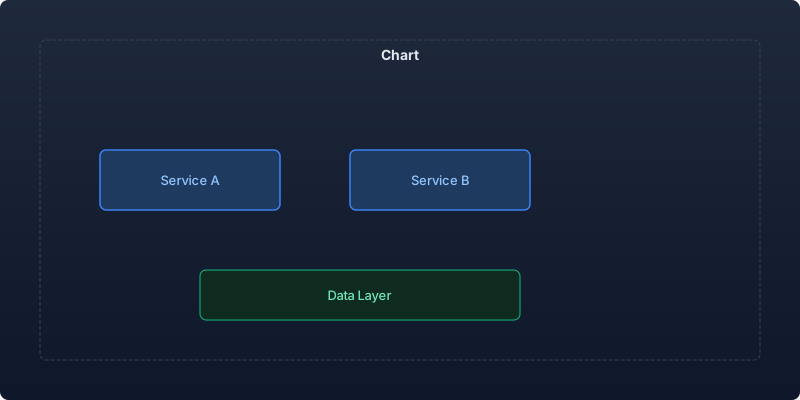
Deployment Models
| Model | Permission | Use Case | Management Account |
|---|---|---|---|
| Self-managed | IAM roles | Legacy, full control | Any account |
| Service-managed | Organizations | Automatic new accounts | Organization management |
| Service-managed (delegated) | Organizations | Security separation | Delegated admin |
Service-Managed vs Self-Managed
| Feature | Self-Managed | Service-Managed |
|---|---|---|
| Permission setup | Manual (IAMroles in each account) | Automatic (Organizations) |
| New account coverage | Manual add | Automatic |
| OU-level targeting | No (account list only) | Yes |
| Automatic drift remediation | No | Yes (with auto-deploy) |
| Account removal handling | Manual cleanup | Automatic (retain/delete) |
| Delegated admin | No | Yes |
Basic StackSet Deployment
Template for Multi-Region Security Baseline
AWSTemplateFormatVersion: '2010-09-09'
Description: Security baseline deployed to all regions via StackSet

Parameters:
  RetentionDays:
    Type: Number
    Default: 90
    Description: CloudWatch log retention in days
  AlertEmail:
    Type: String
    Description: Email for security alerts

Resources:
  SecurityAlertTopic:
    Type: AWS::SNS::Topic
    Properties:
      TopicName: security-alerts
      Subscription:
        - Protocol: email
          Endpoint: !Ref AlertEmail

  ConfigRecorder:
    Type: AWS::Config::ConfigurationRecorder
    Properties:
      RoleARN: !GetAtt ConfigRole.Arn
      RecordingGroup:
        AllSupported: true
        IncludeGlobalResourceTypes: !If
          - IsUsEast1
          - true
          - false

  CloudTrailLogGroup:
    Type: AWS::Logs::LogGroup
    Properties:
      LogGroupName: /aws/cloudtrail/org-trail
      RetentionInDays: !Ref RetentionDays
      KmsKeyId: !GetAtt EncryptionKey.Arn

  EncryptionKey:
    Type: AWS::KMS::Key
    Properties:
      Description: Encryption key for security logs
      EnableKeyRotation: true
      KeyPolicy:
        Version: '2012-10-17'
        Statement:
          - Sid: Enable IAM User Permissions
            Effect: Allow
            Principal:
              AWS: !Sub 'arn:aws:iam::${AWS::AccountId}:root'
            Action: 'kms:*'
            Resource: '*'
          - Sid: Allow CloudTrail
            Effect: Allow
            Principal:
              Service: cloudtrail.amazonaws.com
            Action:
              - kms:GenerateDataKey*
              - kms:DescribeKey
            Resource: '*'

  FlowLogsRole:
    Type: AWS::IAM::Role
    Properties:
      AssumeRolePolicyDocument:
        Version: '2012-10-17'
        Statement:
          - Effect: Allow
            Principal:
              Service: vpc-flow-logs.amazonaws.com
            Action: sts:AssumeRole
      Policies:
        - PolicyName: flow-logs-policy
          PolicyDocument:
            Version: '2012-10-17'
            Statement:
              - Effect: Allow
                Action:
                  - logs:CreateLogGroup
                  - logs:CreateLogStream
                  - logs:PutLogEvents
                  - logs:DescribeLogGroups
                  - logs:DescribeLogStreams
                Resource: '*'

Conditions:
  IsUsEast1: !Equals [!Ref 'AWS::Region', us-east-1]

Outputs:
  SecurityTopicArn:
    Value: !Ref SecurityAlertTopic
    Export:
      Name: security-alert-topic-arn
Deploy StackSet
# Create service-managed StackSet targeting OUs
aws cloudformation create-stack-set \
  --stack-set-name security-baseline \
  --template-body file://security-baseline.yaml \
  --parameters ParameterKey=RetentionDays,ParameterValue=90 \
               ParameterKey=AlertEmail,ParameterValue=security@example.com \
  --permission-model SERVICE_MANAGED \
  --auto-deployment Enabled=true,RetainStacksOnAccountRemoval=false \
  --capabilities CAPABILITY_NAMED_IAM \
  --managed-execution Active=true

# Deploy to specific OUs and regions
aws cloudformation create-stack-instances \
  --stack-set-name security-baseline \
  --deployment-targets OrganizationalUnitIds='["ou-abc-production","ou-def-staging"]' \
  --regions us-east-1 us-west-2 eu-west-1 eu-central-1 ap-southeast-1 \
  --operation-preferences '{
    "RegionConcurrencyType": "PARALLEL",
    "MaxConcurrentPercentage": 25,
    "FailureTolerancePercentage": 10
  }'
Safe Multi-Region Rollout Strategy
Phased Deployment
| Phase | Regions | Accounts | Concurrency | Failure Tolerance | Duration |
|---|---|---|---|---|---|
| 1 (Canary) | us-east-1 | Sandbox OU (5 accounts) | 1 | 0% | 15 min |
| 2 (Expand) | us-east-1, eu-west-1 | NonProd OU (20 accounts) | 25% | 10% | 30 min |
| 3 (Prod) | All 5 regions | All OUs (100 accounts) | 50% | 5% | 60 min |
# Phase 1: Canary deployment
aws cloudformation update-stack-instances \
  --stack-set-name security-baseline \
  --deployment-targets OrganizationalUnitIds='["ou-sandbox"]' \
  --regions us-east-1 \
  --operation-preferences '{
    "MaxConcurrentCount": 1,
    "FailureToleranceCount": 0
  }'

# Wait and validate
aws cloudformation describe-stack-set-operation \
  --stack-set-name security-baseline \
  --operation-id <operation-id> \
  --query 'StackSetOperation.Status'

# Phase 2: Expand to non-prod
aws cloudformation update-stack-instances \
  --stack-set-name security-baseline \
  --deployment-targets OrganizationalUnitIds='["ou-nonprod"]' \
  --regions us-east-1 eu-west-1 \
  --operation-preferences '{
    "MaxConcurrentPercentage": 25,
    "FailureTolerancePercentage": 10
  }'

# Phase 3: Full production rollout
aws cloudformation update-stack-instances \
  --stack-set-name security-baseline \
  --deployment-targets OrganizationalUnitIds='["ou-production","ou-nonprod","ou-sandbox"]' \
  --regions us-east-1 us-west-2 eu-west-1 eu-central-1 ap-southeast-1 \
  --operation-preferences '{
    "RegionConcurrencyType": "PARALLEL",
    "MaxConcurrentPercentage": 50,
    "FailureTolerancePercentage": 5
  }'
Drift Detection at Scale
# Detect drift across all stack instances
aws cloudformation detect-stack-set-drift \
  --stack-set-name security-baseline

# Check drift status
aws cloudformation describe-stack-set-operation \
  --stack-set-name security-baseline \
  --operation-id <drift-operation-id> \
  --query 'StackSetOperation.{Status:Status,DriftStatus:StackSetDriftDetectionDetails.DriftStatus,DriftedCount:StackSetDriftDetectionDetails.DriftedStackInstancesCount}'
Automated Drift Remediation
import boto3

def remediate_drift(stack_set_name):
    """Detect and remediate drift in StackSet instances."""
    cfn = boto3.client('cloudformation')

    # Start drift detection
    response = cfn.detect_stack_set_drift(StackSetName=stack_set_name)
    operation_id = response['OperationId']

    # Wait for completion (simplified)
    waiter = cfn.get_waiter('stack_set_operation_complete')
    waiter.wait(StackSetName=stack_set_name, OperationId=operation_id)

    # Get drifted instances
    paginator = cfn.get_paginator('list_stack_instances')
    drifted = []

    for page in paginator.paginate(
        StackSetName=stack_set_name,
        Filters=[{'Name': 'DRIFT_STATUS', 'Values': 'DRIFTED'}]
    ):
        drifted.extend(page['Summaries'])

    if drifted:
        # Update drifted instances to restore desired state
        accounts = list(set(d['Account'] for d in drifted))
        regions = list(set(d['Region'] for d in drifted))

        cfn.update_stack_instances(
            StackSetName=stack_set_name,
            Accounts=accounts,
            Regions=regions,
            OperationPreferences={
                'MaxConcurrentPercentage': 25,
                'FailureTolerancePercentage': 10
            }
        )

    return len(drifted)
Operational Metrics
| Metric | Target | Measurement |
|---|---|---|
| Deployment success rate | > 98% | Successful instances / total |
| Drift rate | < 5% | Drifted instances / total |
| Deployment duration (100 accounts, 5 regions) | < 90 min | Operation end - start |
| Rollback frequency | < 2% of deployments | Rollbacks / total updates |
| Mean time to detect drift | < 24 hours | Scheduled drift detection |
Common Patterns
Region-Aware Conditionals
Conditions:
  IsUsEast1: !Equals [!Ref 'AWS::Region', us-east-1]
  IsPrimaryRegion: !Or
    - !Equals [!Ref 'AWS::Region', us-east-1]
    - !Equals [!Ref 'AWS::Region', eu-west-1]

Resources:
  # Only create global resources in us-east-1
  IAMRole:
    Type: AWS::IAM::Role
    Condition: IsUsEast1
    Properties:
      RoleName: global-security-role
      # ... IAM role is global, only need one

  # Create in primary regions only
  ReplicatedBucket:
    Type: AWS::S3::Bucket
    Condition: IsPrimaryRegion
    Properties:
      BucketName: !Sub 'security-logs-${AWS::Region}'
Parameter Overrides Per Region
# Override parameters for specific regions/accounts
aws cloudformation create-stack-instances \
  --stack-set-name security-baseline \
  --deployment-targets OrganizationalUnitIds='["ou-production"]' \
  --regions eu-west-1 eu-central-1 \
  --parameter-overrides ParameterKey=RetentionDays,ParameterValue=365
Key Takeaways
- Use service-managed StackSets with Organizations for automatic coverage of new accounts and OU-level targeting without manual IAM role setup.
- Deploy in phases (canary, expand, production) with increasing concurrency and decreasing failure tolerance at each stage.
- Enable auto-deployment so new accounts joining an OU automatically receive the stack without manual intervention.
- Run drift detection on a daily schedule and auto-remediate drifted instances to maintain configuration consistency.
- Use region-aware conditionals for global resources (IAM, Route53) that should only be created in a single region.
- Set failure tolerance to 5-10% for production deployments to allow graceful handling of individual account issues without blocking the entire rollout.
- Keep StackSet templates focused and modular since a single large template is harder to debug across 500 stack instances than multiple smaller templates.
Recommended reading
Per-Team Cost Allocation in Shared Kubernetes Clusters: From Chaos to Clarity
Implementing accurate per-namespace cost allocation in multi-tenant Kubernetes clusters, covering request vs. usage attribution, shared resource amortization, and building showback dashboards that drive accountability.
Measuring and Eliminating Toil: From 40% to 12% of Engineering Time
A systematic approach to identifying, measuring, and automating toil—the repetitive operational work that scales linearly with service growth and prevents engineers from doing creative work.
Serverless Postgres in Production: Branching, Scale-to-Zero, and the End of Database Provisioning
Running Neon serverless Postgres in production for 8 months — covering database branching workflows, scale-to-zero economics, connection pooling, and migration from RDS.



Comments
No comments yet. Be the first to share your thoughts.