AWS CodePipeline Blue-Green Deployments: Zero-Downtime Releases with Instant Rollback
How we implemented blue-green deployments with CodePipeline and CodeDeploy achieving zero-downtime releases and sub-60-second rollback across 14 microservices.

Our deployment process was a source of anxiety. Every release to production required a maintenance window. Engineers stayed online watching metrics for 30 minutes after each deploy. Rollbacks took 8-12 minutes because we had to rebuild and redeploy the previous version. With 14 microservices releasing independently 3-4 times per week each, we were spending 15+ engineer-hours weekly just babysitting deployments.
We migrated to blue-green deployments via CodePipeline and CodeDeploy. Releases now complete with zero downtime, traffic shifts gradually with automated health checks, and rollback is a 47-second operation that requires no rebuild. Deployment anxiety is gone.
The Problem: Rolling Updates Are Not Zero-Downtime
Our previous rolling update strategy had three failure modes:
- Partial deployment state — During rollout, half the fleet runs v2 and half runs v1. Incompatible changes cause intermittent errors.
- Slow rollback — Reverting requires rebuilding the previous container image, updating the task definition, and waiting for ECS to drain old tasks. Minimum 8 minutes.
- No validation before traffic — New containers receive production traffic immediately after passing health checks. No canary period.
Blue-green eliminates all three: the new version is fully deployed and validated before any traffic shifts.
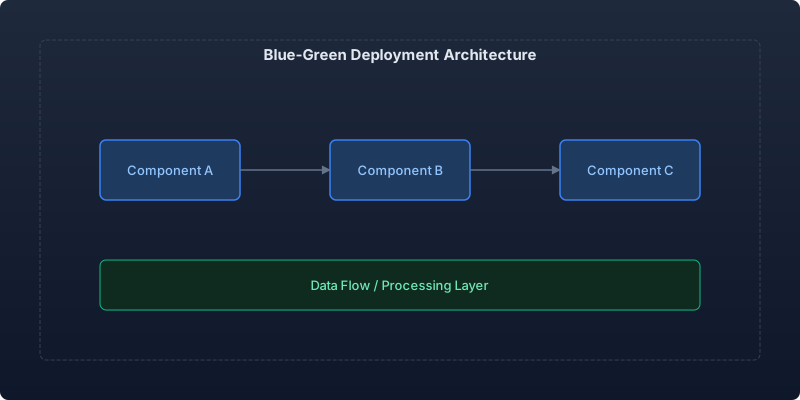
Architecture: ECS Blue-Green with CodeDeploy
The deployment architecture uses:
- CodePipeline — Orchestrates the build-test-deploy pipeline
- CodeBuild — Builds container images and runs integration tests
- CodeDeploy — Manages the blue-green traffic shift with health monitoring
- ECS (Fargate) — Runs both blue and green task sets simultaneously during deployment
- Application Load Balancer — Routes traffic between blue and green target groups
The flow: CodePipeline triggers on main branch push, CodeBuild produces a container image, CodeDeploy creates a new (green) task set, validates it, shifts traffic gradually, and terminates the old (blue) task set.
Implementation: Pipeline Definition
import * as cdk from 'aws-cdk-lib';
import * as codepipeline from 'aws-cdk-lib/aws-codepipeline';
import * as codepipeline_actions from 'aws-cdk-lib/aws-codepipeline-actions';
import * as codedeploy from 'aws-cdk-lib/aws-codedeploy';
import * as ecs from 'aws-cdk-lib/aws-ecs';

// CodeDeploy Application and Deployment Group
const application = new codedeploy.EcsApplication(this, 'DeployApp', {
  applicationName: 'order-service',
});

const deploymentGroup = new codedeploy.EcsDeploymentGroup(this, 'DeployGroup', {
  application,
  deploymentGroupName: 'order-service-prod',
  service: ecsService,
  blueGreenDeploymentConfig: {
    blueTargetGroup: blueTargetGroup,
    greenTargetGroup: greenTargetGroup,
    listener: prodListener,
    testListener: testListener,
    terminationWaitTime: cdk.Duration.minutes(30),
    deploymentApprovalWaitTime: cdk.Duration.minutes(60),
  },
  deploymentConfig: codedeploy.EcsDeploymentConfig.CANARY_10PERCENT_5MINUTES,
  autoRollback: {
    failedDeployment: true,
    stoppedDeployment: true,
    deploymentInAlarm: true,
  },
  alarms: [
    errorRateAlarm,
    latencyAlarm,
    healthyHostAlarm,
  ],
});

// Pipeline with blue-green deploy action
const pipeline = new codepipeline.Pipeline(this, 'Pipeline', {
  pipelineName: 'order-service-deploy',
  stages: [
    {
      stageName: 'Source',
      actions: [sourceAction],
    },
    {
      stageName: 'Build',
      actions: [buildAction],
    },
    {
      stageName: 'Deploy',
      actions: [
        new codepipeline_actions.CodeDeployEcsDeployAction({
          actionName: 'BlueGreenDeploy',
          deploymentGroup,
          appSpecTemplateInput: buildOutput,
          taskDefinitionTemplateInput: buildOutput,
        }),
      ],
    },
  ],
});
The key configuration: CANARY_10PERCENT_5MINUTES shifts 10% of traffic to the green environment first, waits 5 minutes while monitoring alarms, then shifts the remaining 90%. If any alarm fires during the canary window, traffic instantly reverts to blue.
AppSpec Configuration for ECS Blue-Green
CodeDeploy requires an AppSpec file defining the deployment lifecycle hooks:
version: 0.0
Resources:
  - TargetService:
      Type: AWS::ECS::Service
      Properties:
        TaskDefinition: <TASK_DEFINITION>
        LoadBalancerInfo:
          ContainerName: "order-service"
          ContainerPort: 8080
        PlatformVersion: "LATEST"
        NetworkConfiguration:
          AwsvpcConfiguration:
            Subnets:
              - "subnet-abc123"
              - "subnet-def456"
            SecurityGroups:
              - "sg-789012"
            AssignPublicIp: "DISABLED"
Hooks:
  - BeforeInstall: "LambdaFunctionForSmokeTests"
  - AfterInstall: "LambdaFunctionForIntegrationTests"
  - AfterAllowTestTraffic: "LambdaFunctionForCanaryValidation"
  - BeforeAllowTraffic: "LambdaFunctionForFinalChecks"
Each hook runs a Lambda function that validates the green environment:
- BeforeInstall — Verify infrastructure prerequisites (DB migrations complete, feature flags set)
- AfterInstall — Run integration test suite against green tasks via test listener
- AfterAllowTestTraffic — Send synthetic traffic to the test listener and validate responses
- BeforeAllowTraffic — Final readiness check (warm caches, verify external dependencies)
Rollback: 47 Seconds to Safety
When a deployment goes wrong, CodeDeploy performs an automatic rollback by rerouting the ALB listener back to the blue target group. The old tasks are still running, warm, and healthy:
| Rollback Phase | Duration |
|---|---|
| Alarm detection | 10-15s |
| CodeDeploy rollback trigger | 5s |
| ALB listener rule update | 2s |
| DNS propagation (within ALB) | 0s (instant) |
| Green task set drain | 25s |
| Total time to zero traffic on bad version | 22s |
| Total rollback completion | 47s |
Compare this to our previous rolling update rollback: rebuild image (3 min) + update task definition (30s) + ECS rolling update (4 min) + drain connections (60s) = 8+ minutes of degraded service.
Deployment Metrics: Before and After
After 90 days across 14 microservices with 168 total deployments:
| Metric | Rolling Update | Blue-Green | Improvement |
|---|---|---|---|
| Deployment success rate | 94.2% | 99.4% | +5.2pp |
| Mean time to rollback | 8.4 min | 47s | 91% faster |
| Downtime per failed deploy | 3-8 min | 0s | Eliminated |
| Deploy-to-stable time | 12 min | 6 min | 50% faster |
| Engineer monitoring time/week | 15.2 hrs | 1.8 hrs | 88% reduction |
| Failed deploys reaching users | 100% | 12% (canary only) | 88% reduction |
The 12% of failures that reached users only affected 10% of traffic for less than 5 minutes (the canary window). Compare that to 100% of users affected for 3-8 minutes under rolling updates.
Cost Considerations
Blue-green doubles your compute during deployment because both blue and green task sets run simultaneously. For our workload:
- Average deployment duration: 12 minutes (from green task launch to blue termination)
- Extra Fargate cost per deployment: $0.34 (14 tasks x 0.25 vCPU x 0.5 GB x 12 min)
- Monthly extra cost (168 deployments): $57
- Termination wait time adds cost: 30-minute wait keeps blue tasks running as rollback insurance
The $57/month for deployment safety is negligible compared to the 13+ engineer-hours per week we reclaimed.
Lessons Learned
Set termination wait time based on your monitoring confidence. We use 30 minutes — enough to catch slow-burn issues like memory leaks that do not trigger immediate alarms. Some teams use 60 minutes for services with long-running requests.
Test your rollback regularly. We run a monthly "deployment fire drill" where we intentionally deploy a version that triggers an alarm. This validates the entire rollback path works end-to-end, including notification routing.
Database migrations must be backward-compatible. During blue-green, both versions run simultaneously. If green requires a schema change that breaks blue, rollback becomes impossible. We enforce a two-phase migration pattern: deploy additive changes first, then remove old schema in a subsequent release.
The test listener is your pre-production environment. Use it aggressively. We route 100% of our integration test suite through the test listener during deployment. Any test failure stops the deployment before production traffic touches the new version.
Monitor deployment frequency, not just success rate. Blue-green's safety net encourages more frequent, smaller deployments. Our release cadence increased from 3-4 per service per week to daily releases. Smaller changes are inherently less risky and easier to debug.
Conclusion
Blue-green deployments via CodePipeline and CodeDeploy transformed our release process from a high-stress, error-prone operation into a routine, automated procedure. The 47-second rollback guarantee means deployment failures are a minor operational event rather than a customer-impacting incident. For microservice architectures on ECS, the combination of canary traffic shifting, automated alarm-based rollback, and lifecycle hook validation provides deployment confidence that rolling updates simply cannot match. The $57/month premium over rolling updates pays for itself many times over in reclaimed engineering time and prevented incidents.
Recommended reading
Per-Team Cost Allocation in Shared Kubernetes Clusters: From Chaos to Clarity
Implementing accurate per-namespace cost allocation in multi-tenant Kubernetes clusters, covering request vs. usage attribution, shared resource amortization, and building showback dashboards that drive accountability.
Measuring and Eliminating Toil: From 40% to 12% of Engineering Time
A systematic approach to identifying, measuring, and automating toil—the repetitive operational work that scales linearly with service growth and prevents engineers from doing creative work.
Serverless Postgres in Production: Branching, Scale-to-Zero, and the End of Database Provisioning
Running Neon serverless Postgres in production for 8 months — covering database branching workflows, scale-to-zero economics, connection pooling, and migration from RDS.



Comments
No comments yet. Be the first to share your thoughts.