AWS DMS Continuous Replication for Hybrid Cloud Architectures
Building reliable continuous replication between on-premises databases and AWS using DMS — handling schema drift, network failures, and validation at scale.

Hybrid cloud isn't a temporary state for most enterprises — it's a permanent architecture. When your on-premises Oracle database must stay authoritative for compliance reasons but your cloud-native applications need that data with sub-second freshness, continuous replication becomes critical infrastructure. Not a migration tool you run once — a permanent data pipeline that must never fall behind.
We built a continuous replication architecture using AWS DMS that keeps 14 source databases synchronized with their AWS targets, processing 2.8 billion change events daily with a 99.97% uptime SLA.
The Problem: Stale Data in Cloud Applications
Our hybrid architecture had cloud-native microservices reading from AWS databases that were refreshed via nightly ETL jobs. This 24-hour data staleness created cascading problems:
| Issue | Business Impact | Frequency |
|---|---|---|
| Customer sees outdated account balance | Support tickets, trust erosion | 200+ daily |
| Inventory count mismatch | Overselling, fulfillment failures | 50+ daily |
| Compliance report discrepancies | Audit findings, regulatory risk | Monthly |
| Pricing updates delayed | Revenue leakage | Every price change |
| Employee data out of sync | Access control gaps | Every org change |
The business demanded real-time data freshness. The infrastructure team demanded reliability. We needed both.
Architecture: Multi-Source Continuous Replication
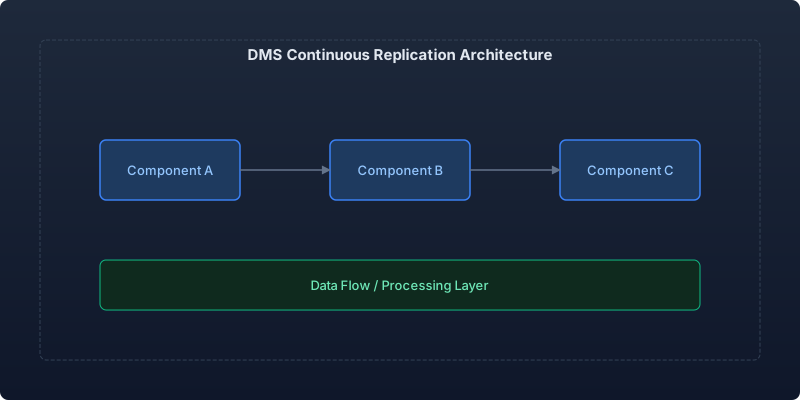
The architecture connects 14 source databases through a fleet of DMS replication instances to their respective AWS targets. Each source-target pair runs as an independent task with its own CDC stream, allowing independent failure recovery.
Replication Topology
| Source | Target | Records/Day | Avg Lag | Instance Type |
|---|---|---|---|---|
| Oracle (Orders) | Aurora PostgreSQL | 450M | 1.2s | dms.r6i.2xlarge |
| Oracle (Inventory) | Aurora PostgreSQL | 280M | 0.8s | dms.r6i.xlarge |
| Oracle (Customers) | DynamoDB | 120M | 2.1s | dms.r6i.xlarge |
| SQL Server (Finance) | Aurora PostgreSQL | 85M | 1.5s | dms.r6i.large |
| SQL Server (HR) | Aurora PostgreSQL | 12M | 0.5s | dms.r6i.large |
| PostgreSQL (Analytics) | Redshift | 1.8B | 45s | dms.r6i.4xlarge |
DMS Task Configuration
// DMS task creation with optimized CDC settings
import { DatabaseMigrationService } from '@aws-sdk/client-database-migration-service';

const dms = new DatabaseMigrationService({ region: 'us-east-1' });

async function createReplicationTask(config: ReplicationConfig) {
  const taskSettings = {
    TargetMetadata: {
      TargetSchema: config.targetSchema,
      SupportLobs: true,
      LobChunkSize: 64,
      LimitedSizeLobMode: true,
      LobMaxSize: 32768,
      ParallelLoadThreads: config.parallelThreads || 8,
      ParallelLoadBufferSize: 500,
      BatchApplyEnabled: true,
      FullLoadMaxRowsToCompare: 10000,
    },
    Logging: {
      EnableLogging: true,
      LogComponents: [
        { Id: 'TRANSFORMATION', Severity: 'LOGGER_SEVERITY_INFO' },
        { Id: 'SOURCE_UNLOAD', Severity: 'LOGGER_SEVERITY_DEFAULT' },
        { Id: 'TARGET_LOAD', Severity: 'LOGGER_SEVERITY_DEFAULT' },
        { Id: 'SOURCE_CAPTURE', Severity: 'LOGGER_SEVERITY_INFO' },
        { Id: 'TARGET_APPLY', Severity: 'LOGGER_SEVERITY_INFO' },
      ],
    },
    ChangeProcessingTuning: {
      BatchApplyPreserveTransaction: true,
      BatchApplyTimeoutMin: 1,
      BatchApplyTimeoutMax: 30,
      BatchSplitSize: 0,
      MemoryLimitTotal: 1024,
      MemoryKeepTime: 60,
      StatementCacheSize: 50,
    },
    ErrorBehavior: {
      DataErrorPolicy: 'LOG_ERROR',
      EventErrorPolicy: 'IGNORE',
      TableErrorPolicy: 'SUSPEND_TABLE',
      RecoverableErrorStopRetryAfterThrottlingMax: true,
      RecoverableErrorThrottlingMax: 1800,
      RecoverableErrorInterval: 5,
      ApplyErrorDeletePolicy: 'IGNORE_RECORD',
      ApplyErrorInsertPolicy: 'LOG_ERROR',
      ApplyErrorUpdatePolicy: 'LOG_ERROR',
    },
    StreamBuffer: {
      StreamBufferCount: 3,
      StreamBufferSizeInMB: 8,
      CtrlStreamBufferSizeInMB: 5,
    },
  };

  return dms.createReplicationTask({
    ReplicationTaskIdentifier: `cdc-${config.sourceName}-to-${config.targetName}`,
    SourceEndpointArn: config.sourceArn,
    TargetEndpointArn: config.targetArn,
    ReplicationInstanceArn: config.instanceArn,
    MigrationType: 'cdc',
    CdcStartPosition: config.startPosition,
    TableMappings: JSON.stringify(config.tableMappings),
    ReplicationTaskSettings: JSON.stringify(taskSettings),
  });
}
Handling Schema Drift
On-premises databases evolve independently of cloud targets. Schema changes on the source that aren't handled gracefully cause replication failures. We built an automated schema drift detection and resolution pipeline:
// Schema drift detector and resolver
interface SchemaDrift {
  type: 'COLUMN_ADDED' | 'COLUMN_REMOVED' | 'COLUMN_TYPE_CHANGED' | 'TABLE_ADDED';
  source: { table: string; column?: string; dataType?: string };
  target: { table: string; column?: string; dataType?: string };
  autoResolvable: boolean;
  resolution?: string;
}

async function detectSchemaDrift(
  sourcePool: Pool,
  targetPool: Pool,
  mappings: TableMapping[]
): Promise<SchemaDrift[]> {
  const drifts: SchemaDrift[] = [];

  for (const mapping of mappings) {
    const sourceColumns = await getTableColumns(sourcePool, mapping.sourceTable);
    const targetColumns = await getTableColumns(targetPool, mapping.targetTable);

    // Detect added columns
    for (const col of sourceColumns) {
      if (!targetColumns.find((tc) => tc.name === mapColumnName(col.name, mapping))) {
        drifts.push({
          type: 'COLUMN_ADDED',
          source: { table: mapping.sourceTable, column: col.name, dataType: col.dataType },
          target: { table: mapping.targetTable },
          autoResolvable: isNullableOrHasDefault(col),
          resolution: `ALTER TABLE ${mapping.targetTable} ADD COLUMN ${mapColumnName(col.name, mapping)} ${mapDataType(col.dataType)};`,
        });
      }
    }

    // Detect type changes
    for (const col of sourceColumns) {
      const targetCol = targetColumns.find((tc) => tc.name === mapColumnName(col.name, mapping));
      if (targetCol && !isCompatibleType(col.dataType, targetCol.dataType)) {
        drifts.push({
          type: 'COLUMN_TYPE_CHANGED',
          source: { table: mapping.sourceTable, column: col.name, dataType: col.dataType },
          target: { table: mapping.targetTable, column: targetCol.name, dataType: targetCol.dataType },
          autoResolvable: isWideningChange(col.dataType, targetCol.dataType),
          resolution: generateAlterStatement(mapping.targetTable, targetCol.name, col.dataType),
        });
      }
    }
  }

  return drifts;
}
We run drift detection every 6 hours. Auto-resolvable drifts (column additions with defaults, type widenings) are applied automatically. Breaking changes trigger PagerDuty alerts for manual review.
Network Resilience: Handling VPN Failures
Direct Connect links fail. VPN tunnels flap. The replication pipeline must handle network interruptions gracefully without requiring full-load recovery:
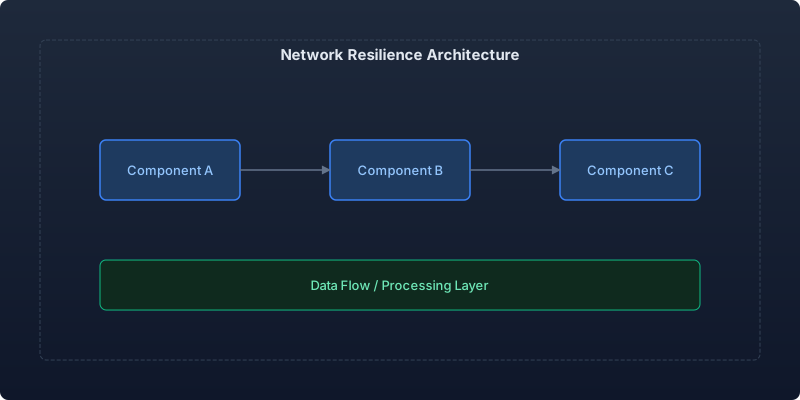
DMS maintains CDC positions in its replication slot/log reader. After a network interruption, it resumes from the last committed position. However, prolonged outages (>24 hours for Oracle) risk source log rotation, which would require a full reload.
Our mitigation strategy:
| Outage Duration | Recovery Strategy | Data Loss Risk |
|---|---|---|
| < 5 minutes | Automatic resume from CDC position | None |
| 5-60 minutes | Resume + validation of affected tables | None |
| 1-24 hours | Resume + full table validation scan | None (logs retained) |
| > 24 hours | Targeted full-load of affected tables | None (but slower) |
#!/bin/bash
# monitor-replication-lag.sh — Alert on growing lag or stalled tasks

TASKS=$(aws dms describe-replication-tasks \
  --filters Name=replication-task-arn,Values=${TASK_ARNS} \
  --query 'ReplicationTasks[].{
    Id:ReplicationTaskIdentifier,
    Status:Status,
    CDCLatency:ReplicationTaskStats.CDCLatencySource,
    TablesLoading:ReplicationTaskStats.TablesLoading,
    TablesErrored:ReplicationTaskStats.TablesErrored
  }' --output json)

echo "$TASKS" | jq -r '.[] | select(.CDCLatency > 60) | .Id' | while read task; do
  echo "ALERT: Task $task has CDC latency > 60 seconds"
  aws cloudwatch put-metric-data \
    --namespace DMS/Custom \
    --metric-name CDCLagCritical \
    --value 1 \
    --dimensions TaskId=$task
done

echo "$TASKS" | jq -r '.[] | select(.TablesErrored > 0) | .Id' | while read task; do
  echo "CRITICAL: Task $task has errored tables"
  # Auto-resume errored tables
  aws dms reload-tables \
    --replication-task-arn "arn:aws:dms:us-east-1:${ACCOUNT}:task:${task}" \
    --tables-to-reload $(get_errored_tables $task)
done
Validation: Continuous Data Integrity Checks
Replication without validation is a trust exercise. We run continuous validation to catch data divergence before downstream applications surface incorrect results:
| Validation Type | Frequency | Scope | Detection Time |
|---|---|---|---|
| Row count comparison | Every 5 min | All tables | 5 min |
| Checksum validation | Hourly | High-priority tables | 1 hour |
| Full row comparison | Daily | Sampled 1% | 24 hours |
| Business rule validation | Real-time | Critical fields | Seconds |
The DMS built-in validation (row count + value comparison) catches most issues. We supplement with business-rule validators for critical data:
-- Continuous validation query: order totals must match
WITH source_totals AS (
  SELECT order_id, SUM(line_amount) as total
  FROM source_orders_replica
  WHERE updated_at > NOW() - INTERVAL '1 hour'
  GROUP BY order_id
),
target_totals AS (
  SELECT order_id, SUM(line_amount) as total
  FROM target_orders
  WHERE updated_at > NOW() - INTERVAL '1 hour'
  GROUP BY order_id
)
SELECT s.order_id, s.total as source_total, t.total as target_total
FROM source_totals s
JOIN target_totals t ON s.order_id = t.order_id
WHERE ABS(s.total - t.total) > 0.01;
Cost Breakdown
| Component | Monthly Cost | Notes |
|---|---|---|
| DMS instances (6 total) | $4,200 | Mixed sizes per workload |
| DMS storage (logs + buffer) | $800 | 2TB total across instances |
| Network transfer (DX) | $1,200 | 2.8B events/day |
| CloudWatch (monitoring) | $180 | Custom metrics + dashboards |
| Lambda (drift detection) | $45 | Runs every 6 hours |
| Total | $6,425/mo |
Compared to the nightly ETL alternative ($2,800/month but with 24h data lag), the $3,600 premium eliminates $180K/year in business impact from stale data.
Key Takeaways
- Continuous replication is infrastructure, not a project — treat it like you treat your database: monitored, maintained, and SLA-bound.
- Batch apply mode is essential for high-throughput sources — single-transaction apply mode can't keep up with 450M changes/day.
- Schema drift detection prevents silent failures — automate what you can, alert on what you can't.
- Validate continuously, not just at setup — data divergence is a when, not an if.
- Size instances for peak, not average — CDC lag during peak hours compounds and takes hours to recover from.
Hybrid cloud replication done well is invisible to application teams — they query AWS databases and get fresh data. Done poorly, it becomes the single most common root cause of data quality incidents. Invest in the monitoring and validation that makes the difference.
Recommended reading
Per-Team Cost Allocation in Shared Kubernetes Clusters: From Chaos to Clarity
Implementing accurate per-namespace cost allocation in multi-tenant Kubernetes clusters, covering request vs. usage attribution, shared resource amortization, and building showback dashboards that drive accountability.
Measuring and Eliminating Toil: From 40% to 12% of Engineering Time
A systematic approach to identifying, measuring, and automating toil—the repetitive operational work that scales linearly with service growth and prevents engineers from doing creative work.
Serverless Postgres in Production: Branching, Scale-to-Zero, and the End of Database Provisioning
Running Neon serverless Postgres in production for 8 months — covering database branching workflows, scale-to-zero economics, connection pooling, and migration from RDS.



Comments
No comments yet. Be the first to share your thoughts.