AWS Transit Gateway Multicast Networking for Distributed Systems
Implementing multicast networking with AWS Transit Gateway to enable efficient one-to-many data distribution across VPCs

Introduction
Multicast networking enables one-to-many data distribution where a single source can efficiently deliver data to multiple receivers simultaneously. AWS Transit Gateway Multicast support brings this capability to cloud environments, enabling use cases like market data feeds, live video distribution, software deployment, and IoT telemetry that would otherwise require complex unicast replication patterns.
Traditional unicast approaches scale linearly with the number of receivers: 100 receivers means 100 copies of the same data. Multicast eliminates this overhead by replicating data at the network level. In production implementations, Transit Gateway multicast reduces bandwidth consumption by 60-90% for one-to-many distribution patterns.
Multicast Architecture on AWS
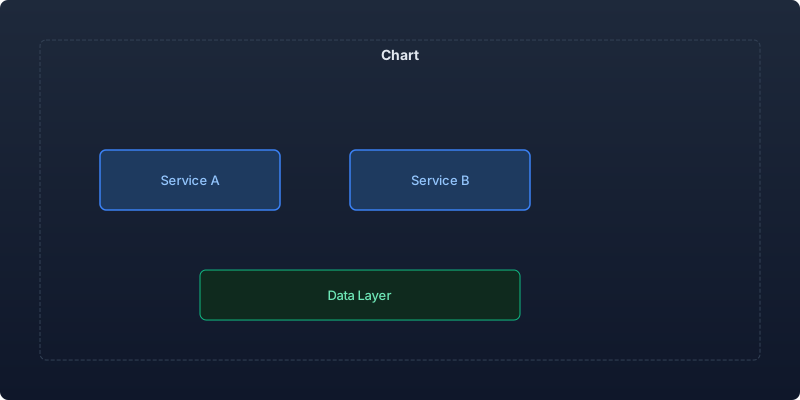
AWS Transit Gateway multicast operates within a multicast domain that spans one or more VPC attachments. Sources and receivers register with the domain to participate in group communication.
Key Components
| Component | Role | Scope |
|---|---|---|
| Transit Gateway | Multicast router | Regional |
| Multicast Domain | Logical grouping | Per TGW |
| Group Source | Data publisher | ENI-level |
| Group Member | Data receiver | ENI-level |
| Multicast Group | IP-based group address | 224.0.0.0/4 |
| IGMP | Group membership protocol | Per subnet |
Setting Up Transit Gateway Multicast
Step 1: Create Transit Gateway with Multicast Support
# Create TGW with multicast enabled
aws ec2 create-transit-gateway \
  --description "Production multicast TGW" \
  --options '{
    "AmazonSideAsn": 64512,
    "AutoAcceptSharedAttachments": "enable",
    "DefaultRouteTableAssociation": "enable",
    "DefaultRouteTablePropagation": "enable",
    "MulticastSupport": "enable",
    "DnsSupport": "enable"
  }'
Step 2: Create Multicast Domain
# Create multicast domain
aws ec2 create-transit-gateway-multicast-domain \
  --transit-gateway-id tgw-0123456789abcdef0 \
  --options '{
    "Igmpv2Support": "enable",
    "StaticSourcesSupport": "enable",
    "AutoAcceptSharedAssociations": "enable"
  }'
Step 3: Associate VPC Subnets
# Associate subnets with multicast domain
aws ec2 associate-transit-gateway-multicast-domain \
  --transit-gateway-multicast-domain-id tgw-mcast-domain-0123456 \
  --transit-gateway-attachment-id tgw-attach-0123456 \
  --subnet-ids subnet-source-001 subnet-receiver-001 subnet-receiver-002
Step 4: Register Sources and Members
# Register multicast source
aws ec2 register-transit-gateway-multicast-group-sources \
  --transit-gateway-multicast-domain-id tgw-mcast-domain-0123456 \
  --group-ip-address 239.1.1.1 \
  --network-interface-ids eni-source-001

# Register multicast members (receivers)
aws ec2 register-transit-gateway-multicast-group-members \
  --transit-gateway-multicast-domain-id tgw-mcast-domain-0123456 \
  --group-ip-address 239.1.1.1 \
  --network-interface-ids eni-receiver-001 eni-receiver-002 eni-receiver-003
Terraform Implementation
resource "aws_ec2_transit_gateway" "multicast" {
  description     = "Production multicast TGW"
  amazon_side_asn = 64512

  multicast_support = "enable"
  dns_support       = "enable"

  default_route_table_association = "enable"
  default_route_table_propagation = "enable"

  tags = {
    Name        = "multicast-tgw"
    Environment = "production"
  }
}

resource "aws_ec2_transit_gateway_multicast_domain" "main" {
  transit_gateway_id = aws_ec2_transit_gateway.multicast.id

  static_sources_support = "enable"
  igmpv2_support         = "enable"

  auto_accept_shared_associations = "enable"

  tags = {
    Name = "market-data-domain"
  }
}

resource "aws_ec2_transit_gateway_vpc_attachment" "source_vpc" {
  subnet_ids         = [aws_subnet.source.id]
  transit_gateway_id = aws_ec2_transit_gateway.multicast.id
  vpc_id             = aws_vpc.source.id
}

resource "aws_ec2_transit_gateway_multicast_domain_association" "source" {
  subnet_id                           = aws_subnet.source.id
  transit_gateway_attachment_id       = aws_ec2_transit_gateway_vpc_attachment.source_vpc.id
  transit_gateway_multicast_domain_id = aws_ec2_transit_gateway_multicast_domain.main.id
}

resource "aws_ec2_transit_gateway_multicast_group_source" "source" {
  group_ip_address                    = "239.1.1.1"
  network_interface_id                = aws_network_interface.source.id
  transit_gateway_multicast_domain_id = aws_ec2_transit_gateway_multicast_domain.main.id
}

resource "aws_ec2_transit_gateway_multicast_group_member" "receivers" {
  for_each = toset(var.receiver_eni_ids)

  group_ip_address                    = "239.1.1.1"
  network_interface_id                = each.value
  transit_gateway_multicast_domain_id = aws_ec2_transit_gateway_multicast_domain.main.id
}
Performance Characteristics
Bandwidth Efficiency: Multicast vs. Unicast
| Receivers | Unicast Bandwidth | Multicast Bandwidth | Savings |
|---|---|---|---|
| 10 | 100 Mbps | 10 Mbps | 90% |
| 50 | 500 Mbps | 10 Mbps | 98% |
| 100 | 1,000 Mbps | 10 Mbps | 99% |
| 500 | 5,000 Mbps | 10 Mbps | 99.8% |
Assuming 10 Mbps source stream. With unicast, each receiver requires a separate copy.
Latency Characteristics
| Metric | Intra-VPC | Cross-VPC (same region) | Cross-AZ |
|---|---|---|---|
| First packet delivery | < 1ms | 1-3ms | 2-5ms |
| Jitter (p99) | < 0.5ms | 1-2ms | 2-4ms |
| Group join latency | < 100ms | 100-500ms | 100-500ms |
| Maximum throughput | 25 Gbps | 50 Gbps (TGW limit) | 50 Gbps |
Source Application: Market Data Publisher
import socket
import struct
import json
import time

class MulticastPublisher:
    def __init__(self, group_address='239.1.1.1', port=5000, ttl=32):
        self.group = group_address
        self.port = port

        self.sock = socket.socket(socket.AF_INET, socket.SOCK_DGRAM, socket.IPPROTO_UDP)
        self.sock.setsockopt(socket.IPPROTO_IP, socket.IP_MULTICAST_TTL, struct.pack('b', ttl))

        # Bind to specific interface for multi-homed hosts
        self.sock.setsockopt(
            socket.IPPROTO_IP,
            socket.IP_MULTICAST_IF,
            socket.inet_aton('10.0.1.10')
        )

    def publish(self, data: dict):
        payload = json.dumps({
            'timestamp': time.time_ns(),
            'sequence': self._next_seq(),
            'data': data
        }).encode('utf-8')

        self.sock.sendto(payload, (self.group, self.port))

    def _next_seq(self):
        if not hasattr(self, '_seq'):
            self._seq = 0
        self._seq += 1
        return self._seq

# Usage
publisher = MulticastPublisher(group_address='239.1.1.1')
publisher.publish({'symbol': 'AAPL', 'price': 185.42, 'volume': 1000})
Receiver Application
import socket
import struct
import json

class MulticastReceiver:
    def __init__(self, group_address='239.1.1.1', port=5000, interface='0.0.0.0'):
        self.group = group_address
        self.port = port

        self.sock = socket.socket(socket.AF_INET, socket.SOCK_DGRAM, socket.IPPROTO_UDP)
        self.sock.setsockopt(socket.SOL_SOCKET, socket.SO_REUSEADDR, 1)
        self.sock.bind(('', port))

        # Join multicast group via IGMP
        mreq = struct.pack(
            '4s4s',
            socket.inet_aton(group_address),
            socket.inet_aton(interface)
        )
        self.sock.setsockopt(socket.IPPROTO_IP, socket.IP_ADD_MEMBERSHIP, mreq)

    def receive(self, buffer_size=65535):
        data, addr = self.sock.recvfrom(buffer_size)
        message = json.loads(data.decode('utf-8'))
        return message, addr

# Usage
receiver = MulticastReceiver(group_address='239.1.1.1')
while True:
    message, source = receiver.receive()
    print(f"Received from {source}: {message}")
Monitoring and Troubleshooting
CloudWatch Metrics for TGW Multicast
# Monitor multicast packets
aws cloudwatch get-metric-statistics \
  --namespace "AWS/TransitGateway" \
  --metric-name "MulticastPacketsIn" \
  --dimensions Name=TransitGateway,Value=tgw-0123456789abcdef0 \
  --start-time "$(date -u -d '1 hour ago' +%Y-%m-%dT%H:%M:%S)" \
  --end-time "$(date -u +%Y-%m-%dT%H:%M:%S)" \
  --period 300 \
  --statistics Sum
Group Membership Verification
# List active multicast group members
aws ec2 search-transit-gateway-multicast-groups \
  --transit-gateway-multicast-domain-id tgw-mcast-domain-0123456 \
  --filters Name=group-ip-address,Values=239.1.1.1

# Verify IGMP join status on instance
sudo tcpdump -i eth0 igmp -nn
Cost Considerations
| Component | Cost | Notes |
|---|---|---|
| Transit Gateway (hourly) | $0.05/hr | Per attachment |
| Data processing | $0.02/GB | Per GB through TGW |
| Multicast domain | Included | No additional charge |
| Cross-AZ data transfer | $0.01/GB | Standard AZ transfer |
For a market data feed at 10 Mbps continuous (3.24 TB/month) with 20 receivers across 4 VPCs:
- Unicast approach: 4 attachments * $36/mo + 64.8 TB * $0.02/GB = $1,440/mo
- Multicast approach: 4 attachments * $36/mo + 3.24 TB * $0.02/GB = $209/mo
- Savings: $1,231/mo (85% reduction)
Key Takeaways
- Transit Gateway multicast eliminates linear bandwidth scaling by replicating data at the network level rather than at the application level.
- Enable IGMP support for dynamic group membership where receivers join and leave groups automatically without manual registration.
- Use static source registration for known publisher endpoints to ensure only authorized sources can transmit to multicast groups.
- Multicast reduces bandwidth costs by 60-99% depending on the number of receivers, with the greatest savings at high receiver counts.
- Cross-VPC multicast latency adds 1-3ms compared to intra-VPC, making it suitable for most real-time applications except ultra-low-latency trading.
- Monitor group membership and packet counts via CloudWatch to detect receivers falling behind or sources failing to transmit.
- Plan multicast group addresses carefully using the 239.x.x.x range (administratively scoped) to avoid conflicts with internet multicast ranges.
Recommended reading
Per-Team Cost Allocation in Shared Kubernetes Clusters: From Chaos to Clarity
Implementing accurate per-namespace cost allocation in multi-tenant Kubernetes clusters, covering request vs. usage attribution, shared resource amortization, and building showback dashboards that drive accountability.
Measuring and Eliminating Toil: From 40% to 12% of Engineering Time
A systematic approach to identifying, measuring, and automating toil—the repetitive operational work that scales linearly with service growth and prevents engineers from doing creative work.
Serverless Postgres in Production: Branching, Scale-to-Zero, and the End of Database Provisioning
Running Neon serverless Postgres in production for 8 months — covering database branching workflows, scale-to-zero economics, connection pooling, and migration from RDS.



Comments
No comments yet. Be the first to share your thoughts.