Container Runtime Security with Falco for Kubernetes
Implementing real-time threat detection in Kubernetes clusters using Falco for syscall-level monitoring and automated incident response

Introduction
Container runtime security is the practice of detecting and responding to threats in running containers. While image scanning catches known vulnerabilities before deployment, runtime security detects active exploitation, lateral movement, and anomalous behavior in real-time. Falco, the CNCF-graduated runtime security project, provides syscall-level monitoring with customizable detection rules.
In production Kubernetes environments, Falco typically detects 15-25 security-relevant events per day per 100-pod cluster, with detection latency under 500 milliseconds from syscall to alert. This article covers deployment architecture, rule engineering, and integration with incident response workflows.
Falco Architecture
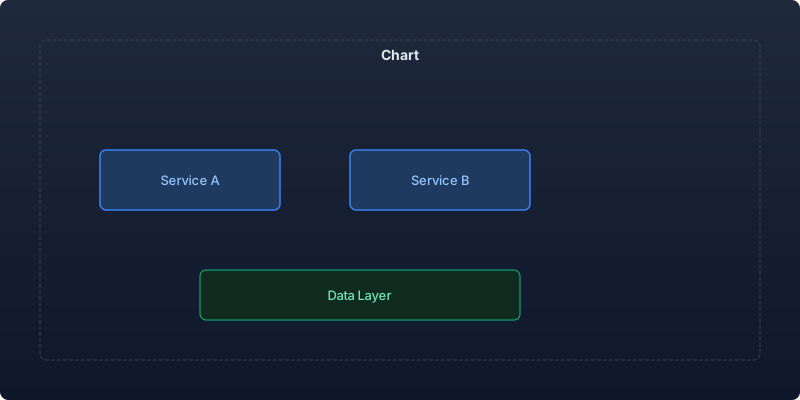
Falco operates by intercepting system calls at the kernel level using either a kernel module or eBPF probe. Every syscall made by every container is evaluated against a rule engine in real-time.
Detection Pipeline
| Stage | Latency | Function |
|---|---|---|
| Syscall capture | < 1μs | Kernel module or eBPF probe |
| Event filtering | < 10μs | Pre-filter uninteresting events |
| Rule evaluation | < 100μs | Match against rule conditions |
| Alert generation | < 1ms | Format and emit alert |
| Alert delivery | 1-50ms | Send to configured outputs |
| Total end-to-end | < 100ms | From syscall to alert delivery |
Deployment with Helm
# Add Falco Helm repo
helm repo add falcosecurity https://falcosecurity.github.io/charts
helm repo update

# Install Falco with eBPF driver
helm install falco falcosecurity/falco \
  --namespace falco-system \
  --create-namespace \
  --set driver.kind=ebpf \
  --set falcosidekick.enabled=true \
  --set falcosidekick.config.slack.webhookurl="https://hooks.slack.com/services/xxx" \
  --set metrics.enabled=true \
  --set falco.grpc.enabled=true \
  --set falco.grpc_output.enabled=true \
  --values custom-values.yaml
Custom Values Configuration
# custom-values.yaml
falco:
  rules_file:
    - /etc/falco/falco_rules.yaml
    - /etc/falco/falco_rules.local.yaml
    - /etc/falco/rules.d

  json_output: true
  json_include_output_property: true
  log_stderr: true
  log_syslog: false
  log_level: info

  priority: notice

  buffered_outputs: false
  outputs_queue:
    capacity: 1024

  syscall_event_drops:
    actions:
      - log
      - alert
    rate: 0.03333
    max_burst: 1

  grpc:
    enabled: true
    bind_address: "unix:///run/falco/falco.sock"
    threadiness: 0

  grpc_output:
    enabled: true

driver:
  kind: ebpf
  ebpf:
    hostNetwork: true
    leastPrivileged: false

resources:
  requests:
    cpu: 100m
    memory: 512Mi
  limits:
    cpu: 1000m
    memory: 1024Mi

tolerations:
  - effect: NoSchedule
    operator: Exists
Custom Rules for Production
Detecting Container Escape Attempts
- rule: Container Escape via Mount Namespace
  desc: Detect attempts to escape container via mount namespace manipulation
  condition: >
    evt.type in (setns, unshare) and
    container.id != host and
    evt.arg.flags contains CLONE_NEWNS
  output: >
    Container escape attempt via namespace manipulation
    (user=%user.name command=%proc.cmdline container=%container.name
     namespace=%k8s.ns.name pod=%k8s.pod.name image=%container.image.repository)
  priority: CRITICAL
  tags: [container, escape, namespace]

- rule: Suspicious Privilege Escalation in Container
  desc: Detect setuid/setgid or capability manipulation
  condition: >
    spawned_process and
    container and
    (proc.name in (sudo, su, doas) or
     evt.type in (setuid, setgid, capset)) and
    not proc.pname in (entrypoint.sh, docker-entrypoint)
  output: >
    Privilege escalation detected
    (user=%user.name command=%proc.cmdline container=%container.name
     parent=%proc.pname ns=%k8s.ns.name)
  priority: CRITICAL
  tags: [container, privilege_escalation]
Detecting Cryptomining
- rule: Detect Cryptomining Activity
  desc: Detect processes connecting to known mining pools or using mining binaries
  condition: >
    spawned_process and container and
    (proc.name in (xmrig, minerd, minergate, cgminer, bfgminer, cpuminer) or
     proc.cmdline contains "stratum+tcp://" or
     proc.cmdline contains "stratum+ssl://" or
     proc.cmdline contains "--coin" or
     (proc.cmdline contains "-o " and proc.cmdline contains ":3333"))
  output: >
    Cryptomining activity detected
    (command=%proc.cmdline container=%container.name
     image=%container.image.repository ns=%k8s.ns.name pod=%k8s.pod.name)
  priority: CRITICAL
  tags: [container, cryptomining, malware]

- rule: Outbound Connection to Mining Pool
  desc: Detect network connections to known mining pool ports
  condition: >
    outbound and container and
    fd.sport in (3333, 4444, 5555, 7777, 8888, 9999, 14433, 14444)
  output: >
    Outbound connection to potential mining pool
    (command=%proc.cmdline connection=%fd.name container=%container.name
     ns=%k8s.ns.name image=%container.image.repository)
  priority: HIGH
  tags: [container, cryptomining, network]
Detecting Lateral Movement
- rule: Kubernetes Service Account Token Access
  desc: Detect reading of service account tokens from within containers
  condition: >
    open_read and container and
    fd.name startswith /var/run/secrets/kubernetes.io/serviceaccount and
    proc.name != pause and
    not k8s_allowed_sa_readers
  output: >
    Service account token read from container
    (file=%fd.name command=%proc.cmdline container=%container.name
     ns=%k8s.ns.name pod=%k8s.pod.name)
  priority: WARNING
  tags: [kubernetes, lateral_movement, credential_access]

- list: k8s_allowed_sa_readers
  items: [kube-proxy, coredns, calico-node, falco]
Performance Impact
Falco's performance overhead varies by driver type and workload:
| Driver | CPU Overhead | Memory | Syscall Latency | Packet Drop Rate |
|---|---|---|---|---|
| Kernel Module | 1-3% | 256-512 MB | < 1μs | < 0.01% |
| eBPF (modern) | 2-5% | 256-512 MB | 1-2μs | < 0.05% |
| eBPF (legacy) | 3-8% | 512 MB-1 GB | 2-5μs | 0.1-0.5% |
| Plugin (no driver) | < 1% | 128-256 MB | N/A | N/A |
Benchmark: Rule Count vs. Performance
| Active Rules | Events/sec (capacity) | CPU Usage | Alert Latency |
|---|---|---|---|
| 50 (default) | 250,000 | 2% | < 50ms |
| 100 | 200,000 | 3% | < 75ms |
| 200 | 150,000 | 5% | < 100ms |
| 500 | 80,000 | 10% | < 200ms |
Integration with Falcosidekick
Falcosidekick provides 60+ output destinations for Falco alerts:
# falcosidekick configuration
config:
  slack:
    webhookurl: "https://hooks.slack.com/services/xxx"
    minimumpriority: "warning"
    messageformat: |
      *Priority:* {{ .Priority }}
      *Rule:* {{ .Rule }}
      *Output:* {{ .Output }}
      *Namespace:* {{ index .OutputFields "k8s.ns.name" }}
      *Pod:* {{ index .OutputFields "k8s.pod.name" }}

  pagerduty:
    routingkey: "your-routing-key"
    minimumpriority: "critical"

  prometheus:
    enabled: true
    listen_address: ":9090"

  kuberneteseventgenerator:
    enabled: true
    minimumpriority: "warning"
Automated Response with Falco Talon
# falco-talon rules for automated response
- action: Terminate Pod
  description: Kill pods with critical security violations
  match:
    rules:
      - Container Escape via Mount Namespace
      - Detect Cryptomining Activity
    priority: critical
  responses:
    - action: kubernetes:terminate
      parameters:
        grace_period_seconds: 0

- action: Network Isolation
  description: Isolate pods with suspicious network activity
  match:
    rules:
      - Outbound Connection to Mining Pool
    priority: high
  responses:
    - action: kubernetes:networkpolicy
      parameters:
        allow:
          - "192.168.0.0/16"
Key Takeaways
- Falco detects threats at the syscall level with under 100ms end-to-end latency from system call to alert delivery, enabling real-time response.
- Use eBPF driver on modern kernels (5.8+) for the best balance of performance and safety, with 2-5% CPU overhead per node.
- Custom rules should target your specific threat model rather than relying solely on default rules which generate noise for generic container workloads.
- Performance scales with rule count so keep active rules under 200 for high-throughput environments processing more than 150,000 events per second.
- Integrate Falcosidekick for multi-channel alerting routing critical alerts to PagerDuty while sending warnings to Slack for review.
- Automated pod termination for critical threats like cryptomining and container escapes reduces mean time to containment from minutes to seconds.
- Monitor Falco itself for dropped events, which indicate the rule engine cannot keep up with syscall volume and requires tuning or scaling.
Recommended reading
Per-Team Cost Allocation in Shared Kubernetes Clusters: From Chaos to Clarity
Implementing accurate per-namespace cost allocation in multi-tenant Kubernetes clusters, covering request vs. usage attribution, shared resource amortization, and building showback dashboards that drive accountability.
Measuring and Eliminating Toil: From 40% to 12% of Engineering Time
A systematic approach to identifying, measuring, and automating toil—the repetitive operational work that scales linearly with service growth and prevents engineers from doing creative work.
Serverless Postgres in Production: Branching, Scale-to-Zero, and the End of Database Provisioning
Running Neon serverless Postgres in production for 8 months — covering database branching workflows, scale-to-zero economics, connection pooling, and migration from RDS.



Comments
No comments yet. Be the first to share your thoughts.