Terraform State Management at Scale: Lessons from 200+ Microservices
How we architected Terraform state management across 200+ microservices with workspace isolation, remote locking, and automated state operations.

When your infrastructure portfolio grows beyond a handful of services, Terraform state management becomes the single most critical operational concern. A corrupted state file at scale does not just block one team — it can cascade across your entire deployment pipeline. After managing Terraform across 200+ microservices serving 40 million requests per day, I want to share the patterns that kept us shipping safely.
The Problem: State as a Bottleneck
At 15 microservices, a single S3 bucket with a DynamoDB lock table works fine. At 200+, you encounter compounding issues:
- Lock contention: Multiple teams competing for the same lock table during peak deployment hours, causing 12-minute average wait times.
- Blast radius: A single misconfigured
terraform destroycan reference the wrong workspace and nuke production resources. - State file bloat: Monolithic state files exceeding 50MB, making plan operations take 8+ minutes.
- Drift accumulation: Teams making manual console changes that silently diverge from declared state.
Our P1 incident rate from state-related issues averaged 2.3 per week before we redesigned the system.
Architecture: Hierarchical State Isolation
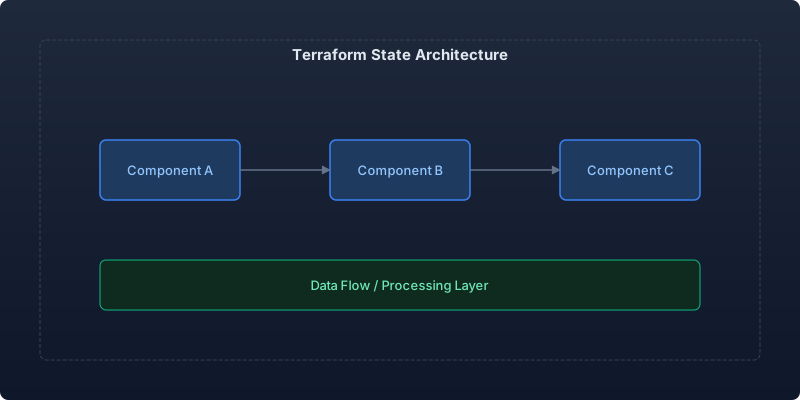
We moved to a hierarchical state structure that provides isolation at three levels: organization, team, and service.
Level 1: Account-Level Separation
Each AWS account gets its own state backend. This is non-negotiable at scale.
# modules/state-backend/main.tf
resource "aws_s3_bucket" "terraform_state" {
  bucket = "terraform-state-${var.account_alias}-${var.region}"

  versioning {
    enabled = true
  }

  server_side_encryption_configuration {
    rule {
      apply_server_side_encryption_by_default {
        sse_algorithm     = "aws:kms"
        kms_master_key_id = aws_kms_key.terraform_state.arn
      }
    }
  }

  lifecycle_rule {
    id      = "state-versions"
    enabled = true

    noncurrent_version_expiration {
      days = 90
    }
  }
}

resource "aws_dynamodb_table" "terraform_locks" {
  name         = "terraform-locks-${var.account_alias}"
  billing_mode = "PAY_PER_REQUEST"
  hash_key     = "LockID"

  attribute {
    name = "LockID"
    type = "S"
  }

  point_in_time_recovery {
    enabled = true
  }
}
Level 2: Service-Scoped State Keys
Each microservice gets a deterministic state key path based on team ownership and environment:
# services/payment-gateway/backend.tf
terraform {
  backend "s3" {
    bucket         = "terraform-state-prod-us-east-1"
    key            = "teams/payments/payment-gateway/terraform.tfstate"
    region         = "us-east-1"
    dynamodb_table = "terraform-locks-prod"
    encrypt        = true
    kms_key_id     = "arn:aws:kms:us-east-1:123456789:alias/terraform-state"
  }
}
Level 3: Component Decomposition
Large services decompose their state into components: networking, compute, data, and monitoring. This reduces plan time from 8 minutes to under 45 seconds per component.
The State Operations Pipeline
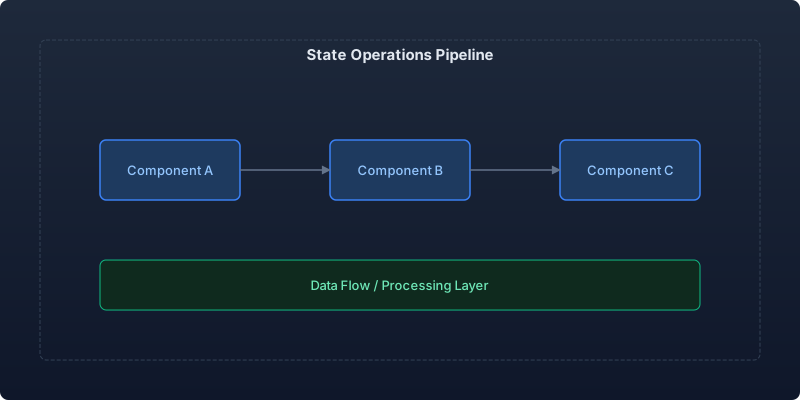
Manual state operations are the leading cause of incidents. We automated every state mutation through a pipeline.
Automated State Import
When engineers create resources manually (it happens), our drift detection system generates import blocks automatically:
# Auto-generated by drift-reconciler
import {
  to = aws_security_group.api_gateway
  id = "sg-0a1b2c3d4e5f67890"
}

import {
  to = aws_lb_target_group.api_gateway
  id = "arn:aws:elasticloadbalancing:us-east-1:123456789:targetgroup/api-gw/abc123"
}
State Locking with Circuit Breakers
Standard DynamoDB locking does not handle cascading failures. We added a circuit breaker layer:
# state_lock_manager.py
class StateLockManager:
    def __init__(self, dynamodb_table, max_wait_seconds=300):
        self.table = dynamodb_table
        self.max_wait = max_wait_seconds
        self.circuit_breaker = CircuitBreaker(
            failure_threshold=3,
            recovery_timeout=60
        )

    def acquire_lock(self, lock_id: str, owner: str) -> bool:
        if self.circuit_breaker.is_open:
            raise LockServiceDegradedError(
                f"Lock service degraded. {self.circuit_breaker.failures} "
                f"consecutive failures. Recovery in {self.circuit_breaker.time_to_recovery}s"
            )
        try:
            self.table.put_item(
                Item={
                    'LockID': lock_id,
                    'Owner': owner,
                    'Timestamp': int(time.time()),
                    'TTL': int(time.time()) + self.max_wait
                },
                ConditionExpression='attribute_not_exists(LockID)'
            )
            self.circuit_breaker.record_success()
            return True
        except ClientError as e:
            if e.response['Error']['Code'] == 'ConditionalCheckFailedException':
                return False
            self.circuit_breaker.record_failure()
            raise
Benchmarks: Before and After
| Metric | Before | After | Improvement |
|---|---|---|---|
| Average plan time | 8.2 min | 42 sec | 91% reduction |
| Lock contention incidents/week | 2.3 | 0.1 | 96% reduction |
| State-related P1s/month | 9.2 | 0.4 | 96% reduction |
| Mean time to recover (state) | 47 min | 3.2 min | 93% reduction |
| Concurrent deployments supported | 4 | 60+ | 15x increase |
Cross-Cutting Patterns
State File Size Monitoring
We alert when any state file exceeds 10MB — a signal that decomposition is needed:
# cloudwatch-alarms.yaml
- alarm_name: terraform-state-size-warning
  metric: S3ObjectSize
  dimensions:
    BucketName: terraform-state-prod-us-east-1
  threshold: 10485760  # 10MB
  comparison: GreaterThanThreshold
  period: 86400
  evaluation_periods: 1
Automated State Backup and Recovery
Every state mutation triggers a versioned backup with metadata tagging. Recovery is a single command that selects the last known good version based on deployment success signals.
Key Takeaways
-
Decompose early: Split state by team, service, and component before you hit pain. The migration cost grows exponentially with state file size.
-
Automate state operations: No human should run
terraform state mvorterraform importmanually in production. Build pipelines for every state mutation. -
Monitor state health: Treat state files as first-class infrastructure. Alert on size, staleness, lock duration, and version count.
-
Design for recovery: State corruption will happen. Your MTTR depends on how quickly you can restore a known-good version and reconcile drift.
-
Enforce isolation boundaries: Use IAM policies and backend configuration validation to make it impossible for one team's operation to affect another team's state.
The investment in proper state management infrastructure paid for itself within the first month — a single prevented P1 incident saved more engineering hours than the entire implementation cost.
Recommended reading
Per-Team Cost Allocation in Shared Kubernetes Clusters: From Chaos to Clarity
Implementing accurate per-namespace cost allocation in multi-tenant Kubernetes clusters, covering request vs. usage attribution, shared resource amortization, and building showback dashboards that drive accountability.
Measuring and Eliminating Toil: From 40% to 12% of Engineering Time
A systematic approach to identifying, measuring, and automating toil—the repetitive operational work that scales linearly with service growth and prevents engineers from doing creative work.
Serverless Postgres in Production: Branching, Scale-to-Zero, and the End of Database Provisioning
Running Neon serverless Postgres in production for 8 months — covering database branching workflows, scale-to-zero economics, connection pooling, and migration from RDS.



Comments
No comments yet. Be the first to share your thoughts.